
The History of Anaesthesia Society dates the Sprotte spinal needle to 1987. The original paper by Sprotte, Schedel and Pajunk in Regional-Anaesthesie could not be obtained, so this article reads the contemporary British record in the British Journal of Anaesthesia of 1991-1992: a letter citing the paper and describing how Sprotte's group revived an old combined epidural-spinal method with the atraumatic needle; a full-page Rüsch advertisement for the Pajunk-made needle that 'takes the headache out of spinals'; correspondence on threading a 32-gauge spinal catheter through a 24-gauge Sprotte needle; and a Nottingham randomised comparison of the 24-gauge Sprotte with a 26-gauge Quincke needle in urological patients.
Reading Library · Anesthesia Epochs · 中文版
Watch the education video (for clinicians)
1987: The Sprotte Needle — Pencil-Point Spinal Needles · Anesthesia Epochs Education Series
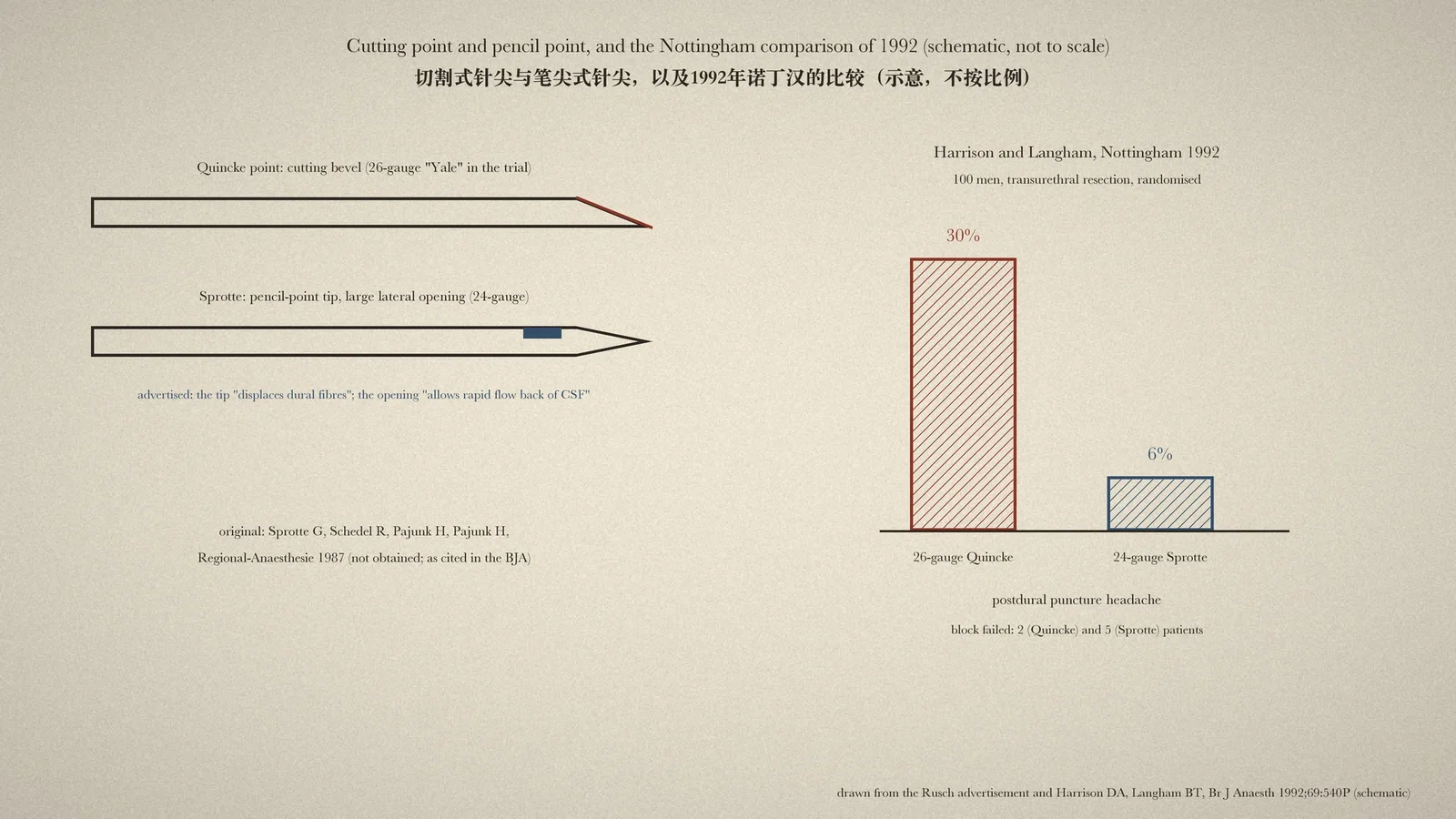
Postdural puncture headache is, as a 1992 report put it, "a recognized complication of spinal anaesthesia", and the influence of needle size and type on it has been studied extensively. The History of Anaesthesia Society (HAS) timeline records one step under 1987: Dr Sprotte "published the trial of the spinal needle" that now carries the Sprotte name. The paper is usually cited as Sprotte G, Schedel R, Pajunk H, Pajunk H, "Eine 'atraumatische' Universalkanüle für einzeitige Regionalanaesthesien" (An "atraumatic" universal cannula for single-shot regional anaesthesia), Regional-Anaesthesie 1987;10:104-8. [5][1]
That paper could not be obtained for this article. What can be read openly is how the needle entered British practice a few years later, in volumes of the British Journal of Anaesthesia (BJA) for 1991 and 1992 held by the Digital Library of India. [1][2][3][4]
How it was sold
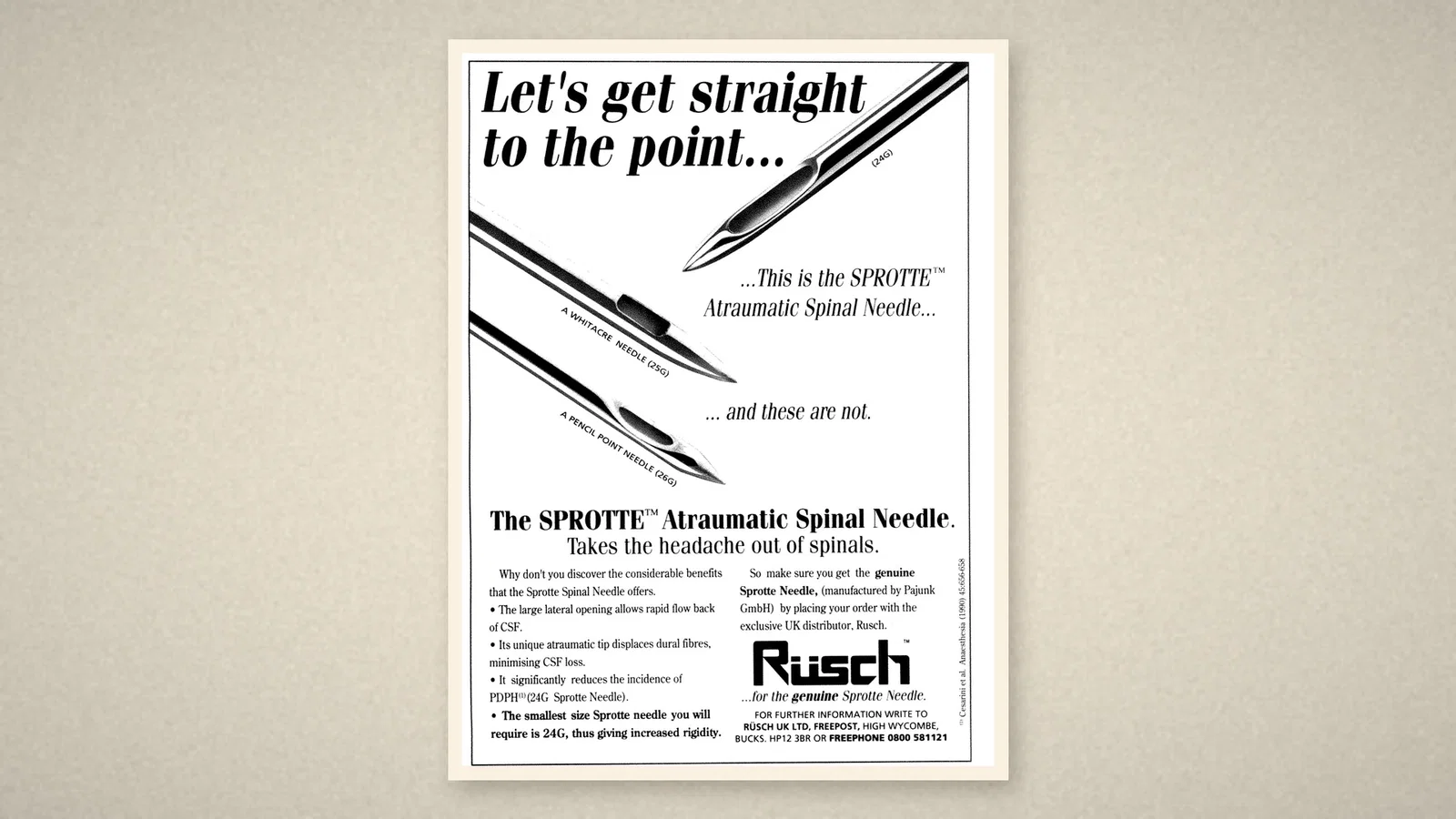
A full-page advertisement in the BJA of 1991 opens: "Let's get straight to the point..." Three needle tips are drawn side by side. One is labelled "This is the SPROTTE™ Atraumatic Spinal Needle"; a Whitacre needle and another pencil-point needle are labelled "and these are not". The headline promises that the Sprotte needle "Takes the headache out of spinals", and the text lists its claims: "The large lateral opening allows rapid flow back of CSF"; "Its unique atraumatic tip displaces dural fibres"; it "significantly reduces the incidence of PDPH". Buyers were told to make sure they got "the genuine Sprotte Needle (manufactured by Pajunk GmbH)" from "the exclusive UK distributor, Rusch". These are advertising claims, and they are reported here as such. [1]
What the original was for
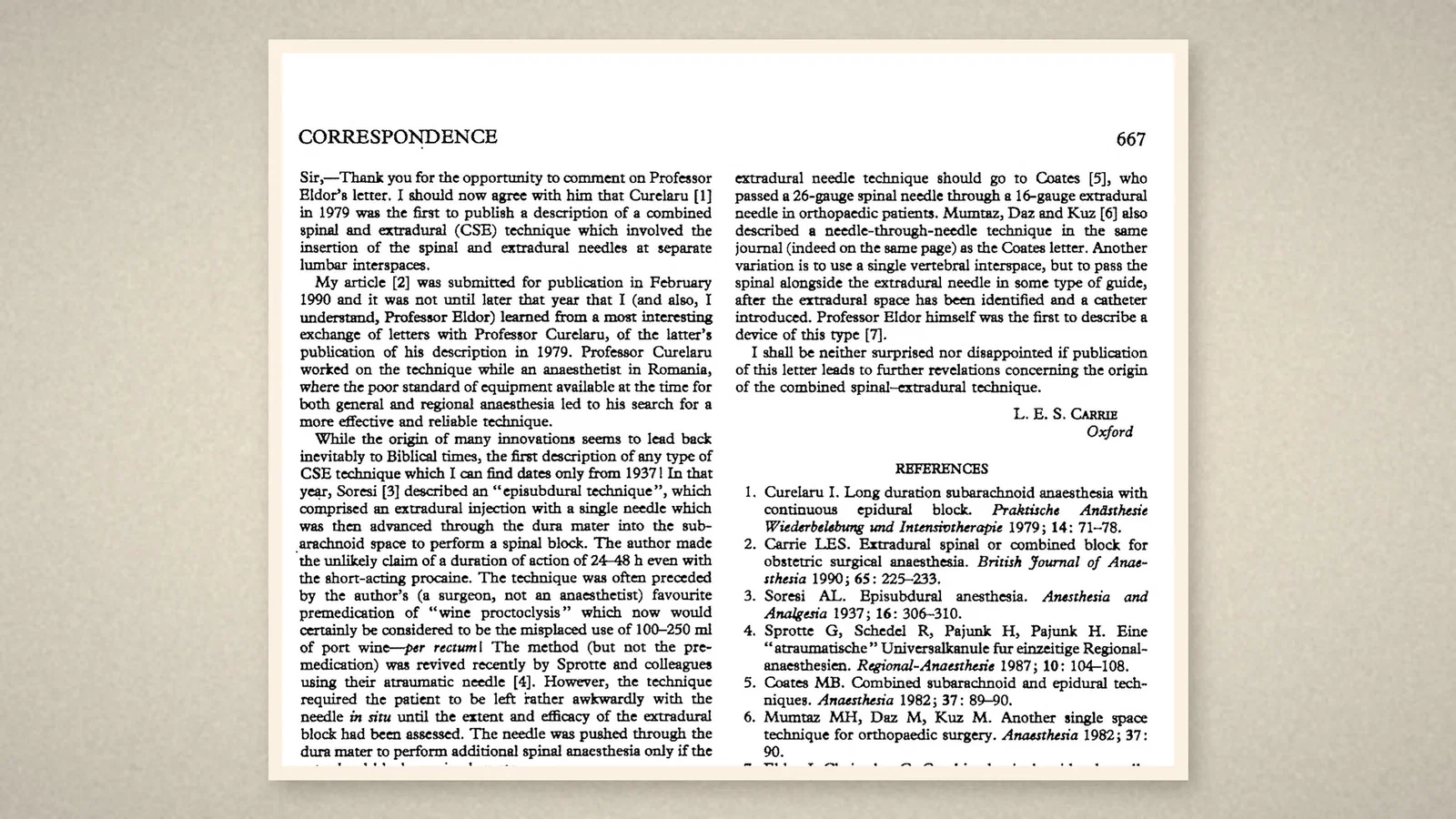
A letter in the same volume shows that the 1987 paper was about more than a spinal needle. L. E. S. Carrie of Oxford, writing on the history of combined spinal and extradural techniques, described Soresi's "episubdural technique" of 1937, in which a single needle gave an extradural injection and was then advanced through the dura for a spinal block. "The method ... was revived recently by Sprotte and colleagues using their atraumatic needle", Carrie wrote, citing the 1987 paper, but "the technique required the patient to be left rather awkwardly with the needle in situ" until the extradural block had been assessed, the needle being pushed through the dura "only if the extradural block was inadequate". This fits the paper's title, a universal cannula for single-shot regional anaesthesia. [1, p. 667]
Questions in the letters
Earlier in 1991 the needle appeared in correspondence about headache after continuous spinal anaesthesia. Correspondents pointed out that "it is possible to thread the 32-gauge catheter through a 24-gauge pencil-pointed Sprotte needle", which they called "a variation on the older Whiteacre needle", and that a study had found no postoperative headache in 55 obstetric patients given spinal injections through such needles. Replying, I. G. Kestin of Bristol agreed that the catheter could pass, but noted that the hub of the needles then available was unsuitable, that modified needles would come from "the manufacturer (Rusch U.K.) in the next few months", and that whether the Sprotte needle would reduce headache "remains to be determined". [2]
A trial in Nottingham
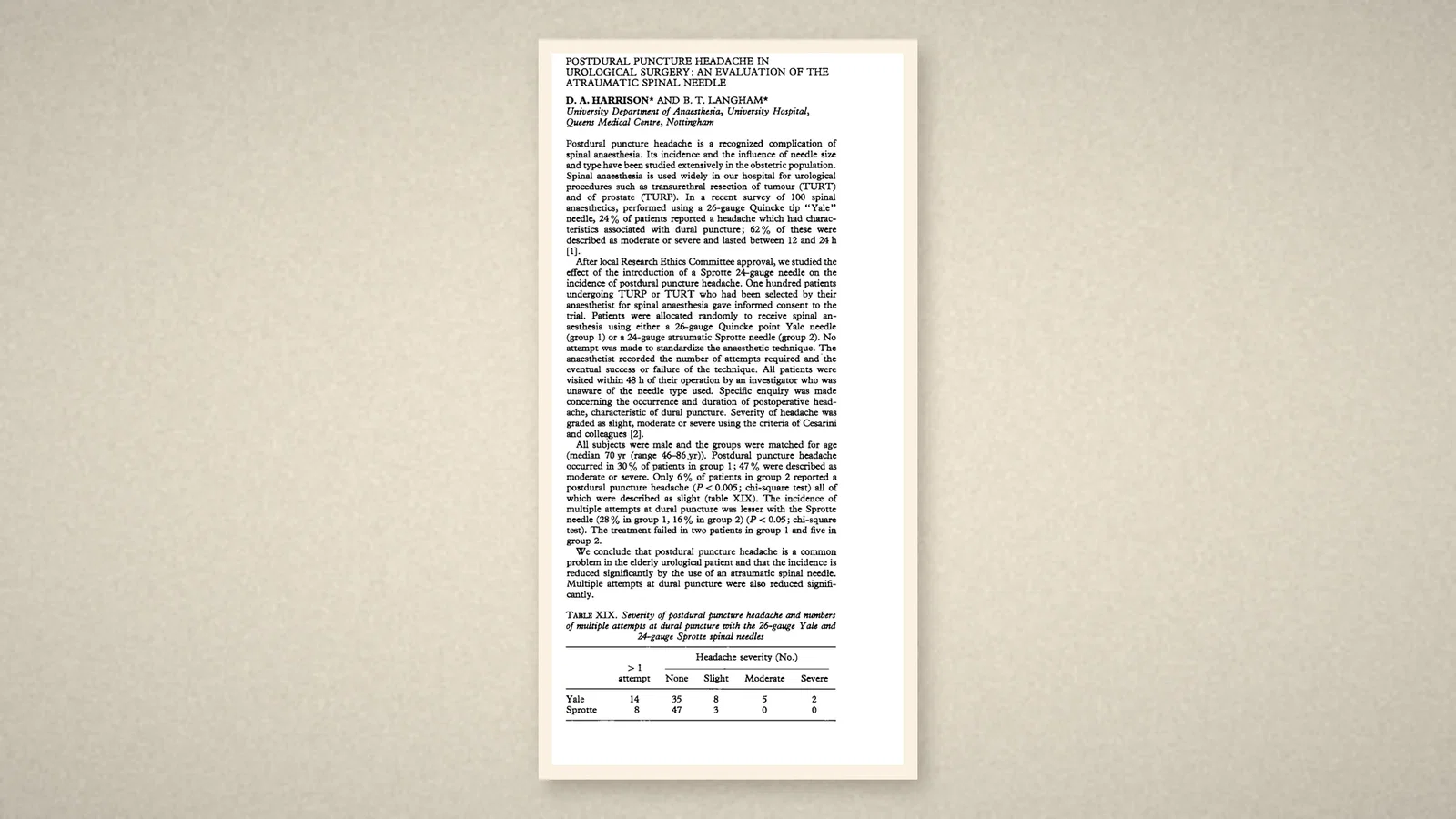
In 1992 D. A. Harrison and B. T. Langham of the University Hospital, Queen's Medical Centre, Nottingham, reported a randomised comparison in urological surgery. With ethics committee approval, 100 patients having transurethral resection under spinal anaesthesia received either "a 26-gauge Quincke point Yale needle (group 1) or a 24-gauge atraumatic Sprotte needle (group 2)", and an investigator unaware of the needle visited each patient within 48 hours. Postdural puncture headache occurred in 30% with the Quincke needle and in 6% with the Sprotte needle, all of the latter slight; multiple attempts at dural puncture were also fewer with the Sprotte needle. The block failed in two patients with the Quincke needle and five with the Sprotte. In the same volume, Shutt and colleagues, comparing Whitacre and Quincke needles for Caesarean section, noted that a zero incidence of headache had also been found "for the 24-gauge Sprotte needle in a similar controlled study in obstetric patients". [3][4, p. 592]
What the record shows
Within five years of the 1987 paper, the Sprotte needle had a British distributor, a confident advertisement, questions about its hub and catheters, and controlled comparisons that supported its main promise while recording a cost in failed blocks. The original German paper remains the missing piece: what Sprotte and colleagues themselves claimed is known here only through a British reader's summary.
Sources and reading limits
Read: in the BJA 1991, vol. 67, Carrie's letter (pp. 666-7) with its references and the full-page Rüsch advertisement, from the Digital Library of India scan on the Internet Archive; the correspondence on headache after continuous spinal anaesthesia with Kestin's reply (vol. 67); in the BJA 1992, vol. 69, Harrison and Langham (p. 540P) and the relevant pages of Shutt and colleagues (pp. 589-94); the HAS timeline entry for 1987.
Not covered: the 1987 original in Regional-Anaesthesie, which could not be obtained; Cesarini and colleagues in Anaesthesia 1990, cited in the letters; the 1992 Anaesthesia correspondence, which is lending-restricted on the Internet Archive and was not opened; the papers of Whitacre and Hart on pencil-point needles. The HAS gives the inventor's first name as Jurgen; the BJA citation gives the initial G.; this article uses only the surname. The HAS calls the 1987 paper a trial; its content is known here only from Carrie's summary. Statements about who described combined techniques earliest are Carrie's and are not repeated as fact. The correspondents on the continuous spinal catheter are not named in the scanned passage. Needle gauges are given only to identify the needles; no drug doses are given. Quotations are from the English originals.
Three illustrations are crops of the BJA 1991 (the advertisement and p. 667) and of the BJA 1992 (p. 540P); one is drawn from them.
- Carrie LES. [Letter on combined spinal-extradural techniques]. Br J Anaesth. 1991;67:666-7; and Rüsch advertisement, The SPROTTE Atraumatic Spinal Needle. Br J Anaesth. 1991;67 (nos. 4-6). Internet Archive
- Correspondence: Headache after continuous spinal anaesthesia, with reply by Kestin IG. Br J Anaesth. 1991;67 (nos. 1-3). Internet Archive
- Harrison DA, Langham BT. Postdural puncture headache in urological surgery: an evaluation of the atraumatic spinal needle. Br J Anaesth. 1992;69:540P. Internet Archive
- Shutt LE, Valentine SJ, Wee MYK, Page RJ, Prosser A, Thomas TA. Spinal anaesthesia for Caesarean section: comparison of 22-gauge and 25-gauge Whitacre needles with 26-gauge Quincke needles. Br J Anaesth. 1992;69:589-94. Internet Archive
- History of Anaesthesia Society. Timeline. HAS
Continue exploring
Related reading connects shared questions and contexts; it does not by itself establish historical influence.
- 1926: Greene's Round-Pointed Needle Against Post-Puncture Headache
- 1891: Quincke's Lumbar Puncture Report, After Measuring Pressure
Anesthesia Epochs · The Source Room · About & Editorial Method
Published November 2, 2026. Sources and reading limits are stated above. Illustrations are labelled as original source images or AI-made. Historical accounts are educational; they are not current treatment instructions.