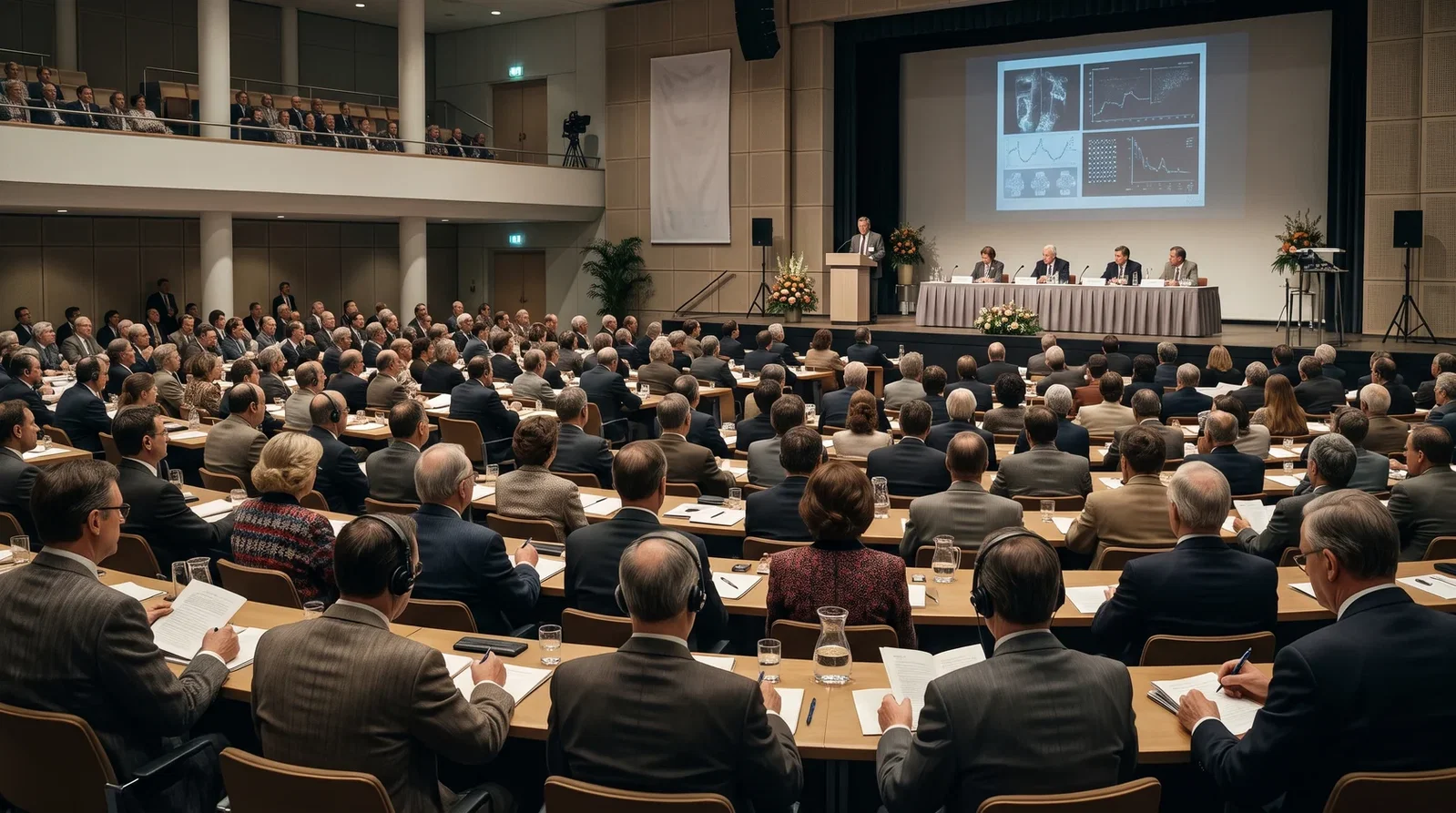
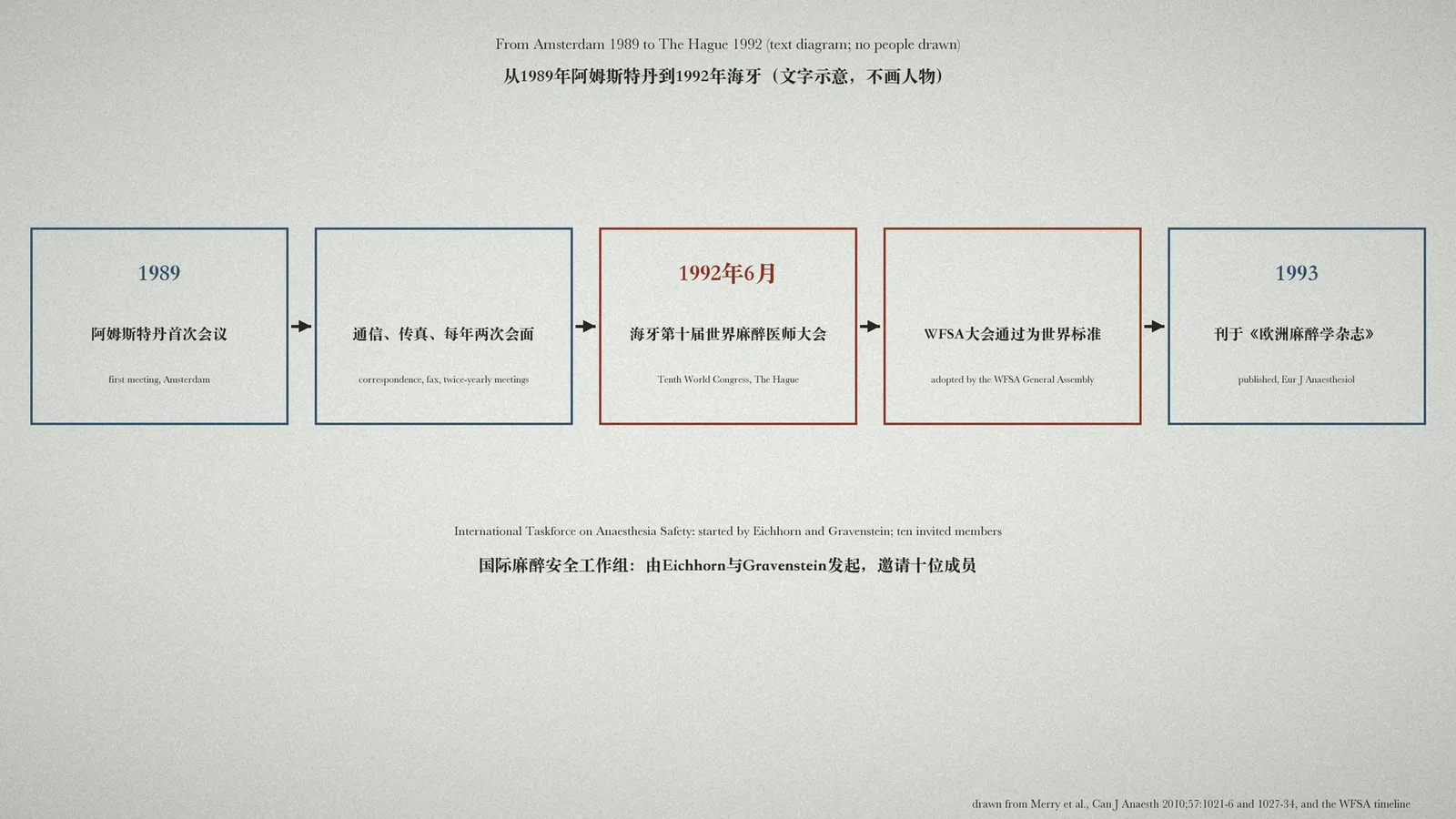
Merry, Cooper, Soyannwo, Wilson and Eichhorn, writing in the Canadian Journal of Anesthesia in 2010, recount how the independent International Taskforce on Anaesthesia Safety, started by Eichhorn and Gravenstein with ten invited members who met in Amsterdam in 1989, drafted international standards by correspondence, fax and twice-yearly meetings; presented in two plenary sessions at the Tenth World Congress of Anaesthesiologists in The Hague in June 1992, they were adopted by the WFSA General Assembly as official world standards and published with background articles in the European Journal of Anaesthesiology; the document had General Standards and Perianesthetic Care and Monitoring Standards graded by level of resources, and a WHO Safe Surgery Saves Lives working group revised it, keeping its structure, with WFSA endorsement in Cape Town in March 2008 and publication in 2010.
Reading Library · Anesthesia Epochs · 中文版
Watch the education video (for clinicians)
1992: WFSA International Standards — Adopted in The Hague · Anesthesia Epochs Education Series
How can one safety standard for anaesthesia apply both to a large hospital in Boston and to a rural hospital with almost nothing? In 1992 the World Federation of Societies of Anaesthesiologists (WFSA) adopted International Standards for a Safe Practice of Anaesthesia that tried to answer that question. The 1993 published text is not covered in this article, which reads instead two open-access papers of 2010, an account of the standards' origins by those who revised them and the revised text itself, together with the WFSA's own history timeline. [1][2][3]
An independent taskforce
Alan F. Merry, Jeffrey B. Cooper, Olaitan Soyannwo, Iain H. Wilson and John H. Eichhorn wrote in 2010 that one obvious factor in the safety of anaesthesia in high-income countries had been intraoperative safety-monitoring standards based on the precedent-setting Harvard Standards for Minimal Monitoring; monitoring gives early warning and time to act, and standards also lend authority to arguments over scarce health resources. [1, introduction]
An independent group of anaesthesiologists, the International Taskforce on Anaesthesia Safety, set itself the mission "to enhance the safety of anaesthesia by promotion of international standards for anaesthesia practice". The aim was not to supersede standards already published by various countries but to augment and support them, and to offer a model and resource to countries that had none. Started by J. H. Eichhorn and J. S. Gravenstein, once funding was secured the taskforce invited ten independent members with strong credentials in their national anaesthesia patient safety movements, from countries that had or were formulating safety standards. [1, introduction][1, standards development]
The group met in Amsterdam in 1989. Its members collected every available anaesthesia standards document from around the world; mindful that the standards had to apply across very different settings and resources, they debated scope and content by correspondence, fax and twice-yearly meetings, consulted senior anaesthetists in many countries, and wrote the standards through a long process of drafting and refinement. [1, standards development]
Two sections, several levels
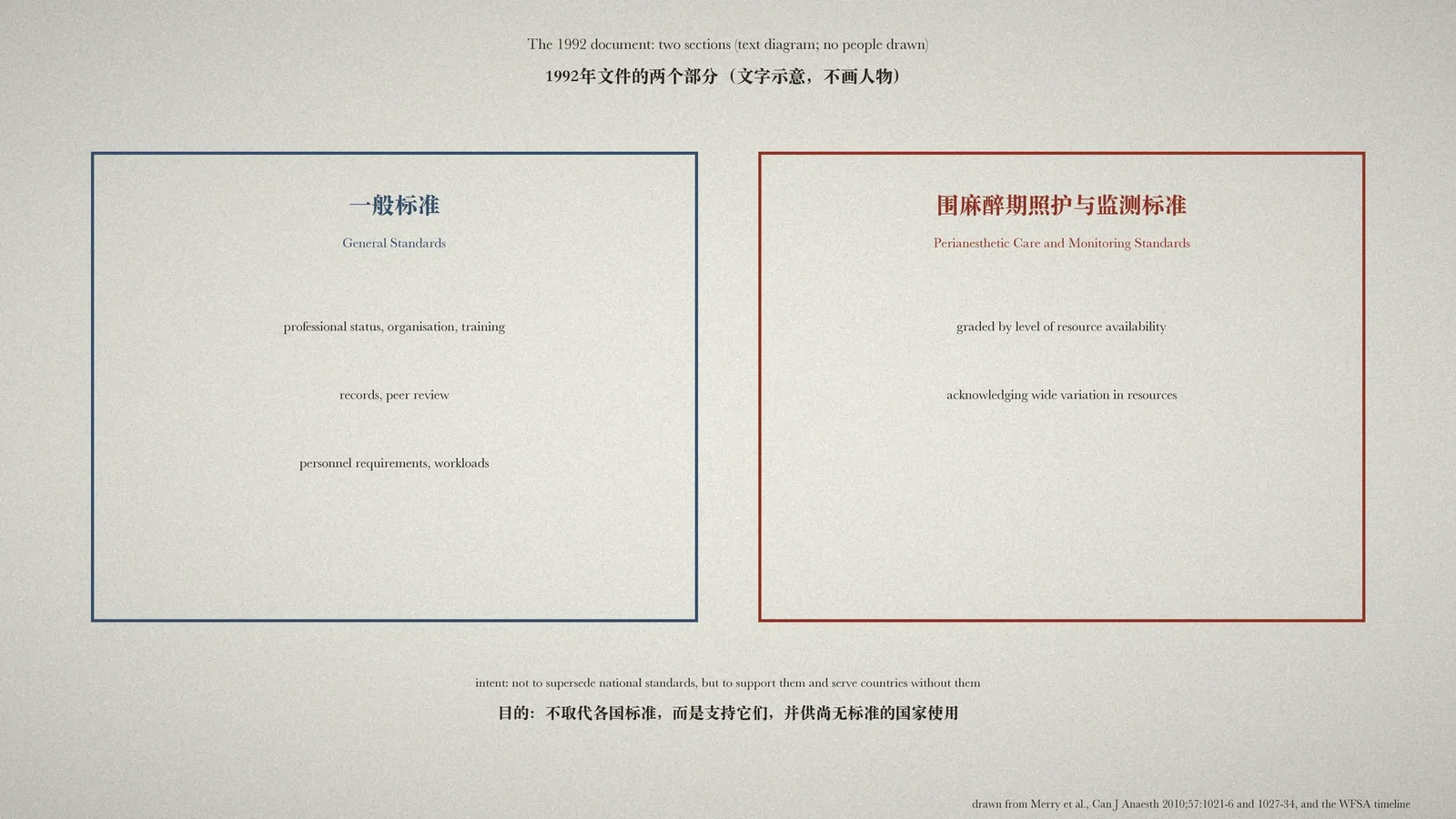
The document had two sections. The General Standards covered professional status, organisation and training in detail, along with records, peer review, personnel requirements and appropriate workloads. The Perianesthetic Care and Monitoring Standards were notable for setting requirements according to different levels of resource availability, acknowledging how widely available medical resources varied around the world. [1, introduction]
The Hague, June 1992
In June 1992 the standards were presented to the Tenth World Congress of Anaesthesiologists in The Hague in two plenary sessions dedicated to the purpose. At the congress the WFSA General Assembly adopted the document as its official world standards and commended it to member societies; the document and a series of background articles were then published in the European Journal of Anaesthesiology. The WFSA timeline, under 1992, likewise records that the International Standards were published by the WFSA and agreed by member societies, citing a 1993 supplement of that journal. [1, standards development][3]
A revision years later
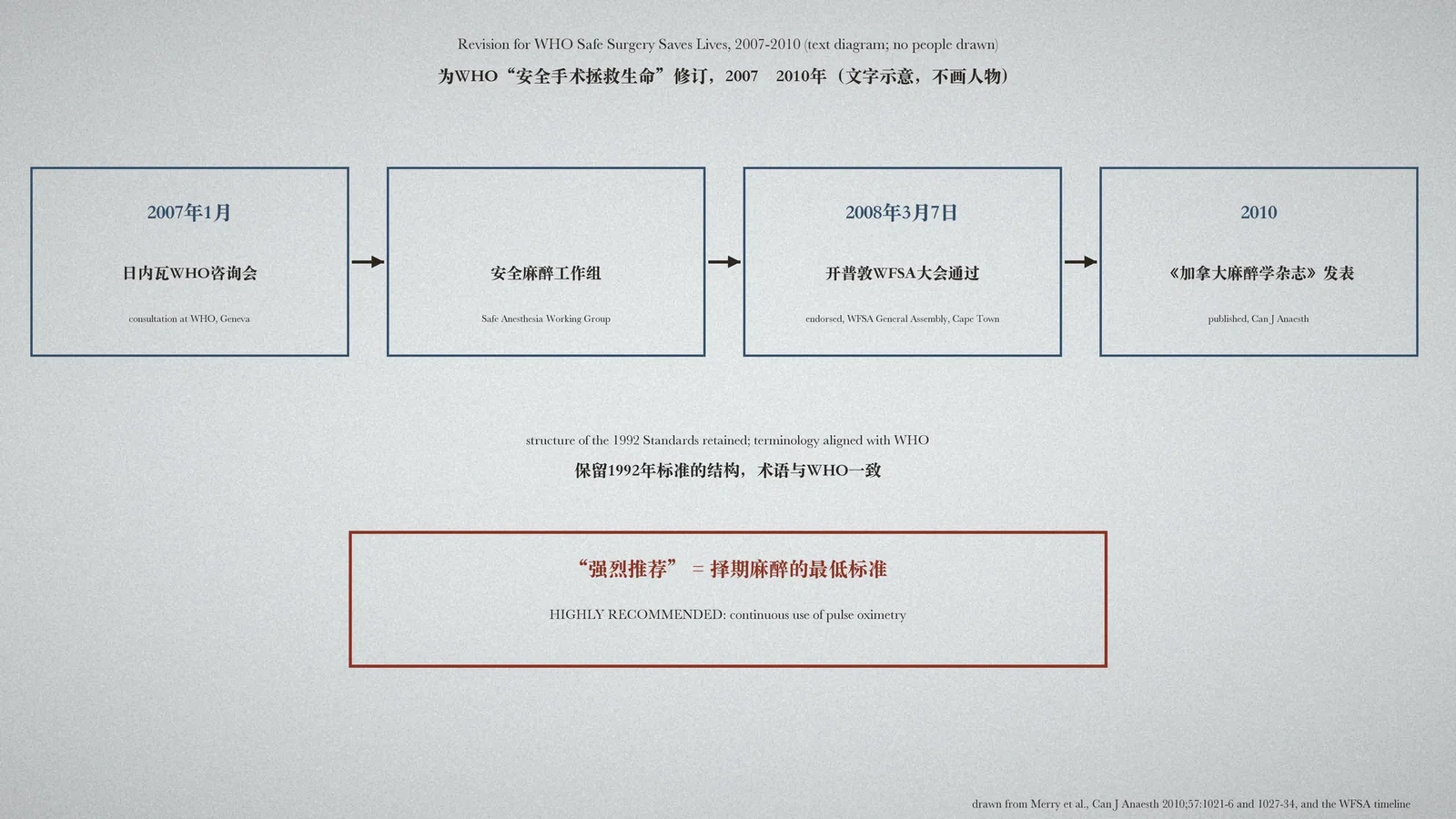
In January 2007 these authors were invited to the Safe Surgery Saves Lives consultation led by Atul Gawande at WHO headquarters in Geneva, after which the Safe Anesthesia Working Group was formed. They valued the foundation laid by the 1992 taskforce, preferred to build on it rather than repeat it, and judged that revision of the 1992 standards was "overdue". The revision kept the overall structure of the 1992 standards, aligned the terminology with WHO's, was endorsed by the WFSA General Assembly in Cape Town on 7 March 2008, and was published in the Canadian Journal of Anesthesia in 2010. [1, introduction][1, standards development]
The 2010 text adopted WHO's standardised language, calling the minimum expected in all anaesthesia for elective surgery HIGHLY RECOMMENDED, the functional equivalent of mandatory, and made continuous pulse oximetry one of those standards. [2, introduction][2, monitoring]
The gap
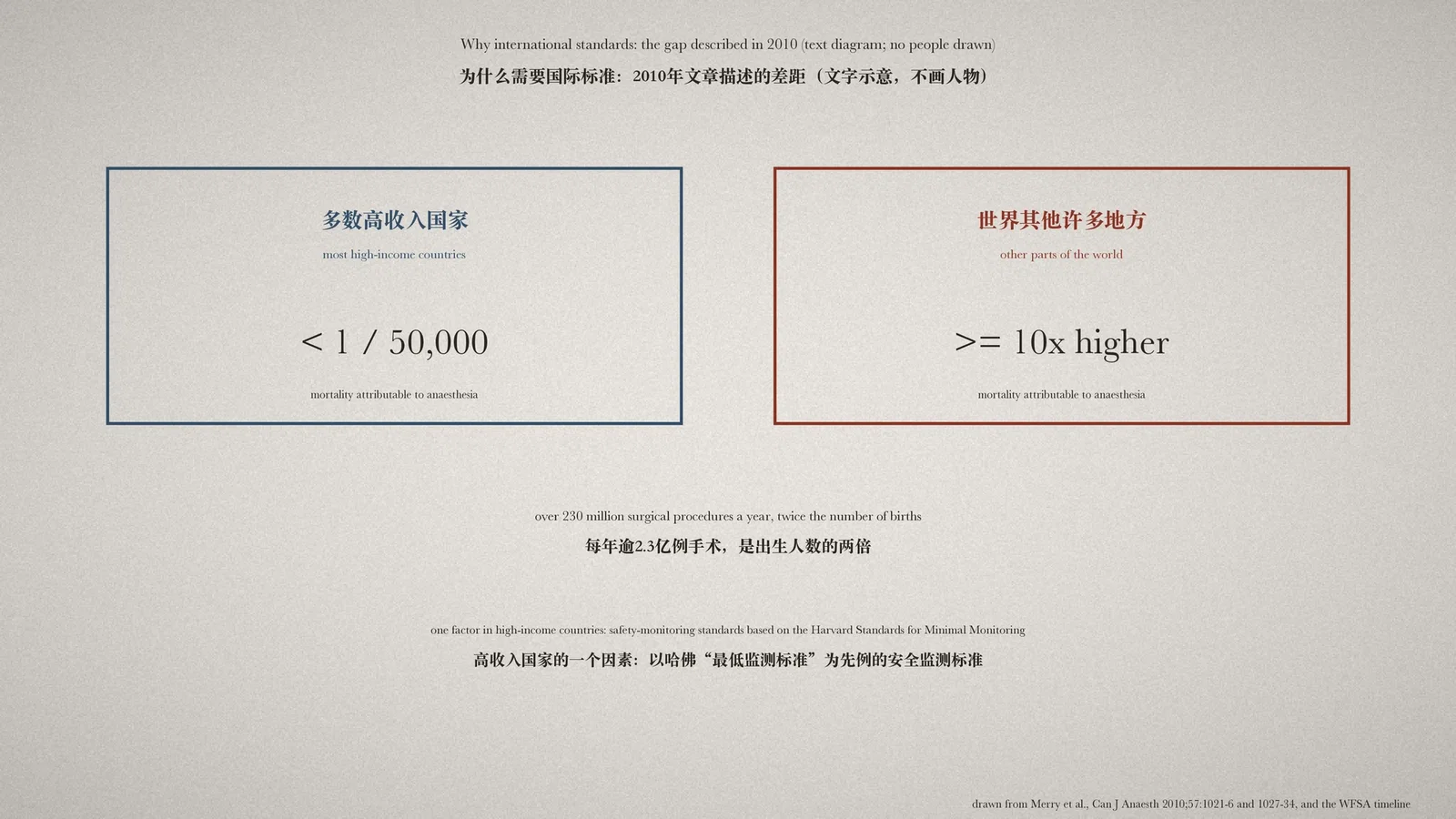
The revisers described the gap behind the work: over 230 million surgical procedures a year worldwide, twice the number of births; in most high-income countries mortality attributable to anaesthesia typically below 1 in 50,000, and often at least ten times higher elsewhere. [1, introduction]
What the record shows
What is most worth remembering about the 1992 standards may be their grading by resources: they neither imposed high-income practice unchanged on every country nor gave up a minimum because resources were short. The 2010 and 2018 versions were both built on that framework.
Sources and reading limits
Read: Merry, Cooper, Soyannwo, Wilson and Eichhorn, "An iterative process of global quality improvement: the International Standards for a Safe Practice of Anesthesia 2010" (Can J Anaesth 2010;57:1021-6), read in full in the Europe PMC open-access text; the companion "International Standards for a Safe Practice of Anesthesia 2010" (pp. 1027-34), introduction and monitoring sections; the WFSA history timeline entries for 1989-1993 and 2008-2010.
Not covered: the 1992/1993 text of the standards and Eichhorn's account of their formulation in the 1993 supplement of the European Journal of Anaesthesiology; page images of the 2010 papers (the Europe PMC and Springer copies could not be accessed), so all four illustrations are text diagrams drawn from the sources.
Limits: the 2010 authors were themselves members of the working groups, and their paper is used as a participants' account; the clauses of the 1992 standards were not checked.
- Merry AF, Cooper JB, Soyannwo O, Wilson IH, Eichhorn JH. An iterative process of global quality improvement: the International Standards for a Safe Practice of Anesthesia 2010. Can J Anaesth. 2010;57:1021-6. doi:10.1007/s12630-010-9380-7. Europe PMC
- Merry AF, Cooper JB, Soyannwo O, Wilson IH, Eichhorn JH. International Standards for a Safe Practice of Anesthesia 2010. Can J Anaesth. 2010;57:1027-34. doi:10.1007/s12630-010-9381-6. Europe PMC
- World Federation of Societies of Anaesthesiologists. WFSA history timeline. Web page
Continue exploring
Related reading connects shared questions and contexts; it does not by itself establish historical influence.
- 2018: WHO and the WFSA Publish International Standards for Safe Anesthesia
- 2008: WHO Introduces a 19-Item Surgical Safety Checklist
Anesthesia Epochs · The Source Room · About & Editorial Method
Published November 4, 2026. Sources and reading limits are stated above. Illustrations are labelled as original source images or AI-made. Historical accounts are educational; they are not current treatment instructions.