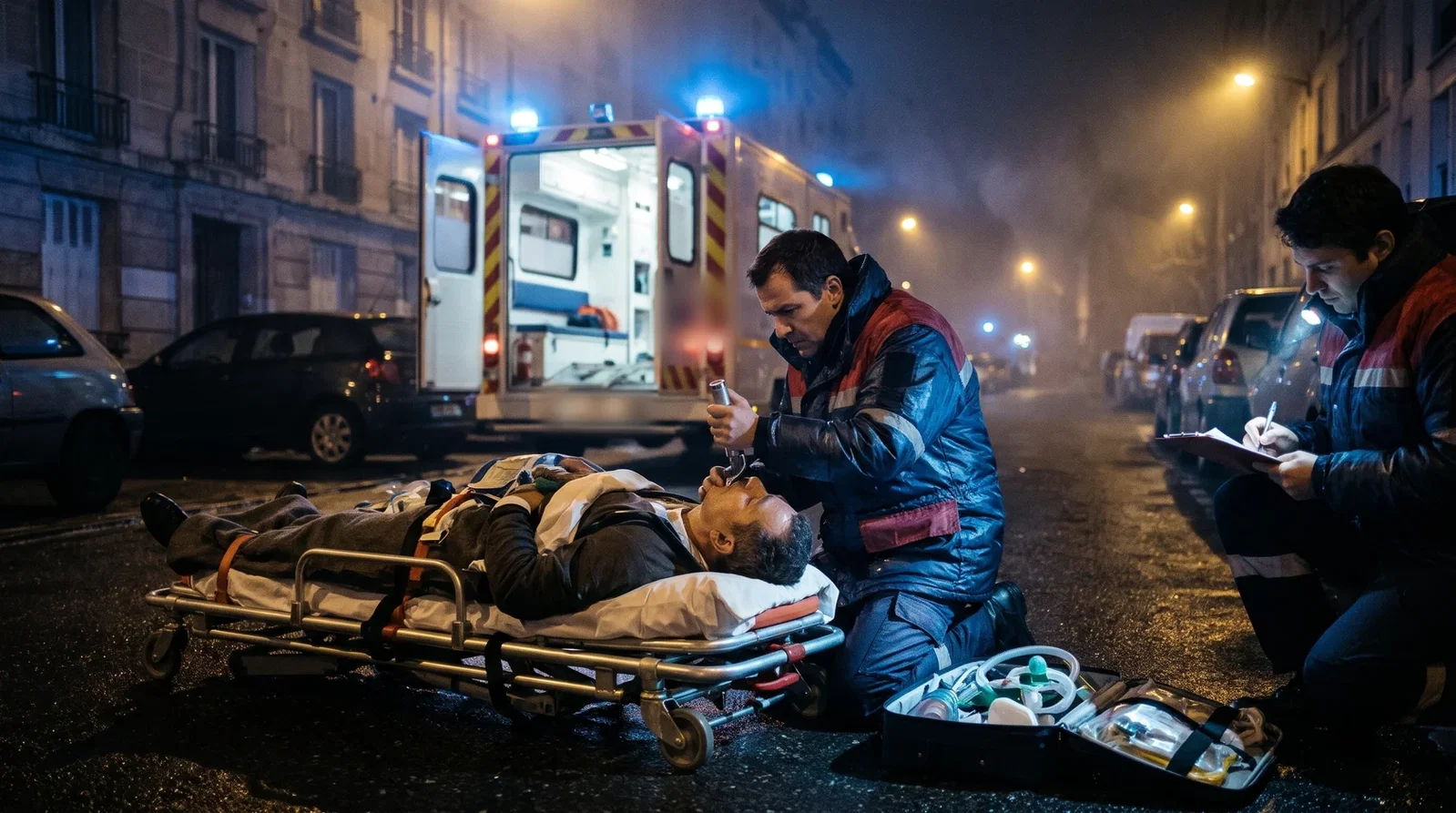
In December 1997 Anesthesiology (vol. 87, no. 6) printed 'The Intubation Difficulty Scale (IDS): proposal and evaluation of a new score characterizing the complexity of endotracheal intubation' by Frédéric Adnet and six colleagues from anaesthesia and emergency services in the Paris region, submitted on 12 March and accepted on 5 August 1997, with an editorial by Benumof. With no uniform way of describing a difficult intubation, the authors wrote, reported incidences could hardly be compared. They defined difficulty as divergence from an 'ideal' intubation, one effortless first attempt by one operator with one technique, a fully visible glottis and abducted cords, scored 0; each extra attempt, operator or alternative technique added 1 point, the Cormack grade minus one was added, increased lifting force, external laryngeal pressure and adducted cords added 1 each, and impossible intubation scored infinity; Sellick's manoeuvre added nothing. In 315 theatre and 311 prehospital intubations, 53% in theatre scored 0, 6.3% in theatre and 16.1% prehospital scored above 5, and the IDS correlated with time to intubation and a visual analogue scale. The authors cautioned that the two series were not directly comparable and called for larger studies.
Reading Library · Anesthesia Epochs · 中文版
Watch the education video (for clinicians)
1997: The Intubation Difficulty Scale — Counting the Departures · Anesthesia Epochs Education Series
"Was that intubation difficult?" Before 1997 the answer depended on whom you asked. Some went by the laryngoscopic grade, some counted attempts, some timed it, some went by feel. A group of anaesthetists and emergency physicians in the Paris region argued that, without a shared definition, published rates of "difficult intubation" could not be compared at all. They proposed a score that could be calculated. [1, p. 1290]
No common language
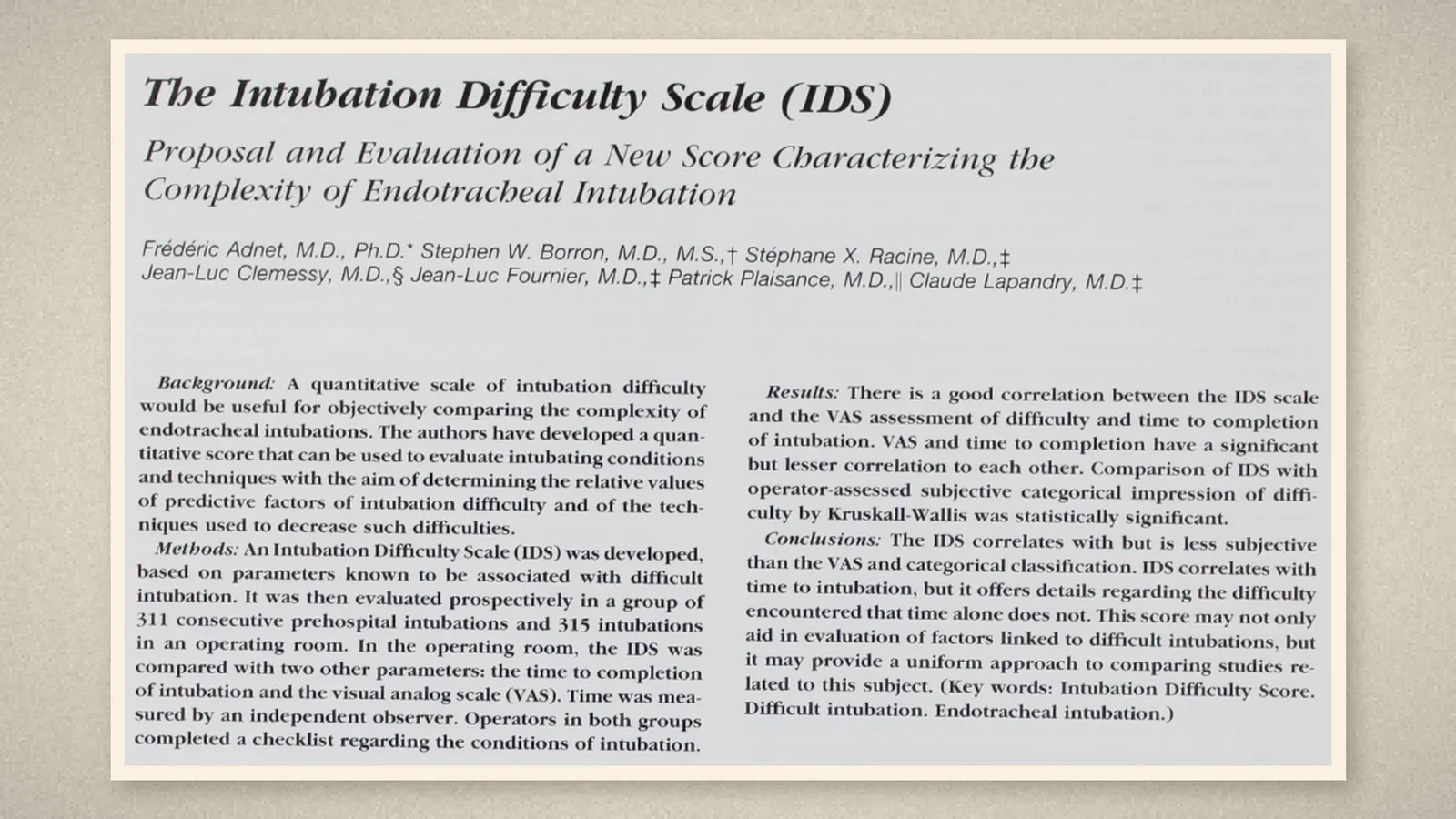
In December 1997 Anesthesiology (vol. 87, no. 6) printed "The Intubation Difficulty Scale (IDS): proposal and evaluation of a new score characterizing the complexity of endotracheal intubation" by Frédéric Adnet, Stephen W. Borron, Stéphane X. Racine, Jean-Luc Clemessy, Jean-Luc Fournier, Patrick Plaisance and Claude Lapandry, from departments of anaesthesiology and emergency services in the Paris region; the first author was an assistant professor with SAMU 93 at Hôpital Avicenne. It was submitted on 12 March 1997, accepted on 5 August 1997, and accompanied by an editorial by Benumof. [1, p. 1290]
Difficult tracheal intubation, the introduction said, can be a major source of morbidity and mortality, particularly in emergencies, and its complexity is often discussed, but "no uniform method of description of the 'difficult intubation' exists". For want of a standard definition, the incidence and the factors associated with difficulty varied drastically between institutions and periods and were virtually impossible to compare directly. The authors therefore proposed a progressive, quantitative score built from seven parameters, which the operator or an independent observer could calculate immediately after intubation. [1, p. 1290]
How far from an "ideal" intubation
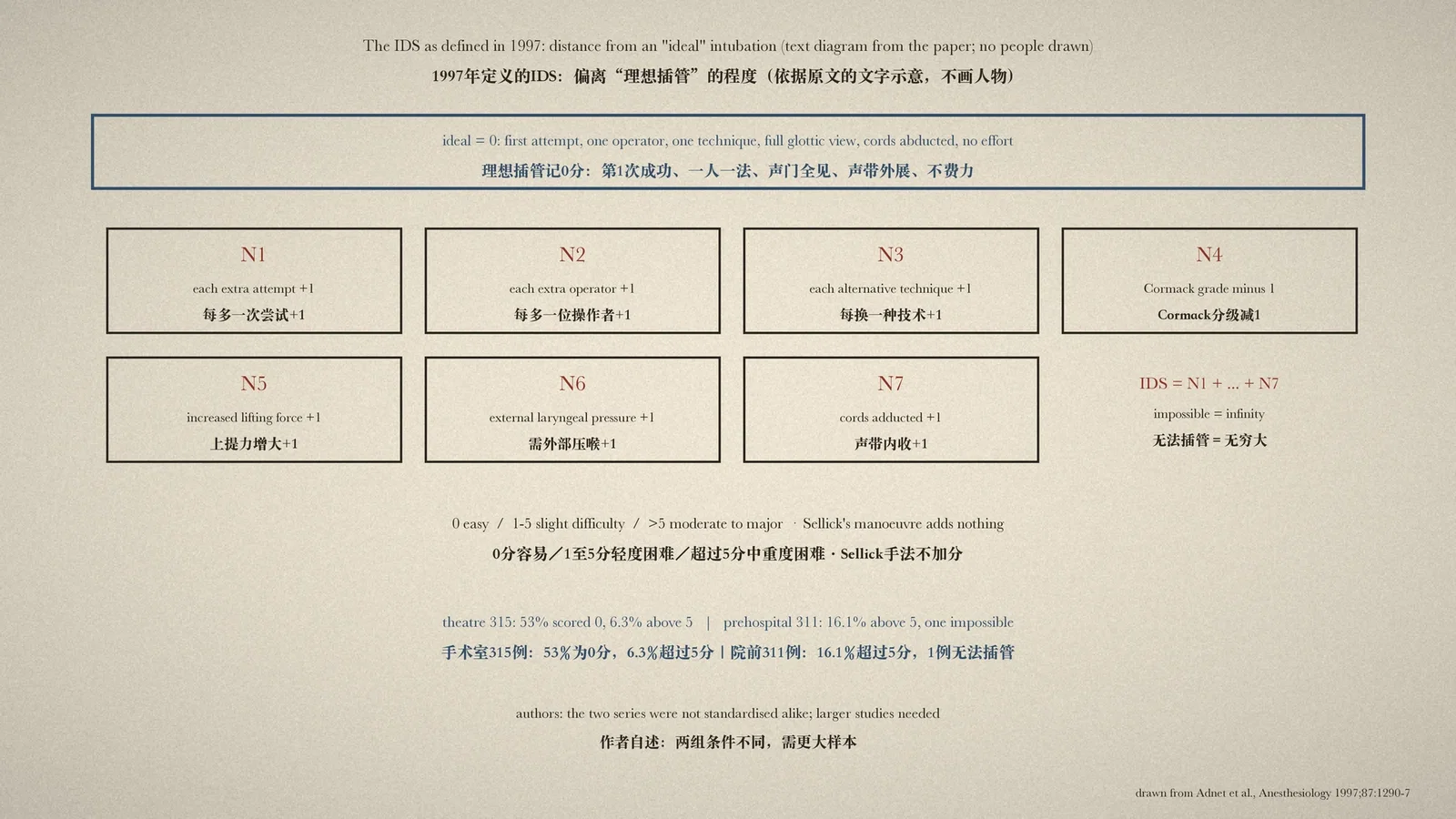
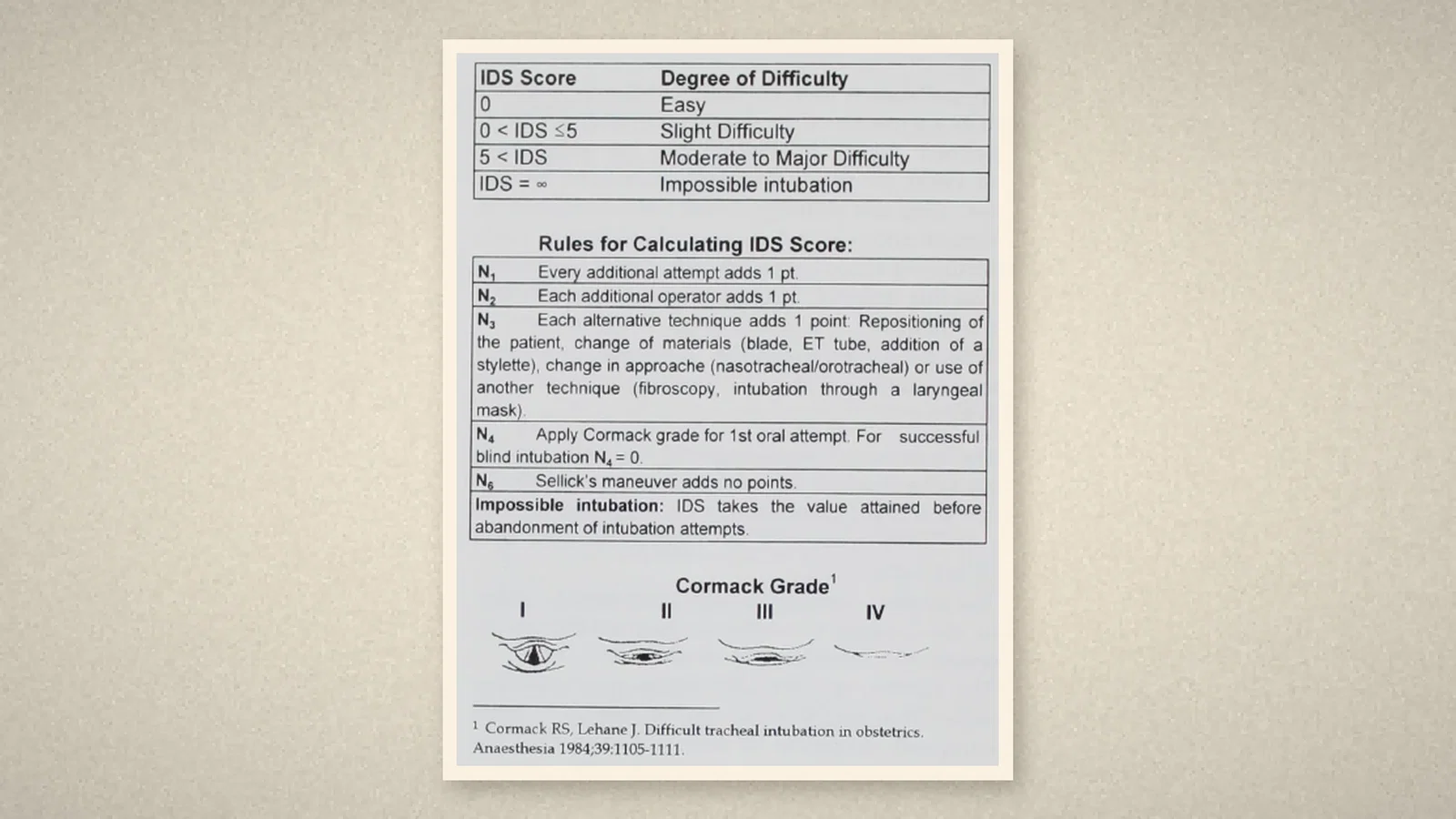
The starting point was a definition: intubation difficulty is the degree of divergence from a predefined "ideal" intubation, one done without effort, at the first attempt, by one operator, with one technique, with full view of the laryngeal aperture and the cords abducted. Such an intubation scores 0. Every variation adds to the difficulty, the total being the sum of all variations, and impossible intubation is defined as infinity. [1, p. 1291]
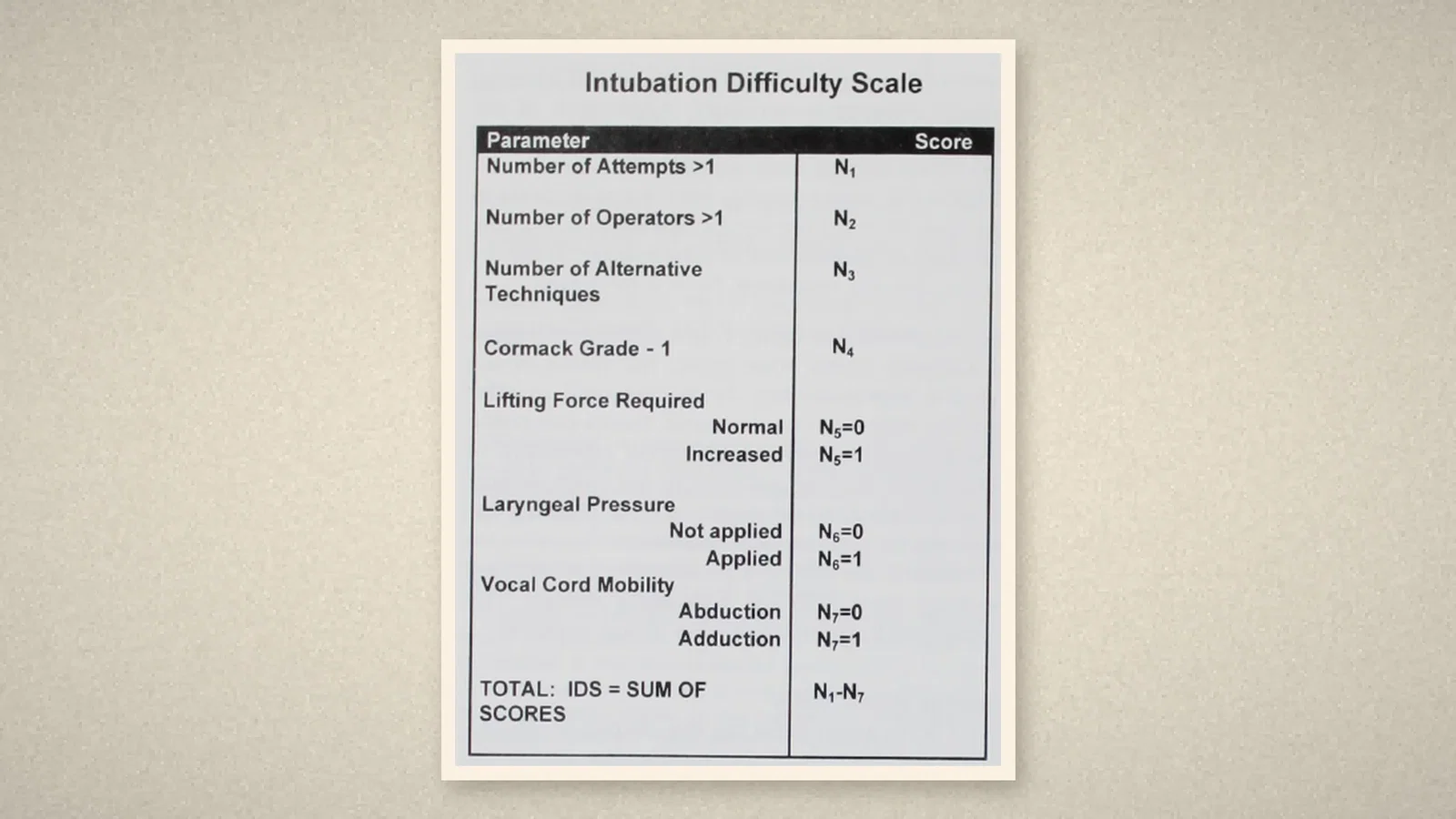
The seven variables were these. N1: the number of supplementary attempts, an attempt being one advance of the tube towards the glottis. N2: the number of supplementary operators who actually attempted the intubation, not those assisting. N3: the number of alternative techniques, such as a change from oral to blind nasal intubation or from a curved to a straight blade. N4: the Cormack grade minus one, assessed at the first operator's first attempt. N5: 1 point if the operator felt that more lifting force than usual was needed. N6: 1 point if external laryngeal pressure was needed to improve the view, while Sellick's manoeuvre, applied against aspiration, does not change the score. N7: 1 point if the cords were adducted and in the way of the tube. "In a manner analogous to the Glasgow Coma Scale", the components could be recorded separately to show where the difficulty lay and then added up. [1, p. 1291]
Theatre and prehospital
The study had review board approval and two prospective series. In theatre, so as not to change anyone's habits while still comparing a "standardised" intubation, the investigators observed every intubation in the study period and kept only those meeting conditions set in advance: a certified anaesthesiologist or nurse anaesthetist with at least two years' experience, a routine operation after induction and neuromuscular blockade, and a first attempt by the oral route with a standard Macintosh technique. An independent observer timed each intubation. Afterwards the operator marked a visual analogue scale of difficulty and filled in a questionnaire on attempts, techniques, Cormack grade, laryngeal pressure, abnormal force, number of operators and cord position, ending with a choice of "easy, somewhat difficult, difficult". The operators did not know how the score was built. In the prehospital series, SAMU emergency physicians completed the same questionnaire after intubating in the field, and in both series the first author calculated the IDS afterwards. [1, p. 1291][1, p. 1292]
In theatre, 53.0% (167 of 315) scored 0, none was impossible, and 6.3% scored above 5, meaning moderate to major difficulty. The IDS correlated significantly with the operators' categories, with time to intubation and with the visual analogue scale. Prehospital, one of 311 intubations was impossible, 16.1% scored above 5, and scores were significantly higher than in theatre. [1, p. 1293][1, p. 1294]
The laryngoscopic grade is not the difficulty
One set of figures in the discussion makes the point. In theatre, 21 of 34 intubations with a Cormack grade of III or worse succeeded at the first attempt, while four intubations with a grade I view were judged very difficult both by the operators and by the IDS. Glottic exposure alone, the authors concluded, is an incomplete reflection of difficulty, so its weight in the IDS is limited and quickly saturated, adding at most 3 points. [1, p. 1294][1, p. 1295]
They also weighed the alternatives. The visual analogue scale grows more dependent on the operator's experience as difficulty rises; time captures major problems but not moderate ones, and is inaccurate without an independent observer; and the three categories, although they ran parallel to the IDS, varied widely in the transitional range, showing "no true 'border'" between easy and moderately difficult intubation. [1, p. 1296]
The authors admitted that the theatre series was more or less standardised while the prehospital series was not, "rendering any direct comparison of the two groups questionable". They concluded that the visual analogue scale, categorical classification and time were all problematic, that the IDS blended subjective and objective criteria to describe the progressive nature of difficulty, and that further evaluation in large series was desirable. [1, p. 1296]
What the record shows
The IDS starts by saying exactly what "no difficulty" means, then records each departure from it and adds them up. It gave studies a common yardstick, and it put the laryngoscopic grade in its place: important, but only one part of difficulty.
Sources and reading limits
Read: Adnet, Borron, Racine, Clemessy, Fournier, Plaisance and Lapandry, "The Intubation Difficulty Scale (IDS)", Anesthesiology 1997;87:1290-7 (the whole paper: abstract, introduction, definition and variables, methods, results, discussion, conclusion and Figs 1-6; page images of pp. 1290 and 1292 checked). Obtained through institutional access.
Not covered: Benumof's accompanying editorial; the ASA difficult airway guidelines and the other definitions the authors cite; later validation studies of the IDS. The ASA timeline entry was used only as a lead.
Limits: the theatre series was standardised and the prehospital series was not, and the authors themselves call direct comparison questionable; the IDS was calculated afterwards by the first author from the operators' questionnaires; the lifting-force item is subjective by design; the authors call for larger studies. Statistics are given as the paper reports them. Patients are not identified.
Three illustrations are crops of Anesthesiology 1997 pp. 1290 and 1292 (title and abstract, both halves of Fig. 1). One is a text diagram drawn from the paper, with no people drawn.
- Adnet F, Borron SW, Racine SX, Clemessy JL, Fournier JL, Plaisance P, Lapandry C. The intubation difficulty scale (IDS): proposal and evaluation of a new score characterizing the complexity of endotracheal intubation. Anesthesiology. 1997;87:1290-7. DOI
Continue exploring
Related reading connects shared questions and contexts; it does not by itself establish historical influence.
- 1984: Cormack and Lehane Grade the Laryngoscopic View in Four Levels
- 1985: Mallampati and Colleagues Propose a Pharyngeal Sign Predicting Difficult Intubation
Anesthesia Epochs · The Source Room · About & Editorial Method
Published November 3, 2026. Sources and reading limits are stated above. Illustrations are labelled as original source images or AI-made. Historical accounts are educational; they are not current treatment instructions.