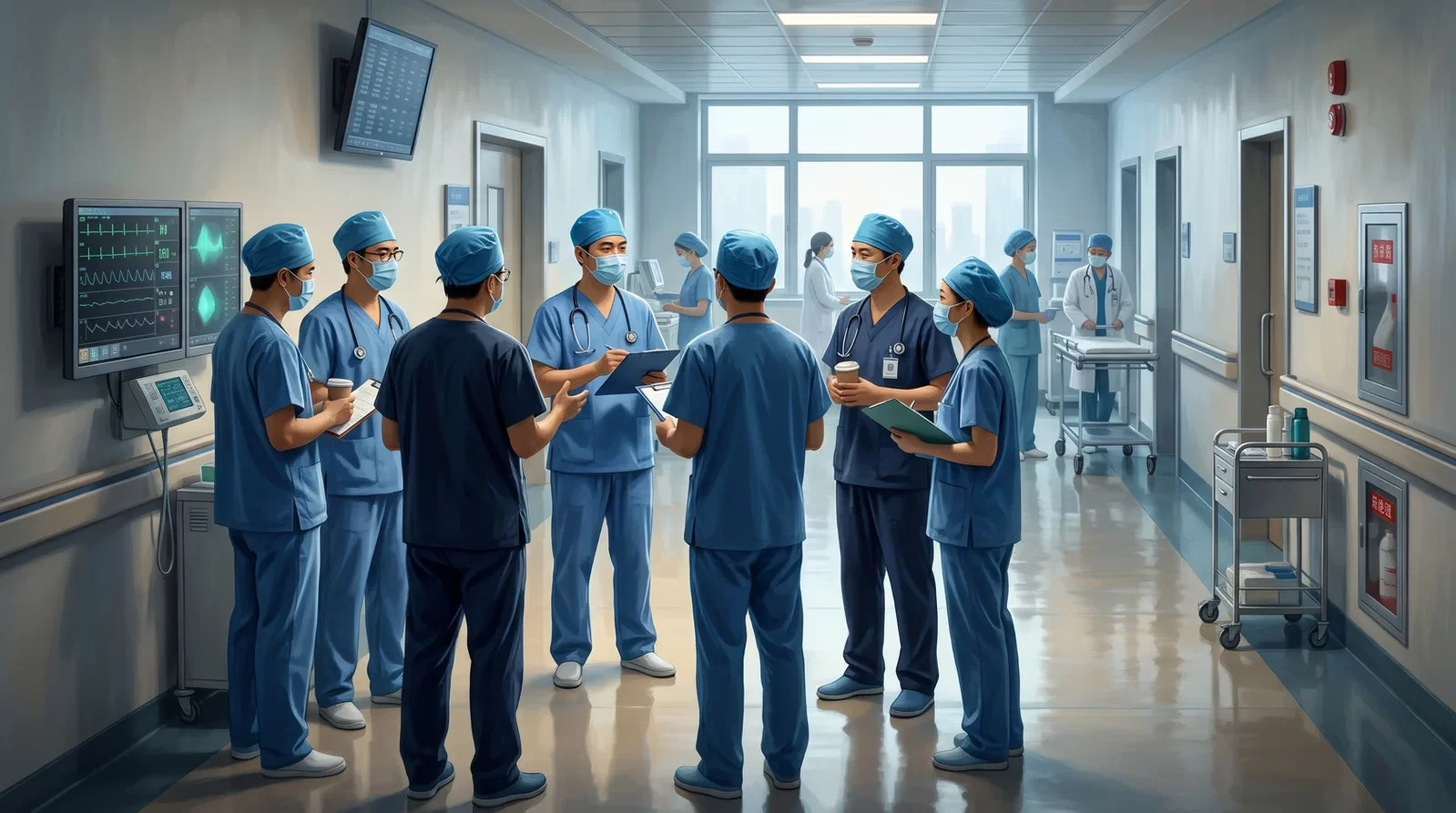
On 8 August 2018 seven departments of the Chinese government, led by the National Health Commission, issued a notice (国卫医发〔2018〕21号) circulating an Opinion on Strengthening and Improving Anaesthesia Services, aimed at easing the shortage of anaesthesiologists; it set workforce targets for 2020, 2030 and 2035 and called for more residency training places, anaesthesia nurses and technicians, anaesthesia and pain clinics, sedation and analgesia outside the operating room including labour analgesia, quality control, fairer pricing and a ratio of anaesthesiologists to surgeons rising to 1:3 in tertiary general hospitals. The text was reprinted in the State Council Gazette 2019 No. 1, and Huang Yuguang of Peking Union Medical College Hospital discussed its five groups of measures in 2019.
Reading Library · Anesthesia Epochs · 中文版
Watch the education video (for clinicians)
2018: China's Anaesthesia Services Opinion — Workforce Targets · Anesthesia Epochs Education Series
The standing of a specialty is sometimes written into the first sentence of a government document. On 8 August 2018 China's National Health Commission and six other departments jointly issued an opinion on anaesthesia. It opened: "Anaesthesiology is an important part of clinical medicine, and the anaesthesia department is an important clinical specialty that reflects the overall capability of a medical institution." Its purpose followed at once: to ease the shortage of anaesthesiologists in China. This article reads the document itself and one commentary from the same months; it does not judge how the policy was later carried out. [1][2]
Seven departments, one document number
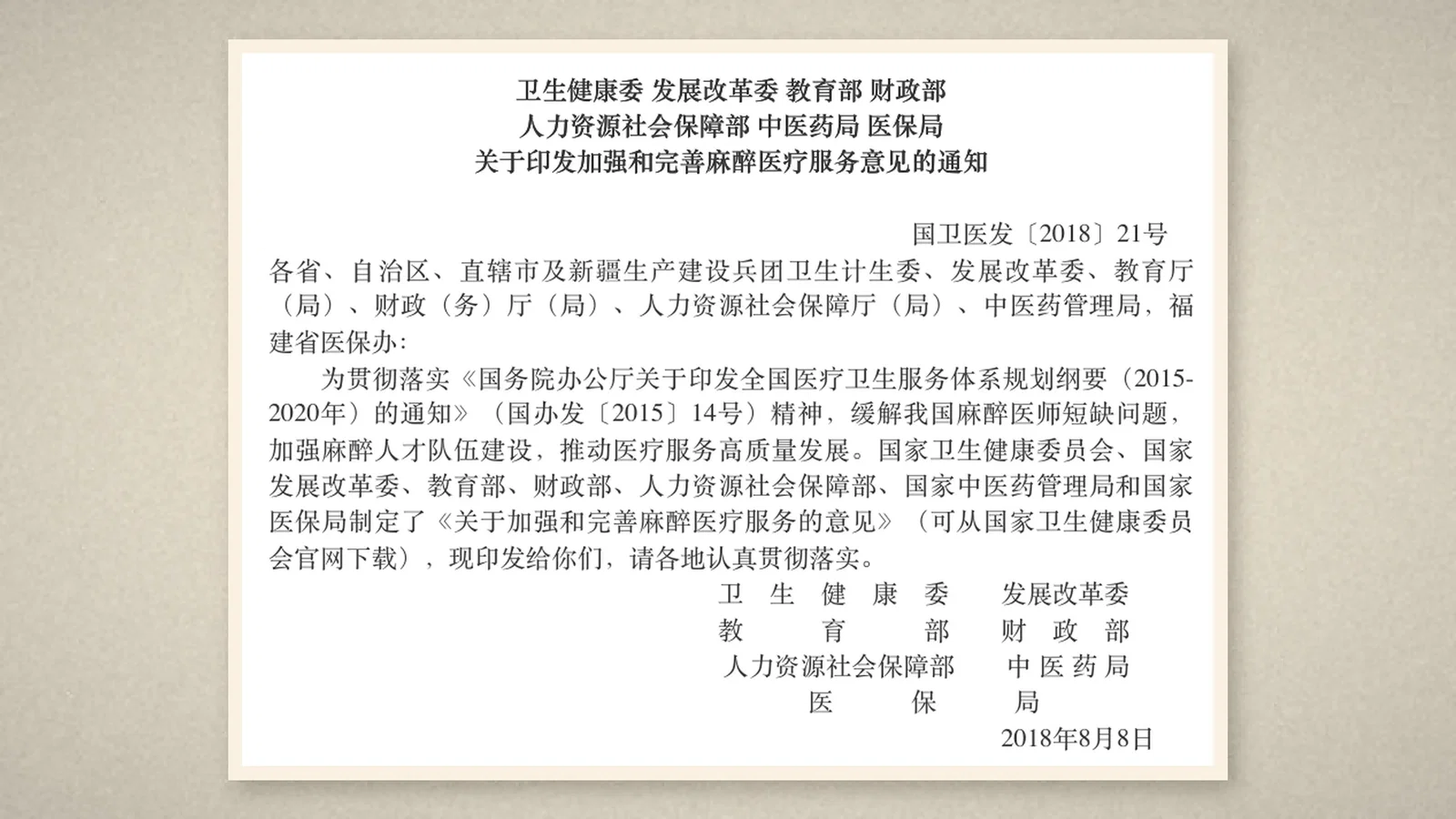
The formal title is the Notice on Issuing the Opinion on Strengthening and Improving Anaesthesia Services, document 国卫医发〔2018〕21号, dated 8 August 2018. Seven bodies signed it: the National Health Commission, the National Development and Reform Commission, the Ministry of Education, the Ministry of Finance, the Ministry of Human Resources and Social Security, the National Administration of Traditional Chinese Medicine and the National Healthcare Security Administration. Addressed to their counterparts in every province, autonomous region and municipality, the notice said the Opinion carried out the national plan for the health-service system issued by the State Council's General Office in 2015, in order to ease the shortage of anaesthesiologists, strengthen the anaesthesia workforce and raise the quality of medical services. The full text was later reprinted in the State Council Gazette, 2019 No. 1. [1][2]
That a document about one clinical department needed signatures from planning, education, finance, personnel, traditional medicine and insurance bodies says something in itself: where doctors are trained, how posts are created, who pays and how services are priced all belong to different parts of government.
The workforce targets
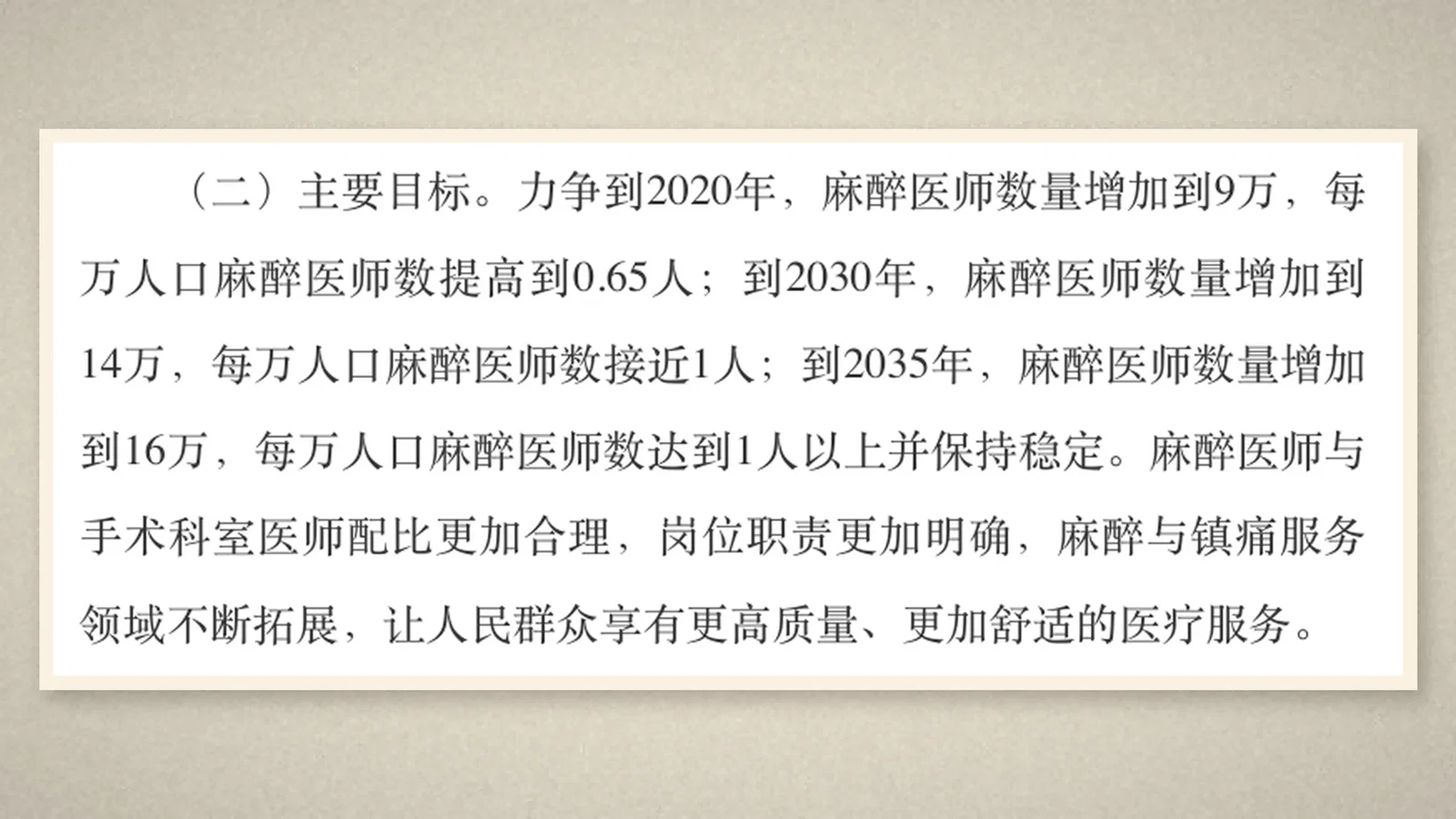
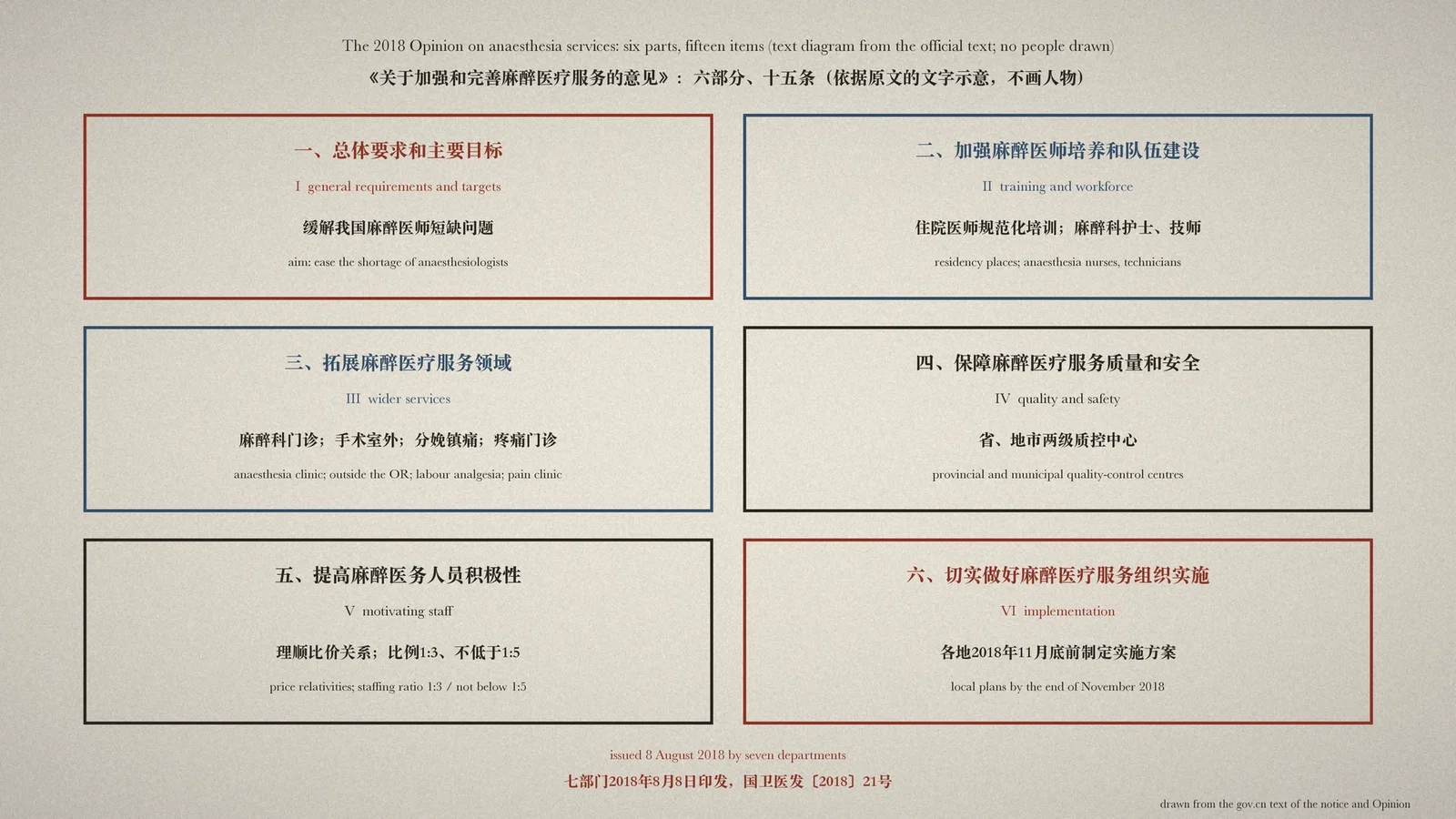
Part one set out general requirements and main targets. The requirements were to train more anaesthesiologists, improve the mix of anaesthesia staff, widen the scope of services, promote analgesia services and secure quality and safety. The targets were specific: by 2020, 90,000 anaesthesiologists, or 0.65 per 10,000 people; by 2030, 140,000, close to one per 10,000; by 2035, 160,000, more than one per 10,000 and stable. Staffing ratios between anaesthesiologists and surgeons were to become more reasonable, and anaesthesia and analgesia services were to keep expanding. [1]
These are policy targets, not counts. The document did not say how many anaesthesiologists China had. Writing early in 2019, Huang Yuguang of Peking Union Medical College Hospital put it this way: by the European and American standard of 2.4 anaesthesiologists per 10,000 people, China would need 300,000, but it had only about 76,000, a quarter of that. [3]
Training, posts and services
Part two dealt with training and the workforce. Undergraduate enrolment in anaesthesiology was to remain stable, and anaesthesia teaching was to be strengthened within general medical degrees; residency training places in anaesthesia were to increase gradually, weighted towards the central and western regions; and anaesthesiologists already working in those regions and below the prefectural level were to receive targeted continuing education. Supporting posts were added: anaesthesia departments in hospitals of secondary level and above were to have anaesthesia nurses, working under anaesthesiologists in perioperative nursing, pain management and the handling of equipment, supplies, drugs and records; where possible, hospitals could employ anaesthesia technicians to service and repair equipment. [1]
Part three carried anaesthesia beyond the operating table. Surgical anaesthesia was to suit day surgery, with more perioperative acute pain treatment and postoperative monitoring and analgesia. Hospitals with the means could open anaesthesia clinics for assessment, booking and preparation before operations and invasive procedures, and units for critically ill patients after anaesthesia. Outside the operating room, priority went to painless gastrointestinal endoscopy and bronchoscopy, labour analgesia and painless rehabilitation, with management of cancer pain, chronic pain and end-of-life care, pain clinics, and the extension of pain management through hospital networks to primary care and the home. Operating-room nursing was to be managed by the anaesthesia department. [1]
Part four concerned quality and safety: support for anaesthesia departments in county and prefectural hospitals and regional centres, technical standards, quality indicators and quality-control centres at provincial and municipal levels. [1]
Ratios and motivation
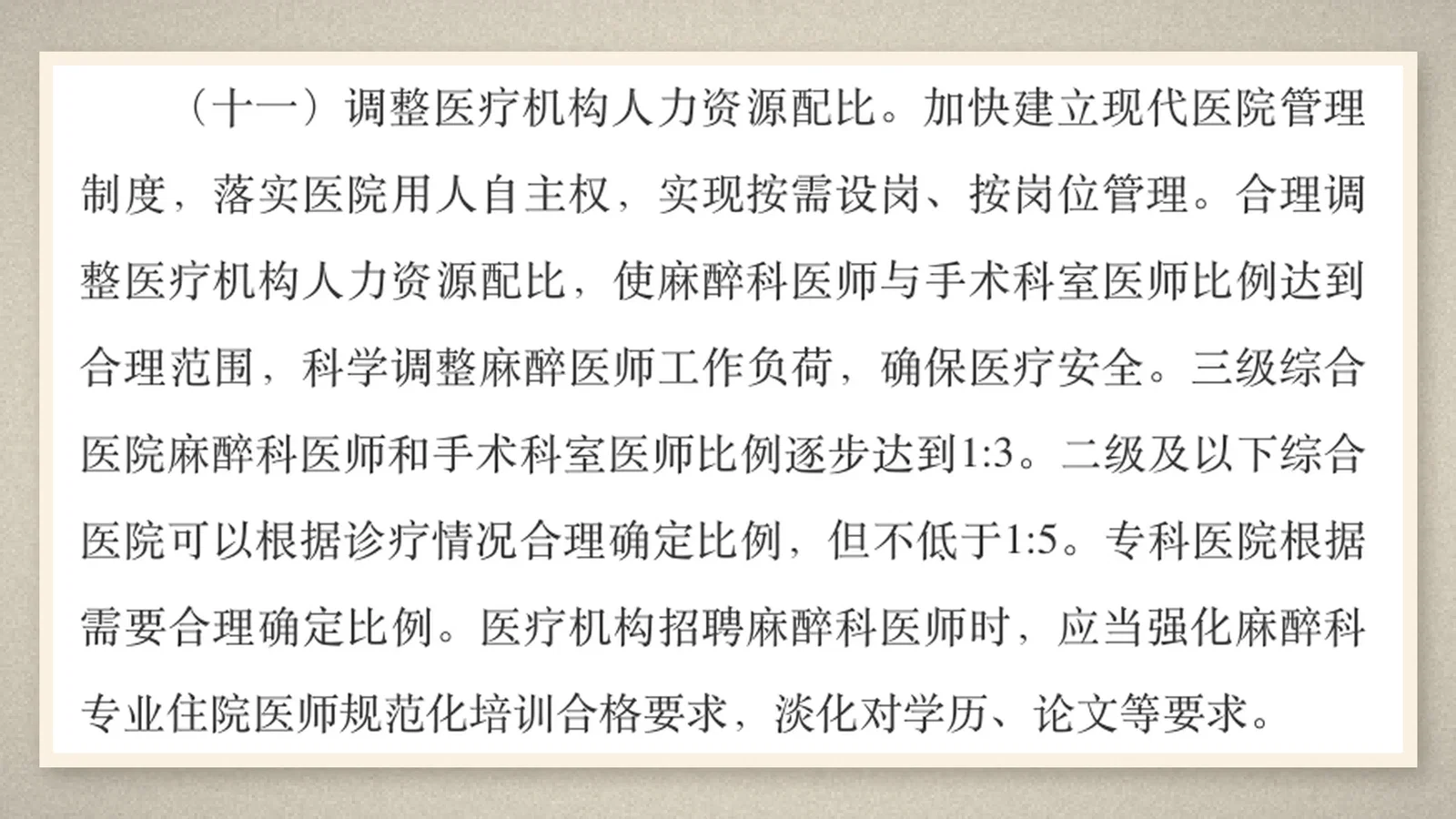
Part five asked how to keep people in anaesthesia. Price relativities were to be put right, with costs calculated from the severity of illness, length of operation, special features of the patient's age and the investment in training, so that the value of the work was reflected, while patients' basic costs did not rise overall. Tertiary general hospitals were to move gradually to one anaesthesiologist for every three surgeons; secondary and lower general hospitals could set their own ratio, but not below 1:5. In hiring, completion of standardised residency training was to count for more, and degrees and papers for less. Appointments, awards and pay were to favour anaesthesia staff. [1]
Part six covered implementation: every locality was to draw up a training plan and an implementation scheme by the end of November 2018; health authorities were to encourage anaesthesiologists to practise at more than one site; education, finance, insurance and personnel bodies each had tasks; and the National Health Commission was to track progress and supervise regularly. [1]
A department head's reading
Huang Yuguang's "My views on building the discipline of anaesthesiology in China" was posted on the Chinese Medical Association website on 16 January 2019, taken from Chinese Medical Information Herald 2019, vol. 34, no. 1. Huang placed the Opinion in a longer line: the Chinese anaesthesia conference in Harbin in 1979, at which the Chinese Society of Anesthesiology was founded; Ministry of Health document No. 12 of 1989, which declared anaesthesiology a second-level clinical discipline independent of surgery; and standardised residency training from 2014, with 382 training bases and 12,000 trainees by 2018. [3]
Huang summarised the Opinion as five groups of measures and called the shortage of staff the most pressing problem. Many anaesthesiologists worked chronically overloaded; Huang wrote that more than ten young and middle-aged anaesthesiologists had died suddenly since 2014, and that a 2015 survey in the Beijing-Tianjin-Hebei region found a burnout rate of 68.9%. Huang added that of the four domains assigned to the specialty in 1989, clinical anaesthesia, emergency resuscitation, intensive care and pain medicine, all but the first had moved or were moving away to develop independently, so anaesthesiology "must step out of the operating room". [3]
What the record shows
The Opinion turned a specialty's shortage into a set of targets and ratios that can be checked, and stretched the reach of anaesthesia from the operating room to clinics, endoscopy suites, delivery rooms and homes. It records judgements and hopes as of 2018; whether the targets were met is a question for later statistics.
Sources and reading limits
Read: the full text of the notice and Opinion (国卫医发〔2018〕21号) in the State Council policy library, including the header metadata, the notice and all fifteen items in six parts; the same notice as printed in the State Council Gazette 2019 No. 1 (title, number, signatories, date and text checked); and Huang Yuguang's commentary in full (Chinese Medical Association website, 16 January 2019). Neither government page offers a PDF (the Gazette issue page has an empty download link), so both pages were printed to PDF to check page images and crop illustrations; their text matches the web pages.
Not covered: the attachment on the National Health Commission website and any Gazette PDF; the 2015 plan and the medical-education reform opinion that the notice cites; the local schemes due by the end of November 2018; the 1989 Ministry of Health document No. 12 and the 2014 residency documents that Huang mentions; any statistics on whether the targets were reached.
Limits: the numbers of anaesthesiologists and the ratios are policy targets, not counts. The figures of about 76,000 anaesthesiologists, 382 bases, 12,000 trainees, more than ten sudden deaths and the 68.9% burnout rate are Huang's; the underlying surveys were not seen.
Three illustrations are crops of the printed government pages (the notice as printed in the Gazette, item 2 and item 11 of the Opinion). One is a text diagram drawn from the official text, with no people drawn.
- National Health Commission, National Development and Reform Commission, Ministry of Education, Ministry of Finance, Ministry of Human Resources and Social Security, National Administration of Traditional Chinese Medicine, National Healthcare Security Administration. Notice on issuing the Opinion on strengthening and improving anaesthesia services (国卫医发〔2018〕21号). 8 August 2018. gov.cn
- State Council Gazette 2019 No. 1. Notice on issuing the Opinion on strengthening and improving anaesthesia services. gov.cn
- Huang Y. 未来中国麻醉学科建设之我见 [My views on building the discipline of anaesthesiology in China]. Chinese Medical Information Herald. 2019;34(1). Chinese Medical Association
Continue exploring
Related reading connects shared questions and contexts; it does not by itself establish historical influence.
- 1986: Xuzhou Medical College Admits Undergraduates in Anaesthesiology
- 1950: Wu Jue Builds an Anaesthesia Department at Zhongshan Hospital
- 1979: The Chinese Society of Anesthesiology Is Founded in Harbin
Anesthesia Epochs · The Source Room · About & Editorial Method
Published November 4, 2026. Sources and reading limits are stated above. Illustrations are labelled as original source images or AI-made. Historical accounts are educational; they are not current treatment instructions.