On 10 August 1897 Felix Hoffmann at Bayer in Elberfeld prepared pure acetylsalicylic acid; the drug was registered as the trademark Aspirin in 1899 and patented in the United States in 1900, but a German patent was refused, and Arthur Eichengrün’s later claim to have directed the work has led to the discovery being seen as teamwork.
Reading Library · Anesthesia Epochs · 中文版
Watch the education video (for clinicians)
1897: Hoffmann's Aspirin — Patent, Trademark and Disputed Credit · Anesthesia Epochs Education Series
On 10 August 1897, in the pharmaceutical laboratory of the Bayer dye company at Elberfeld in Germany, the chemist Felix Hoffmann prepared a sample of pure acetylsalicylic acid. Two years later the compound went on sale under the registered trademark "Aspirin". [2] Those two sentences appear in almost every history of drugs. The other half of the story — who asked for the work, who got the drug to market, who received the patent and the money — was still being argued a century later.
The chemistry in the patent
United States Patent No. 644,077 is in the name of Felix Hoffmann, assignor to the Farbenfabriken of Elberfeld Company of New York; the application was filed on 1 August 1898 and the patent is dated 27 February 1900. [1, p. 1]
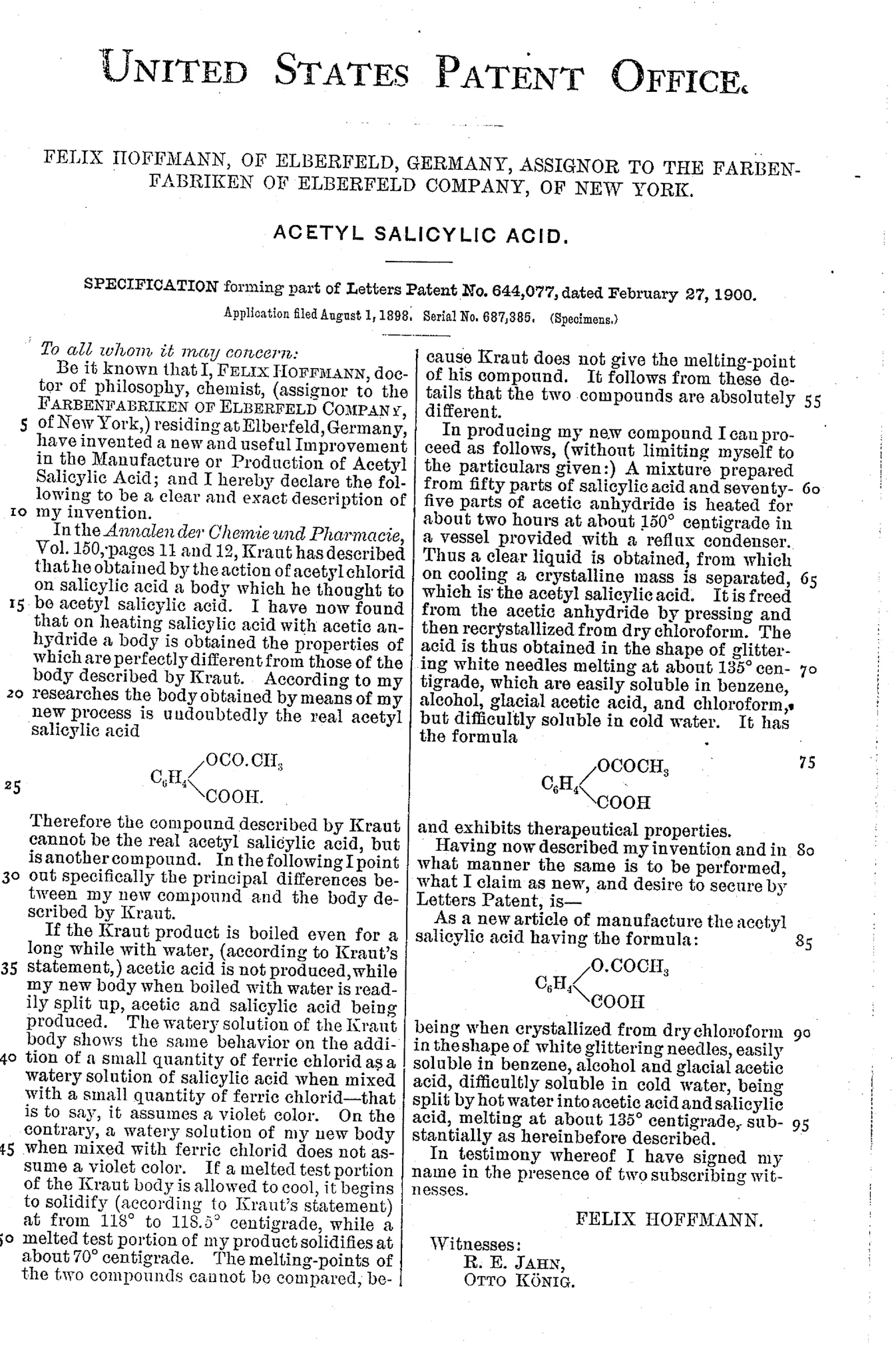
The specification opens by setting its product apart from earlier work. Kraut had reported in volume 150 of the Annalen der Chemie und Pharmacie a body obtained by the action of acetyl chloride on salicylic acid, which Kraut took to be acetylsalicylic acid; Hoffmann says that heating salicylic acid with acetic anhydride gives a body with entirely different properties, and that Hoffmann's is the "real" acetylsalicylic acid. [1, p. 1] The method: fifty parts of salicylic acid and seventy-five parts of acetic anhydride heated for about two hours at about 150 °C under a reflux condenser; the crystals that separate on cooling are pressed and recrystallised from dry chloroform, giving glittering white needles melting at about 135 °C. [1, p. 1] A simple reaction marks the difference: a watery solution of Kraut's product turns violet with a little ferric chloride, while the new body does not. [1, p. 1]
The document establishes a method of preparation and a product, not who first thought of acetylating salicylic acid.
A trademark that held, a German patent that failed
According to the DPMA, "Aspirin" was entered in the trademark register of the Imperial Patent Office in Berlin on 6 March 1899, as German trademark 36433. [3] The same office explains that in 1899 the Imperial Patent Office found the inventive step too small and refused a German patent; part of the background was that Chemische Fabrik v. Heyden had begun selling acetylsalicylic acid as a remedy in 1897. [3] In Germany, then, Bayer relied on the trademark; in the United States there was the 1900 patent in Hoffmann's name. [1, p. 1; 3]
The DPMA also notes who was paid: Heinrich Dreser, head of Bayer's pharmacological laboratory, received royalties on German sales of Aspirin, while Hoffmann and Arthur Eichengrün did not. [3]
A story that first appeared in 1934
The familiar version is that Hoffmann, looking for a drug that would spare a rheumatic father's stomach, searched the literature and made acetylsalicylic acid. Sneader points out that this account first appeared in 1934, as a footnote by the retired chemist Albrecht Schmidt in a history of the chemical industry. [2]
Sneader questions the footnote on two grounds. First, it says the other salicylic acid derivatives had been prepared long before for other purposes and left unnoticed; yet the propionyl, butyryl, valeryl and benzoyl salicylic acids that Dreser named in a paper of 1899 have no earlier record in the literature, and three of them were patented as new compounds in Britain in 1900 — evidence that they were newly made in search of a therapeutic salicylate. Sneader concludes that the 1934 footnote is unreliable. [2] Second, the laboratory reports in the Bayer archives have gaps: Hoffmann wrote no reports between 13 March 1896 and 5 May 1897, and Dreser did not begin writing reports until 16 May 1898, after which, from 27 September 1898, Dreser tested acetylsalicylic acid on its own four times that year. [2]
Eichengrün's account
In an article in Pharmazie in 1949, Arthur Eichengrün wrote of having instructed Hoffmann to synthesise acetylsalicylic acid and that Hoffmann did so without knowing the purpose of the work. [2] Five years earlier, while held in the Theresienstadt concentration camp, Eichengrün had typed a letter to Bayer in similar terms. [2] In Eichengrün's telling, Dreser used the position of head of pharmacology to veto clinical studies, believing mistakenly that the drug harmed the heart, and the drug was then passed quietly to physicians for trial. [2] Checking this, Sneader identifies the first published clinical report as that of Kurt Witthauer of the Deaconess Hospital in Halle, in 1899. [2] The two sources cite that report differently: Sneader gives Die Heilkunde 1899;3:396, while a DPMA caption gives Therapeutische Monatshefte 13, p. 330. [2, 3]
Sneader supports this timeline with two further pieces of evidence. The first is the "eighteen months": in Bayer's fiftieth-anniversary volume of 1918, Eichengrün wrote that after examining acetylsalicylic acid Dreser set it aside for nearly 18 months until taking it up again in 1898, and Dreser, whose chapter followed in the same book, did not dispute it. [2] Dreser had taken up the post at Elberfeld only on 1 April 1897, so if that interval ended around September 1898, Dreser's first tests of the salicylic acid derivatives must have come soon after arriving. [2] The second is the clinician's own words: Witthauer wrote that "after long hesitation" the factory had been convinced by Witthauer's favourable experience to bring Aspirin onto the market, and that Witthauer had received the new salicylate nearly a year earlier, that is around April 1898. [2] Friedrich Fischer, head of the Elberfeld pharmaceutical laboratory in 1897, likewise wrote that Witthauer energetically pushed for the drug's introduction because of its success in the clinic. [2]
These accounts agree with one another, but most come from commemorative volumes, memoirs and later reports rather than from the laboratory record of the day. They make the story of Hoffmann inventing the drug alone for a father hard to sustain; they are not enough to divide the credit for every step precisely between individuals.
In the same 1949 article Eichengrün recalled that in 1941 a showcase in the Deutsches Museum in Munich was labelled "Aspirin: inventors Dreser and Hoffmann", without Eichengrün's name, and Eichengrün attributed the omission to a Jewish origin. [2]
Where the evidence leaves it
Sneader's judgement is that the most reasonable conclusion is that Eichengrün was telling the truth: acetylsalicylic acid was synthesised under Eichengrün's direction, and the drug would not have been introduced in 1899 without Eichengrün's intervention. [2] The DPMA puts it more generally: Aspirin was more probably the result of teamwork, and the story of the "lone inventor" Hoffmann is no longer sustainable. [3] The ASA timeline's 1897 entry also carries a bracketed note calling the attribution controversial. [4, p. 29]
For the history of anaesthesia and analgesia, what is worth keeping here is not a hero's name but the distance between documents. The laboratory date comes from later citations of the archive; the patent proves only a method; the trademark shows a market strategy; and the question of credit was reopened only by a letter written in a concentration camp and a reappraisal half a century later.
Sources and reading limits
Read: the full one-page text of US Patent 644,077, with its page image; Sneader’s 2000 BMJ article in full; the DPMA page “Brands with history: Aspirin”; page 29 of the 2024 ASA timeline.
Not covered: Hoffmann’s laboratory entry of 10 August 1897 and the Bayer laboratory reports, known here only through Sneader and the DPMA; Schmidt’s 1934 book; Eichengrün’s 1949 article and earlier letter; Dreser’s 1899 paper; Witthauer’s 1899 report, which Sneader and the DPMA cite differently, so both citations are given; the German patent refusal file. Gerhardt’s 1853 report is treated in a separate article.
- Hoffmann F. Acetyl Salicylic Acid. United States Patent 644,077. Application filed August 1, 1898; dated February 27, 1900. Patent PDF.
- Sneader W. The discovery of aspirin: a reappraisal. BMJ. 2000;321(7276):1591–1594. PMC full text.
- Deutsches Patent- und Markenamt. Brands with history: Aspirin. DPMA page.
- Australian Society of Anaesthetists. History of Anaesthesia Timeline. October 2024, p. 29. PDF.
Continue exploring
Related reading connects shared questions and contexts; it does not by itself establish historical influence.
- 1853: Gerhardt's Report, After the Mixture Hardened
- 1763: Stone Reports a Local Bark in a Public Letter
- 1838: Piria's New Products from Salicin
Anesthesia Epochs · The Source Room · About & Editorial Method
Published November 2, 2026. Sources and reading limits are stated above. Illustrations are labelled as original source images or AI-made. Historical accounts are educational; they are not current treatment instructions.