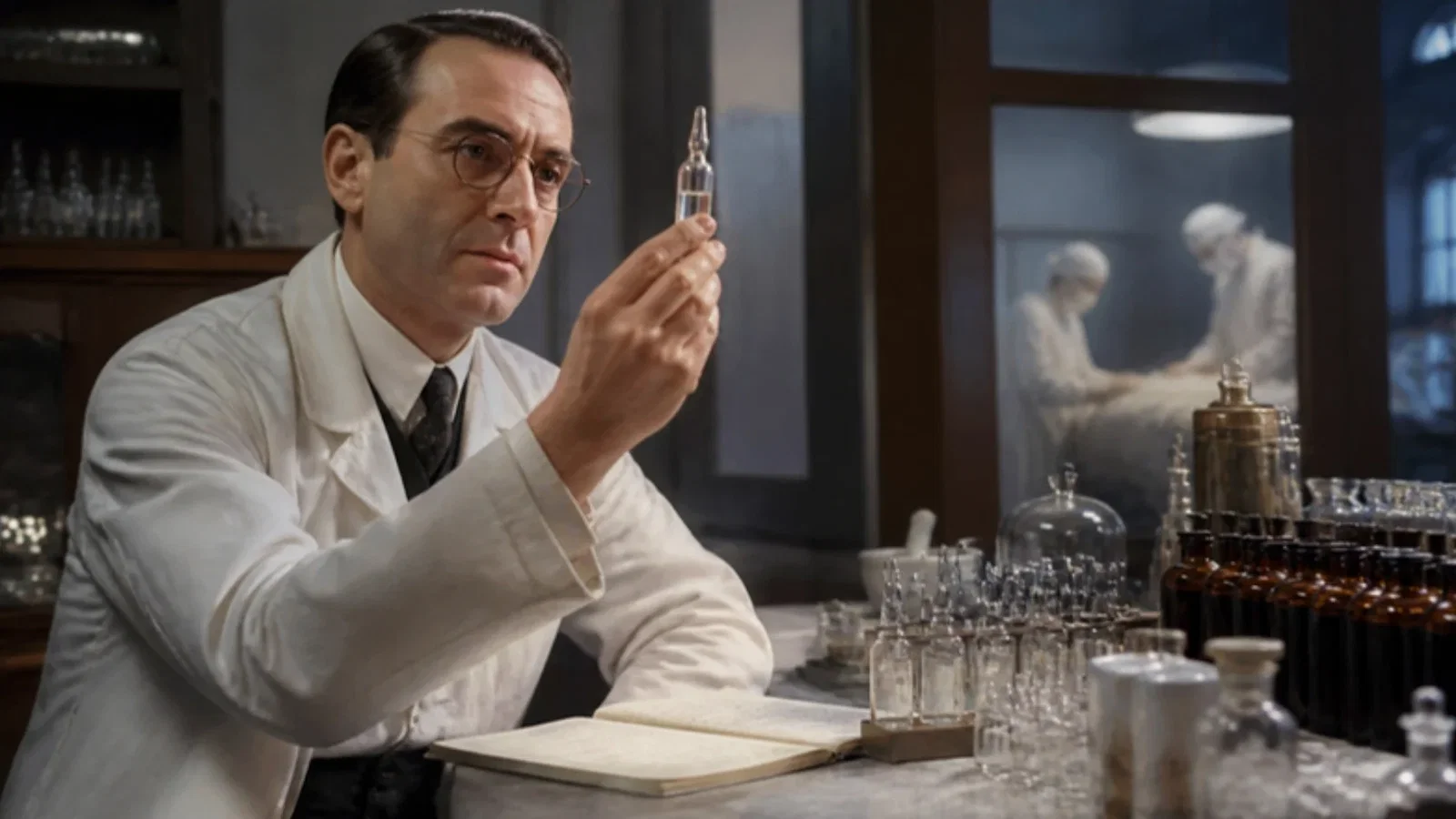
Selye finds that large doses of steroid hormones put rats into a quiet deep anaesthesia; fifteen years later King's College Hospital reports 100 operations under hydroxydione (Viadril), a steroid without hormonal activity.
Reading Library · Anesthesia Epochs · 中文版
Watch the education video (for clinicians)
1941: Selye's Steroid Anaesthesia — From Rats to Viadril · Anesthesia Epochs Education Series
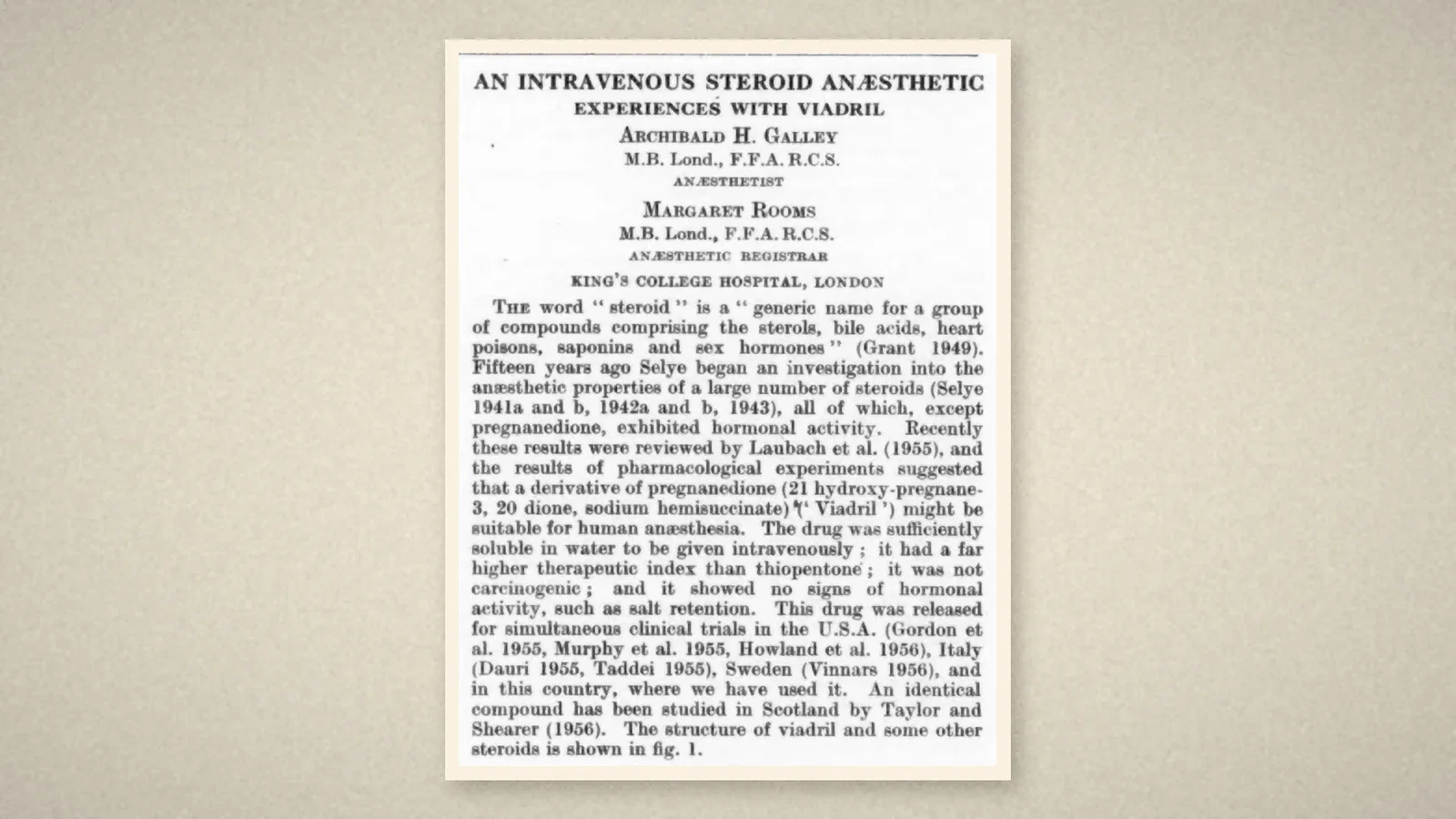
The idea that a steroid molecule can put a person to sleep later produced several intravenous anaesthetics, and neurosteroids are still studied today. It began with an unexpected observation. This article reads two primary papers: Hans Selye's report in the Proceedings of the Society for Experimental Biology and Medicine in January 1941, and the first clinical experience published by Galley and Rooms of King's College Hospital, London, in the Lancet in June 1956.
A surprise: hormones that would not poison rats
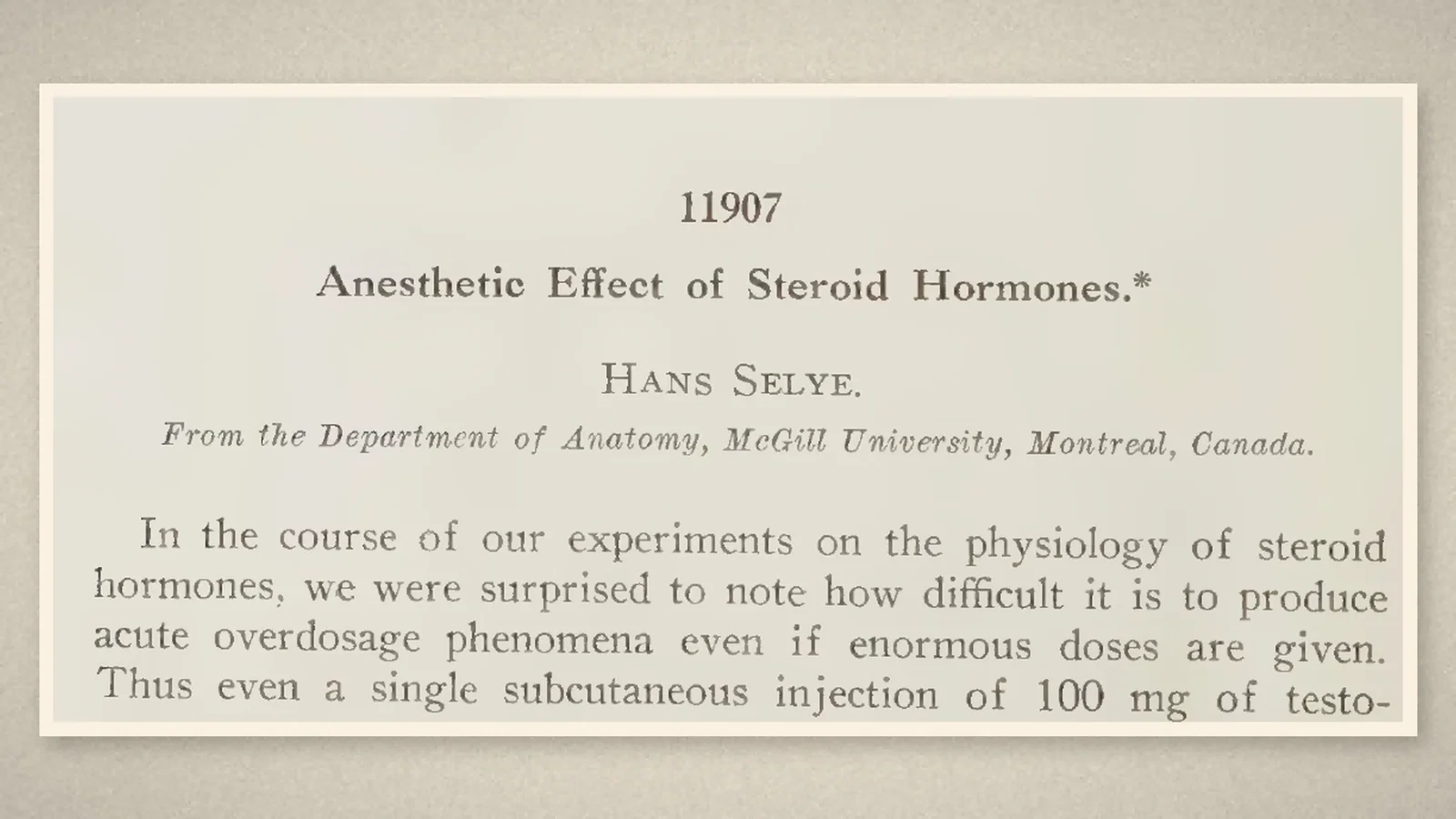
Selye, working "from the Department of Anatomy, McGill" University, was studying the physiology of steroid hormones. "We were surprised to note how difficult it is to produce" acute overdosage, Selye wrote, even with enormous doses: 100 mg of testosterone, progesterone or deoxycorticosterone acetate (D.C.A.) under the skin of a 100 g rat did nothing visible. Suspecting slow absorption from oil, and unable to inject these water-insoluble compounds into veins, Selye gave them "by the intraperitoneal route in the" hope of faster uptake. [1, p. 116–117]
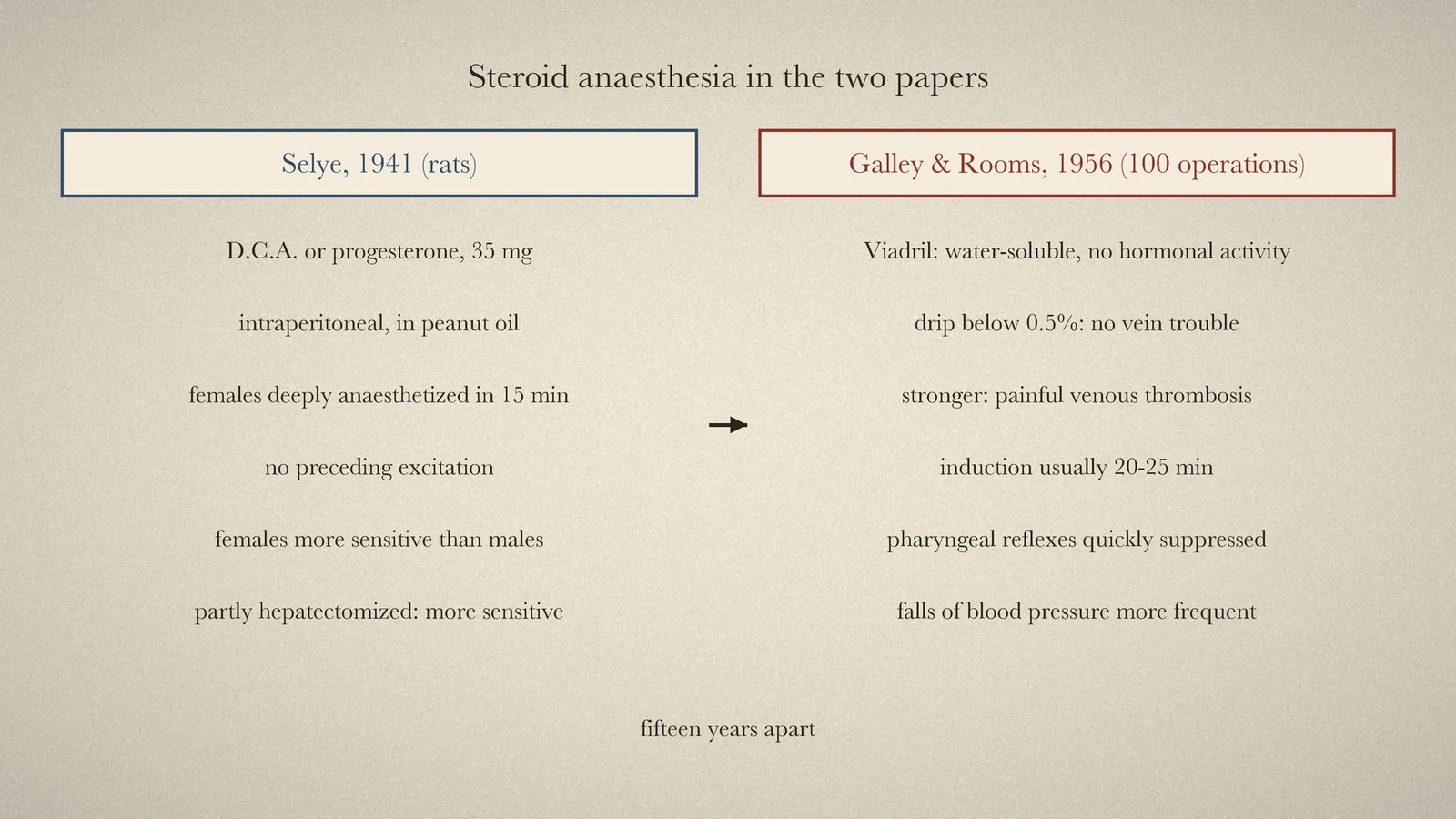
In the first experiment sixty rats, half of each sex, were divided into five groups, and "each animal received a single intraperitoneal injection of 35 mg" of D.C.A., progesterone, testosterone, estradiol or cholesterol. Within fifteen minutes "all the females in the D.C.A. and progesterone groups were" deeply anaesthetised, while most males were normal or only slightly affected; testosterone females took over an hour; "the animals receiving estradiol or cholesterol showed" no anaesthesia. Survivors woke within hours without ill effects. Both the anaesthetic and the toxic action, Selye concluded, were "greater in females than in males". [1, p. 117]
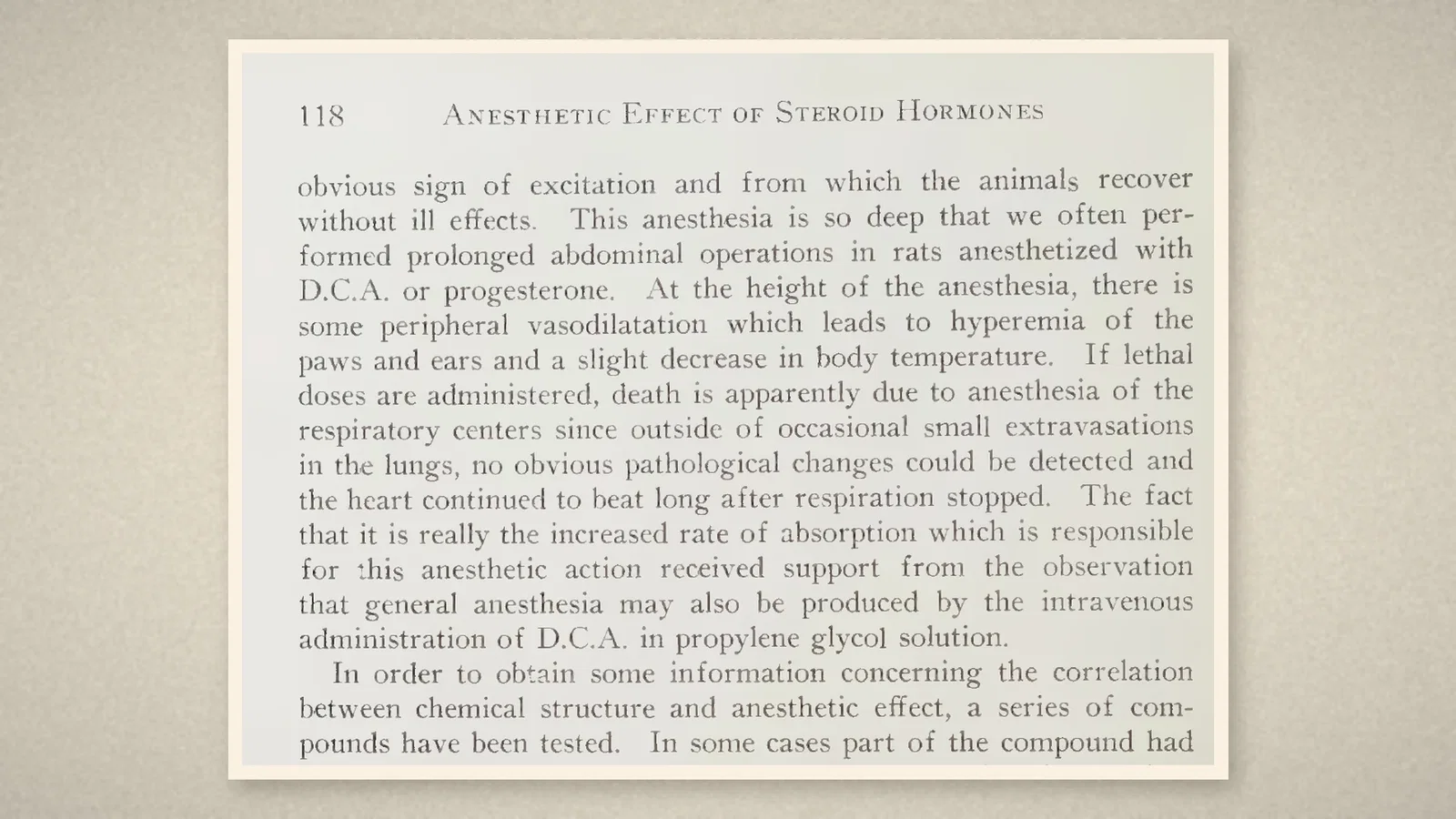
Individual sensitivity varied widely, but in suitable doses these steroids caused "a quiet deep anesthesia which is not preceded by any" sign of excitation, from which animals recovered without harm, so deep that "we often performed prolonged abdominal operations in rats". At lethal doses "death is apparently due to anesthesia of the" respiratory centres, the heart beating long after breathing stopped. General anaesthesia also followed the "intravenous administration of D.C.A. in propylene glycol". [1, p. 117–118]
Comparing many compounds, Selye found no clear link between structure and potency, but "only hormonally active" steroids were anaesthetic. "Partially hepatectomized rats are much more sensitive", suggesting the liver detoxified them. [1, p. 120] The work was paid for by a grant "received from the Schering Corporation of Bloomfield", New Jersey. [1, p. 116]
Fifteen years later: Viadril
On 23 June 1956 Archibald H. Galley, anaesthetist, and Margaret Rooms, anaesthetic registrar, at "King's College Hospital, London", reported their experience. "Fifteen years ago Selye began an investigation" into the anaesthetic properties of many steroids; Laubach and colleagues had reviewed it in 1955, and pharmacology suggested that a pregnanedione derivative, 21-hydroxypregnanedione sodium hemisuccinate, Viadril, might suit human anaesthesia. It was soluble enough to inject; it had a "far higher therapeutic index than thiopentone"; it was not carcinogenic and showed no hormonal activity such as salt retention. It was "released for simultaneous clinical trials" in the United States, Italy, Sweden and Britain. [2, p. 990]
"The 100 operations performed with viadril" as the basic anaesthetic ranged from laryngopharyngectomy and partial gastrectomy to 38 major dental operations. Given first as a 2.5% solution into a fast drip, as in America, it produced "painful venous thrombosis" in most cases; by trial and error, solutions weaker than 0.5% in saline caused no vein trouble. [2, p. 990] "The usual induction period of" 20–25 minutes could be halved with nitrous oxide, pethidine and a relaxant; and unlike thiobarbiturates, a pharyngeal airway under Viadril "does not evoke the pharyngeal reflexes" or laryngospasm. [2, p. 991]
Their verdict
"Viadril is the first steroid to be used in human" anaesthesia, the authors wrote. It suppressed pharyngeal and laryngeal reflexes quickly; "falls of blood-pressure and a rise in pulse-rate are more frequent" than with thiobarbiturates, though usually self-correcting or treatable with methylamphetamine; vomiting was rare, and patients recovered with a "sense of well-being" like that of cortisone. But above 0.5% it caused painful thrombosis, so it had to be dripped, and "consequently, the induction period is long", which would probably limit its use in shorter operations. [2, p. 993]
What the record shows
Selye set out to study hormone overdose and found instead a quiet deep anaesthesia without excitement, along with its problem: the molecules would not dissolve in water. Fifteen years later Viadril solved solubility and hormonal action but brought new problems, irritation of veins and a long induction. From the rat to the operating table, both the promise and the limits of steroid anaesthesia appear in these two papers.
Sources and reading limits
Read: Selye, "Anesthetic effect of steroid hormones", Proc Soc Exp Biol Med 1941;46:116–121, in full (with Table I); Galley and Rooms, "An intravenous steroid anaesthetic: experiences with Viadril", Lancet 23 June 1956, pp. 990–994, in full.
Not covered: Selye's later papers, the 1955 review by Laubach and colleagues, the American and Italian Viadril trials, and the Althesin papers of 1971 and 1972 are not covered; BJA issues of 1971 and 1972 are not on the Internet Archive. The later history of steroid anaesthetics is therefore not told here. "First steroid used in human anaesthesia" is Galley and Rooms's own claim and is attributed to them.
Three illustrations are crops of the two papers; one is a comparison drawn from them.
- Selye H. Anesthetic effect of steroid hormones. Proc Soc Exp Biol Med. 1941;46(1):116-21. Internet Archive
- Galley AH, Rooms M. An intravenous steroid anaesthetic: experiences with Viadril. Lancet. 1956;1(6930):990-4. Internet Archive
Continue exploring
Related reading connects shared questions and contexts; it does not by itself establish historical influence.
- 1934: Wisconsin Tries Abbott's Drug No. 8064 in 45 Patients
- 1940–1952: From Curare to Succinylcholine in Convulsive Therapy
Anesthesia Epochs · The Source Room · About & Editorial Method
Published November 2, 2026. Sources and reading limits are stated above. Illustrations are labelled as original source images or AI-made. Historical accounts are educational; they are not current treatment instructions.