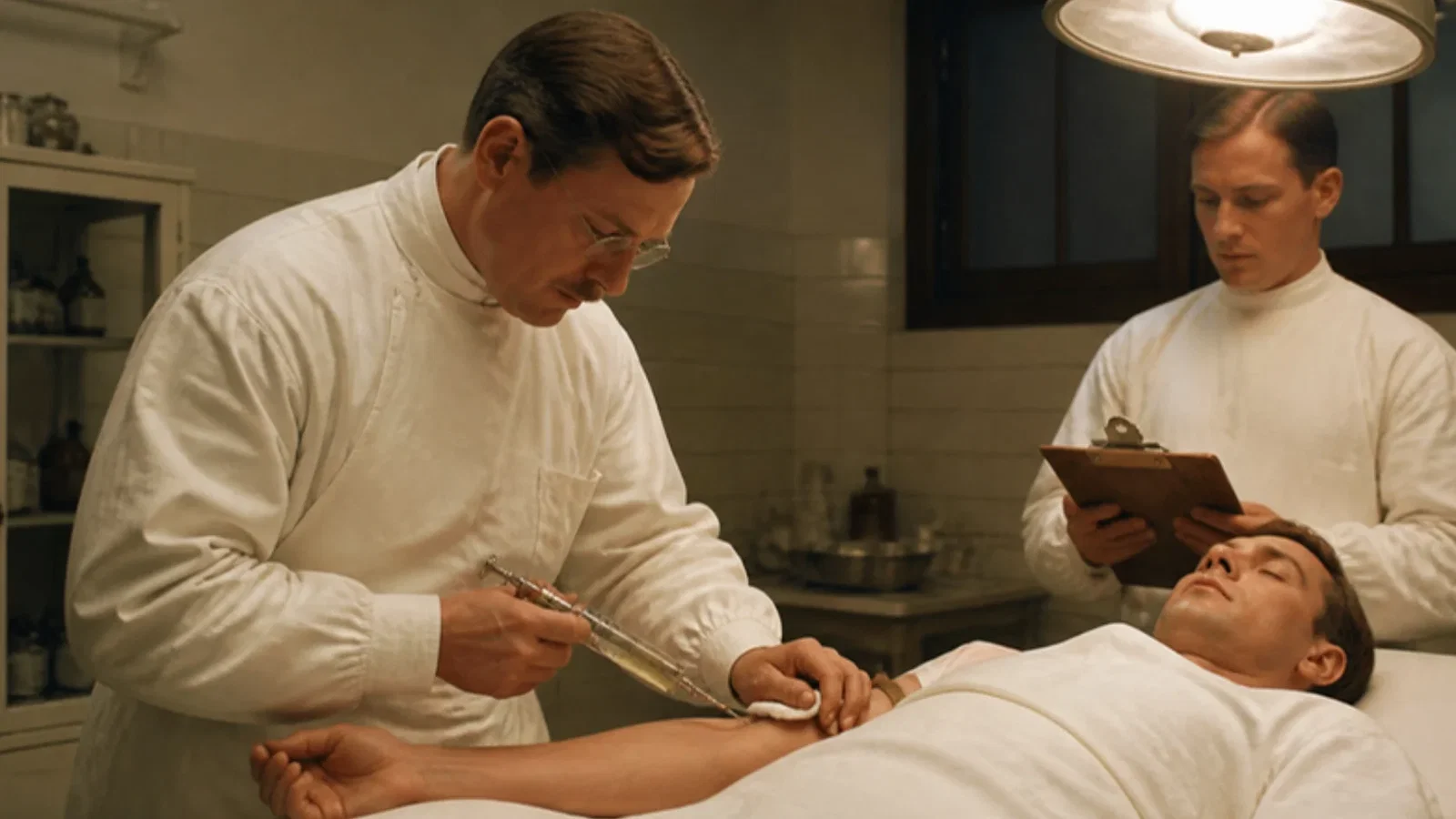
Pharmacologists and anaesthetists in Wisconsin take a short-acting intravenous barbiturate from Abbott from rats, rabbits and dogs to patients.
Reading Library · Anesthesia Epochs · 中文版
Watch the education video (for clinicians)
1934: Thiopental at Wisconsin — Drug No. 8064 · Anesthesia Epochs Education Series
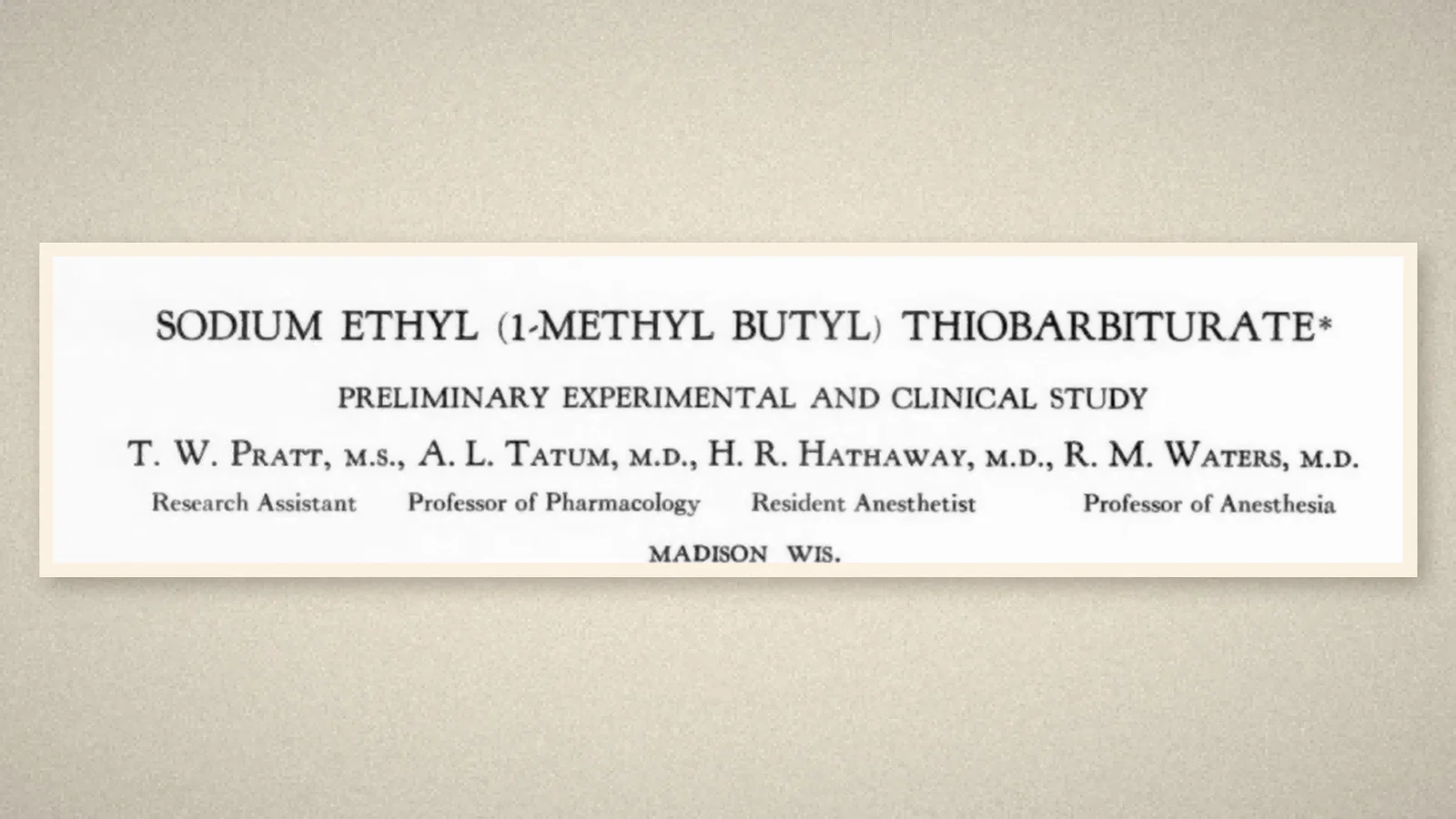
For half a century the standard intravenous induction agent was a thiobarbiturate, sodium thiopental. A short report in the American Journal of Surgery of March 1936 describes the compound's first clinical series at the University of Wisconsin. Its authors were T. W. Pratt, research assistant, A. L. Tatum, professor of pharmacology, H. R. Hathaway, resident anaesthetist, and R. M. Waters, professor of anaesthesia, from "the Departments of Pharmacology and Anesthesia of the University of Wisconsin". [1, p. 464] They never called the drug thiopental. They called it by its laboratory number.
Why another barbiturate
The authors began with a need. Interest in short-acting barbiturates was "partly due to the need of an intravenous anesthetic for minor surgery where block or inhalation anesthesia is inconvenient or contraindicated". But some basal anaesthetics had been misused by injecting them as complete anaesthetics, and "the relatively slow removal of such hypnotics from the blood, when compared to anesthetics of minute-to-minute controllability, properly limits their usefulness in surgery". [1, p. 464] They tested a series of new barbiturates and thiobarbiturates and chose the most promising intravenous agent: "the sodium salt of ethyl (1-methyl butyl) thiobarbituric acid", for brevity "#8064", a compound "submitted to us by the Abbott Laboratories". [1, p. 464]
Rats, rabbits and dogs
Part I was pharmacology. In rabbits given 8064 intravenously the minimal lethal dose was 35 mg per kg, and death "appears to be due to respiratory failure", the heart beating strongly for about two minutes after breathing stopped. Morphine given an hour beforehand lowered the lethal dose from 35 to 20 mg per kg. [1, p. 464–465] In dogs, 15 mg per kg produced five minutes of surgical anaesthesia with "extreme relaxation of skeletal muscles", and 20 mg per kg, "60 per cent of the fatal dose", about ten minutes; "due to the rapid detoxication of #8064, recovery is soon evidenced". [1, p. 465]
Forty-five patients
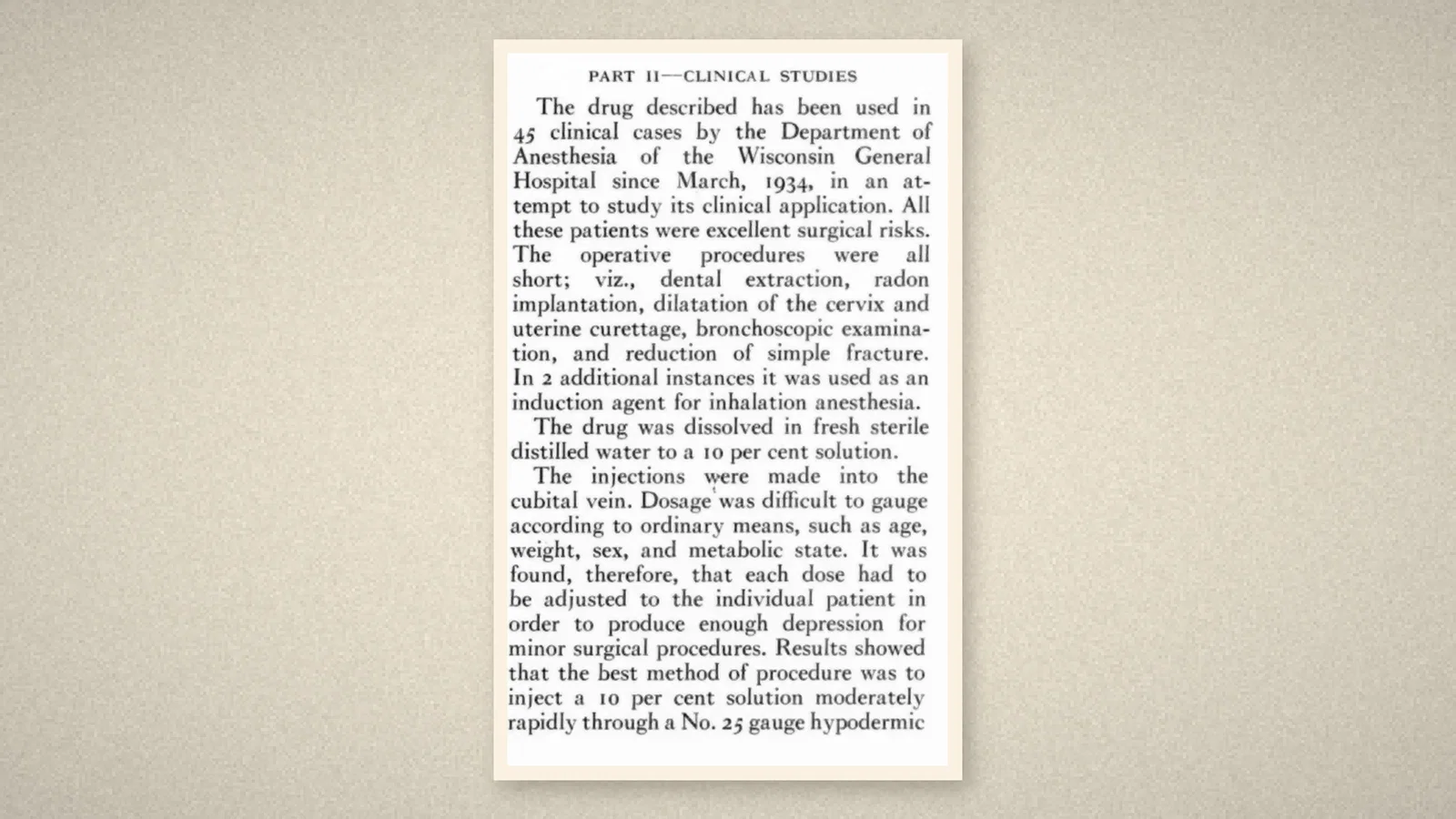
Part II was the clinic. "The drug described has been used in 45 clinical cases by the Department of Anesthesia of the Wisconsin General Hospital since March, 1934." All the patients were "excellent surgical risks", and the operations short: "dental extraction, radon implantation, dilatation of the cervix and uterine curettage, bronchoscopic examination, and reduction of simple fracture". [1, p. 465] A fresh 10 per cent solution was injected into the cubital vein. Dosage could not be predicted from age, weight or sex; "each dose had to be adjusted to the individual patient". The best method was to inject about 1 c.c. every five to ten seconds through a No. 25 needle "until 'the jaw drops'", then 0.5 to 2 c.c. more. [1, p. 465–466]
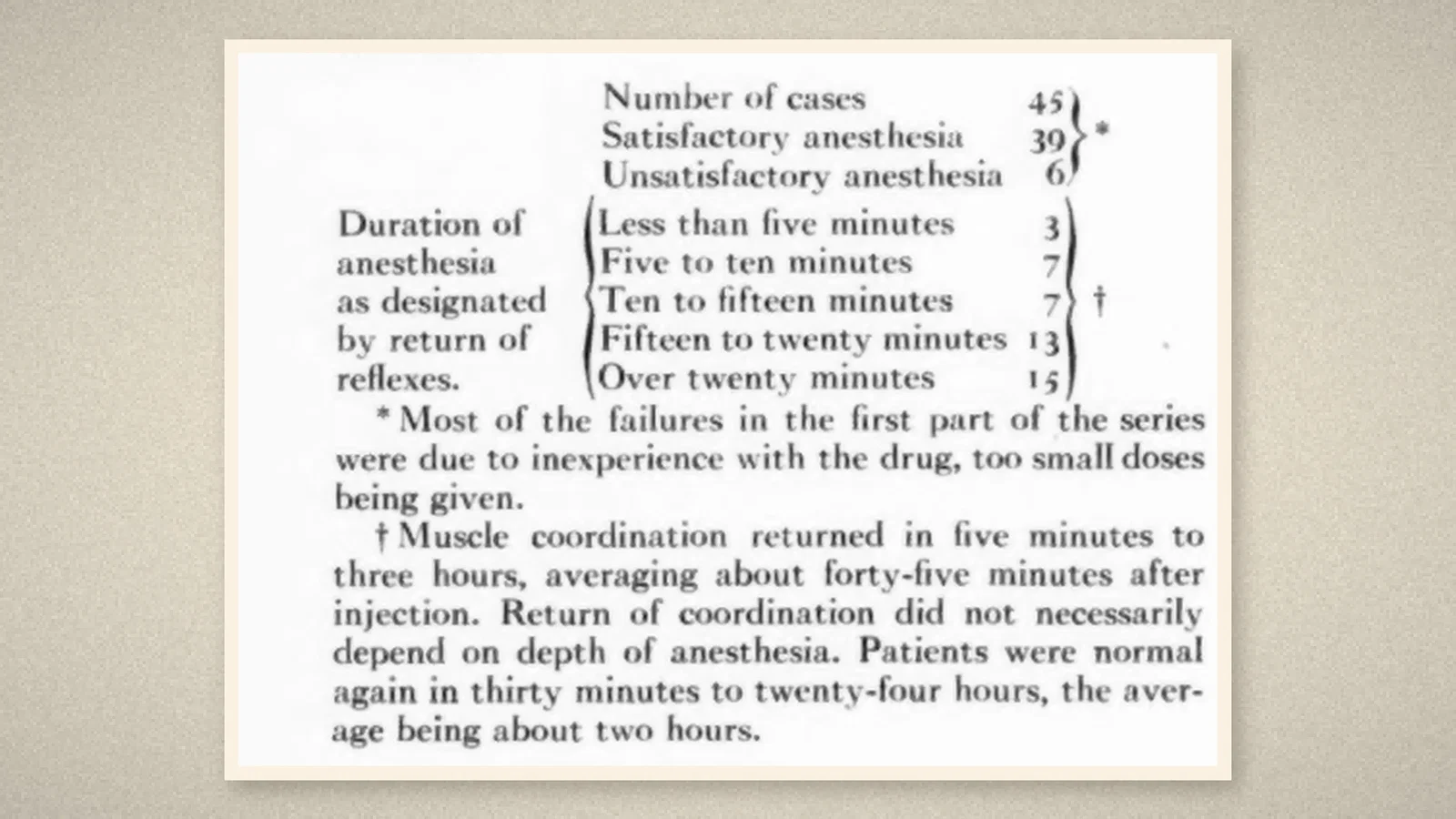
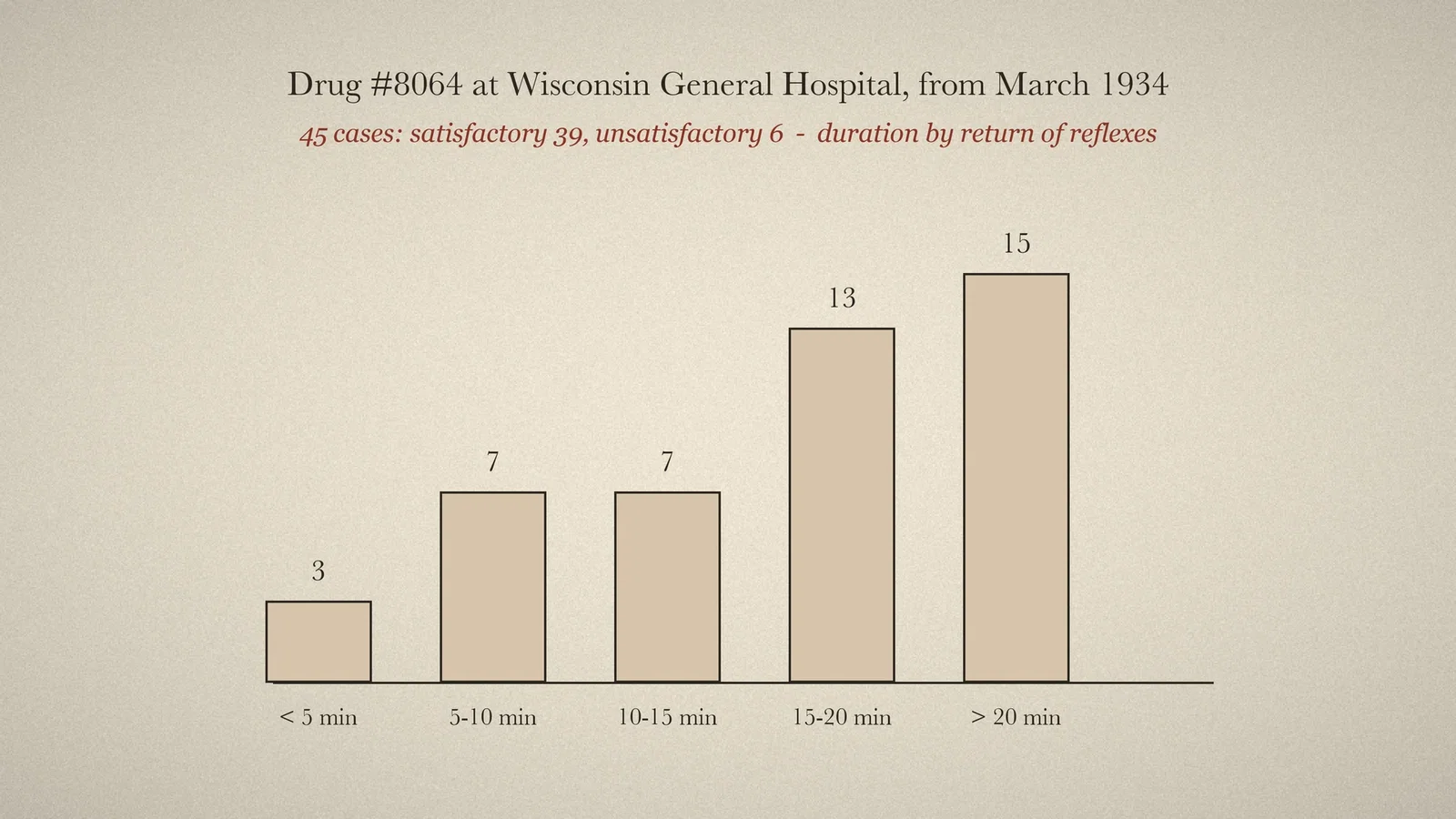
Of 45 cases, 39 gave satisfactory anaesthesia; most early failures were "due to inexperience with the drug, too small doses being given". [1, p. 466] Onset was "gradual and pleasant, accompanied merely by an overpowering desire to sleep". "Respiratory depression occurred in all cases", from a slight fall in rate to occasional transient apnoea, but no effect on blood pressure or pulse was noticed. Hiccough in four patients "disappeared quickly with carbon dioxide inhalations"; a few had nausea, headache or emotional reactions. "No patients expressed active dislike for this type of anesthesia and several requested repetition for subsequent procedures." [1, p. 466]
Three cautions
The authors called it "merely a preliminary pharmacological and clinical study", and drew three conclusions. The drug "should be administered by a capable anesthetist who is equipped to cope with problems involving an oxygen and carbon dioxide imbalance". Being non-volatile, it "is not controllable, but as it is broken down so rapidly in the body it closely approaches the actions of a controllable anesthetic agent". And "it is essentially a hypnotic and not an analgesic drug". Further study, they wrote, was warranted. [1, p. 466]
What the record shows
In Madison a pharmacologist and an anaesthesia department tested a numbered compound together, from rabbits and dogs to forty-five patients having short operations. Their cautions still describe the drug and its relatives: respiratory depression in every case, a dose that has to be titrated to the patient, and no analgesia.
Sources and reading limits
Read: Pratt, Tatum, Hathaway and Waters, American Journal of Surgery, March 1936, pp. 464–466, in full with the results table.
Not covered: Dundee's "Fifty years of thiopentone" (1984) and the HAS timeline are not covered. The paper says only "since March, 1934"; it gives no exact day, makes no claim to a world-first human dose, and does not name the Abbott chemists. The paper calls the compound #8064 and "sodium ethyl (1-methyl butyl) thiobarbiturate"; "thiopental" is used in this article only as the compound's later name. The figure of 39 satisfactory cases was read from the page image.
Three illustrations are crops of the 1936 paper; one is a bar chart drawn from its table.
- Pratt TW, Tatum AL, Hathaway HR, Waters RM. Sodium ethyl (1-methyl butyl) thiobarbiturate: preliminary experimental and clinical study. Am J Surg. 1936;31(3):464-6. Internet Archive
Continue exploring
Related reading connects shared questions and contexts; it does not by itself establish historical influence.
- 1934: Lundy Uses and Observes Thiopental at the Mayo Clinic
- 1927: Ralph Waters Joins Wisconsin with a Three-Year Residency
- 1923: Waters Keeps the Anesthetic and Removes the Carbon Dioxide
Anesthesia Epochs · The Source Room · About & Editorial Method
Published November 2, 2026. Sources and reading limits are stated above. Illustrations are labelled as original source images or AI-made. Historical accounts are educational; they are not current treatment instructions.