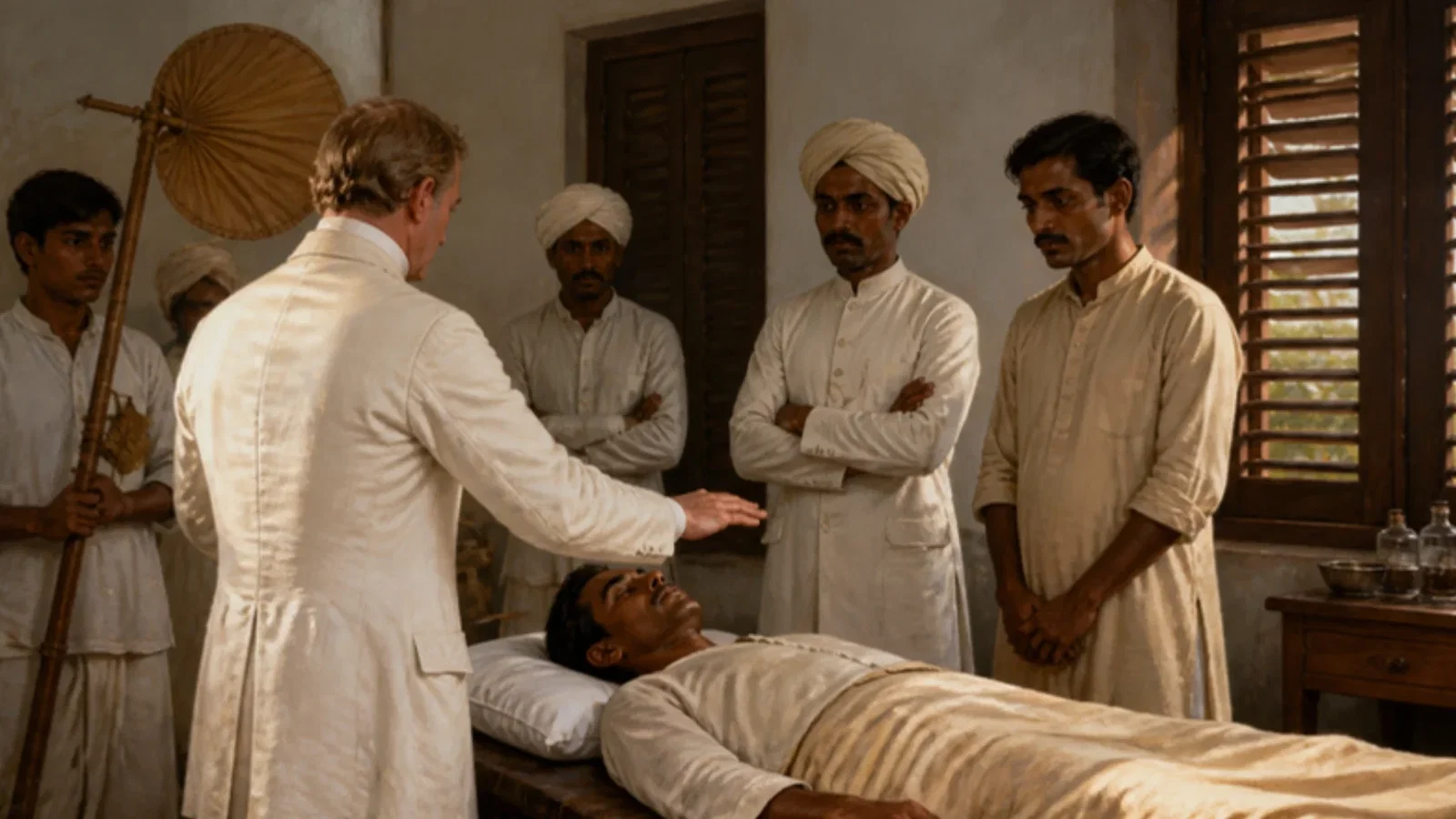
A Bengal civil surgeon tried mesmerism on a convict in pain and reported 73 'painless' operations within eight months; the claims rest on Esdaile's own 1846 book.
Reading Library · Anesthesia Epochs · 中文版
Watch the education video (for clinicians)
1845: Esdaile in Hooghly — Painless Surgery Under Mesmerism · Anesthesia Epochs Education Series
About two years before ether was first given in Calcutta, a surgeon in Bengal was claiming that dozens of patients had felt nothing under the knife. The claim was made in a book, Mesmerism in India, and its Practical Application in Surgery and Medicine, published in London in 1846 by "James Esdaile, M.D., Civil Assistant Surgeon, H.C.S. Bengal". [1] The book is the main record of what happened at Hooghly, and almost everything in it comes from Esdaile. This article reads it closely and sets it beside later assessments.
A book written in a hurry
Esdaile dedicated the book to a father, the Rev. James Esdaile, from Hooghly on 1 February 1846, the day before setting out to join the army on a journey of eleven hundred miles. The dedication speaks of "a new and powerful means of alleviating human suffering among the natives of Bengal". [1] The preface asks critics to examine the alleged facts, which are "the result of only eight months' mesmeric practice, in a country charity hospital". [1] An editor's preface by a brother, David Esdaile, writing from the manse of Rescobie in June 1846, adds polemic: it counts "no less than seventy-six" operations and quotes a London physician, Dr. Copland, as having told a medical society that "pain is a wise provision of nature". [1]
The first trial
The first experiment is told day by day. Madhab Kaura, a hog-dealer serving seven years for wounding a man, had a double hydrocele and was brought from the jail to the charity hospital. On 4 April 1845 the fluid was drawn off one side of the scrotum and two drachms of the usual injection put in. The patient threw back the head, pressed both hands to the groins and grimaced in pain. Esdaile asked the Indian sub-assistant surgeon whether mesmerism had ever been seen at work, heard that a trial at the medical college had failed, and remarked: "I have a great mind to try it on this man, but as I never saw it practised, and know it only from reading, I shall probably not succeed." [1]
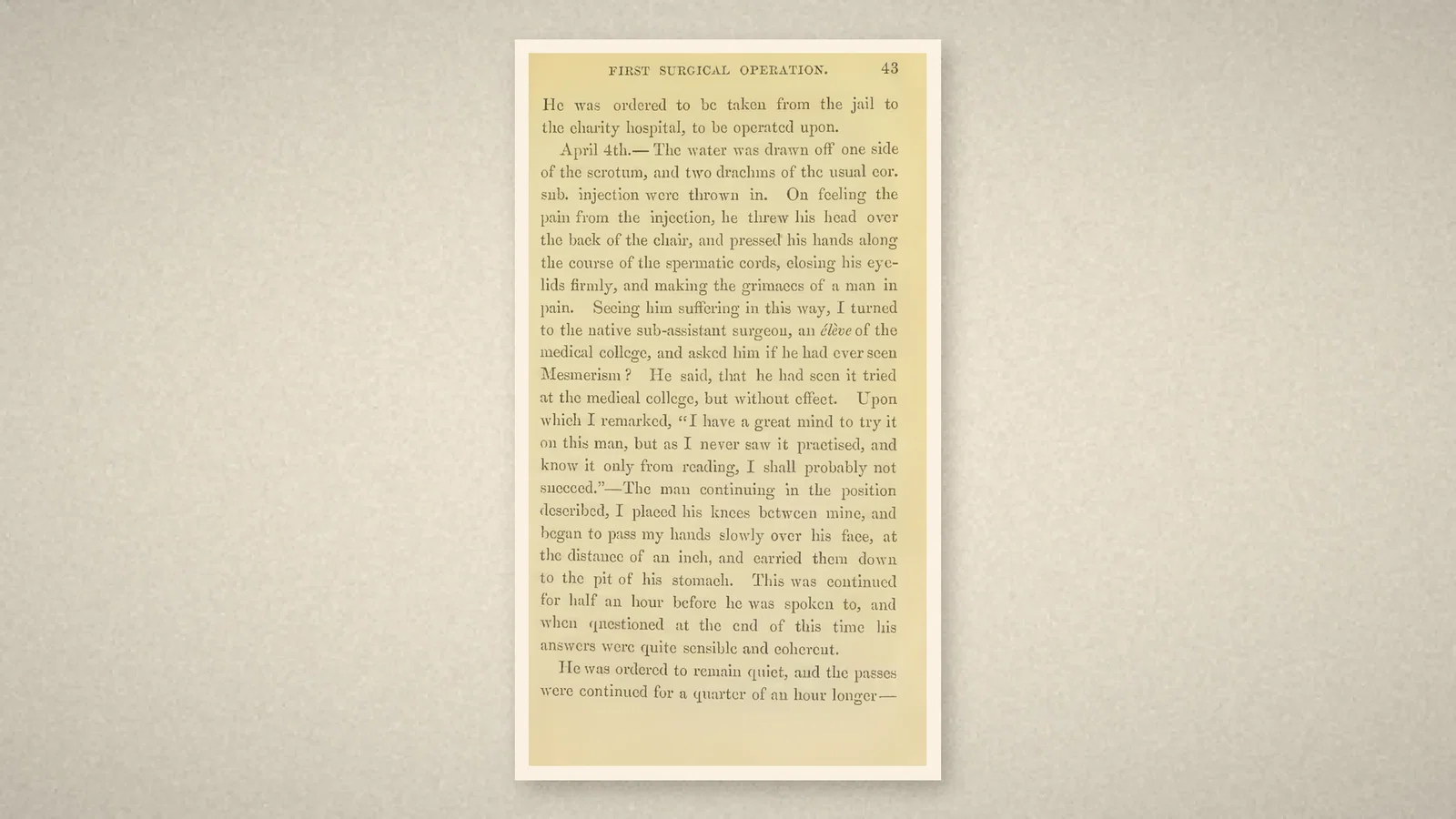
Esdaile made slow passes over the patient's face down to the stomach for half an hour, then a quarter of an hour more, with no effect, and in the heat declared the attempt a failure. While Esdaile rested, the grimacing eased and the patient said there was smoke in the room. Esdaile went on, and after about an hour the patient began to gape, said sleep was coming, gave confused answers and then ignored even a loud call by name. [1] A short statement signed by three witnesses, one of them the sub-assistant surgeon, is printed after the account. [1]
Two days later the injected side was hot and exquisitely tender. Esdaile tried "the Europe charm" again, the patient in bed; after three quarters of an hour Esdaile squeezed the inflamed part "with no more effect than if it had been a bladder", and invited a clergyman to try, in Esdaile's absence, to wake or hurt the patient by any non-mesmeric means. [1]
Seventy-three operations
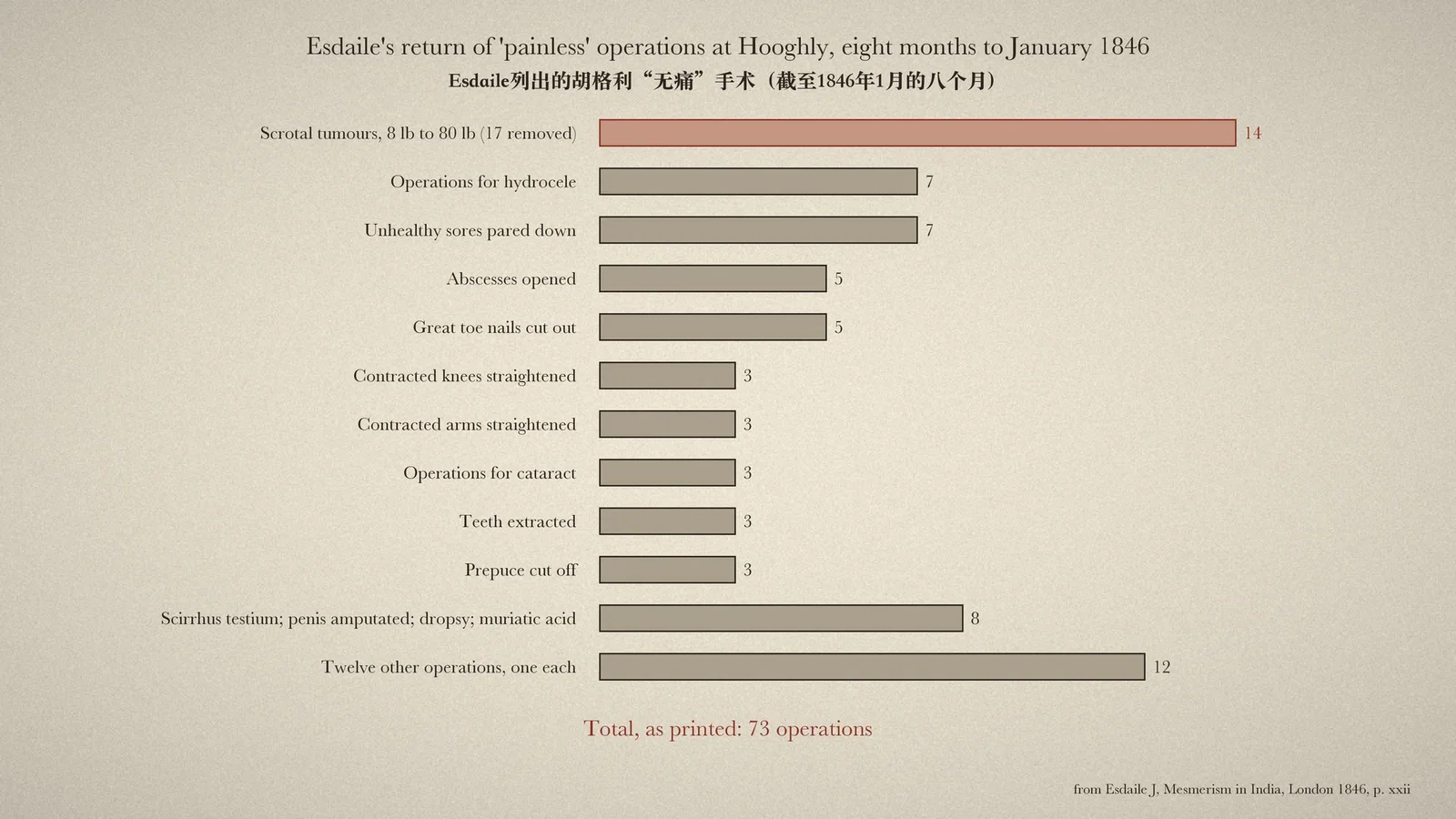
The book prints a "Return showing the Number of painless Surgical Operations performed at Hooghly, during the last eight months". It lists an arm amputation, a breast removal, a tumour from the upper jaw, cataract operations, teeth extractions, seven hydroceles, abscesses, ingrown toenails and, at the bottom, "Scrotal tumours, weighing from 8 lb. to 80 lb., removed 17, painless 14": in all, 73 operations. [1] In a letter to the editor of The Englishman, dated 22 January 1846, Esdaile concluded that painless surgical operations were the "natural birthright" of the natives of Bengal. [1]
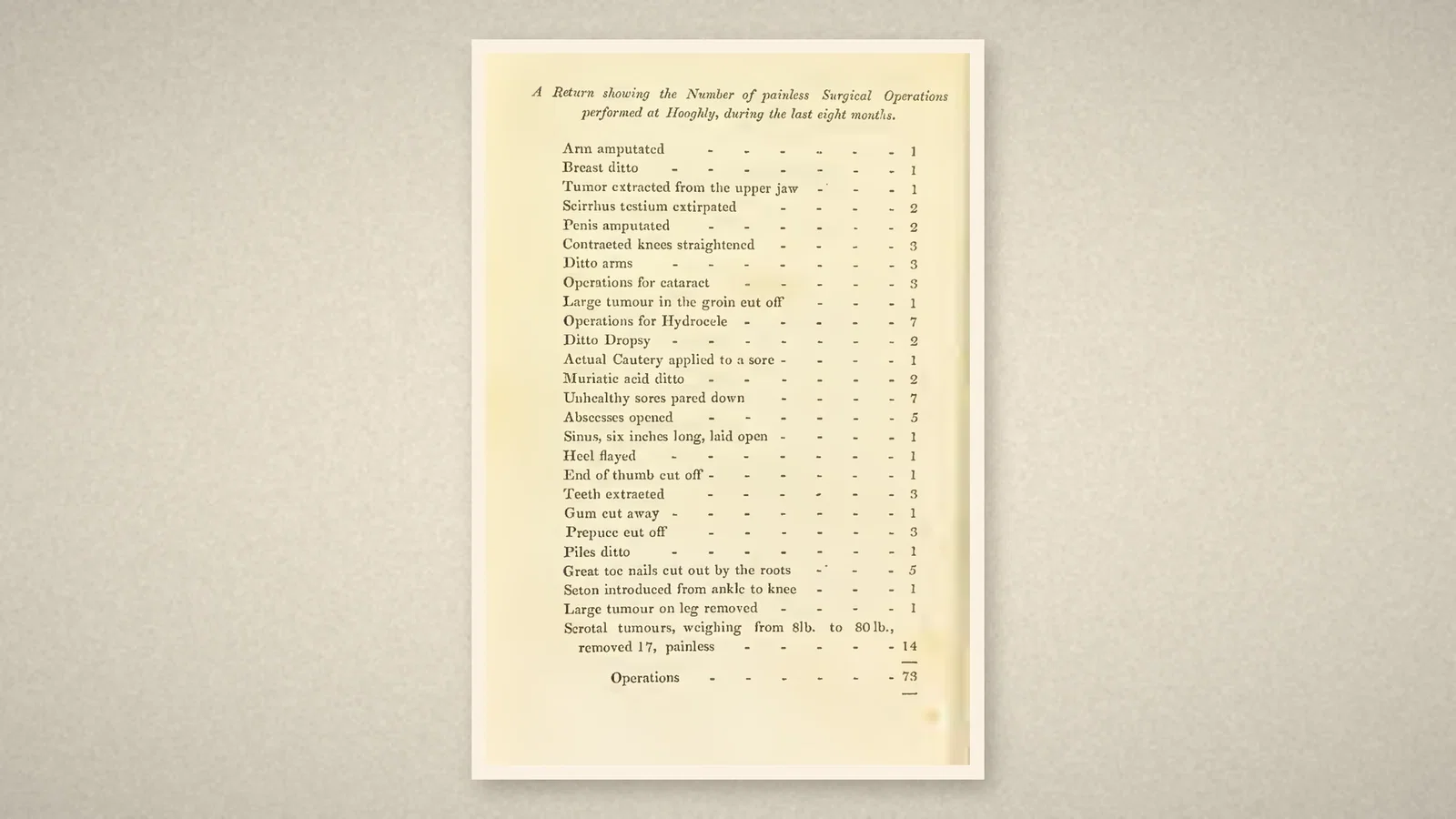
The numbers already show the limits of the record. The editor's preface says seventy-six operations; the return printed a few pages later totals 73. Three of the seventeen scrotal tumour removals were not counted as painless. [1] And every judgement of painlessness is Esdaile's, or that of witnesses Esdaile chose to print.
Later views
A 2024 article by K. Raj describes Esdaile (1808-59) as an Edinburgh-trained surgeon who practised conventional surgery in India for almost fifteen years before turning, in the last five years of service, to mesmeric anaesthesia, working with Indian practices and practitioners of trance induction; the experiments led to a special mesmeric hospital in Calcutta which, "although very successful", ceased to function, "apparently victim to new and cheaper chemical anaesthetics". [3] W. Ernst, in 1995, set the controversy around the Calcutta hospital and its critics in its Victorian context. [4] A 2025 WFSA history of anaesthesia in India dates Esdaile's mesmerism-assisted surgery at Hooghly to 1843 and the first ether in Calcutta to 1847. [2] Esdaile's own book places the first trial in April 1845.
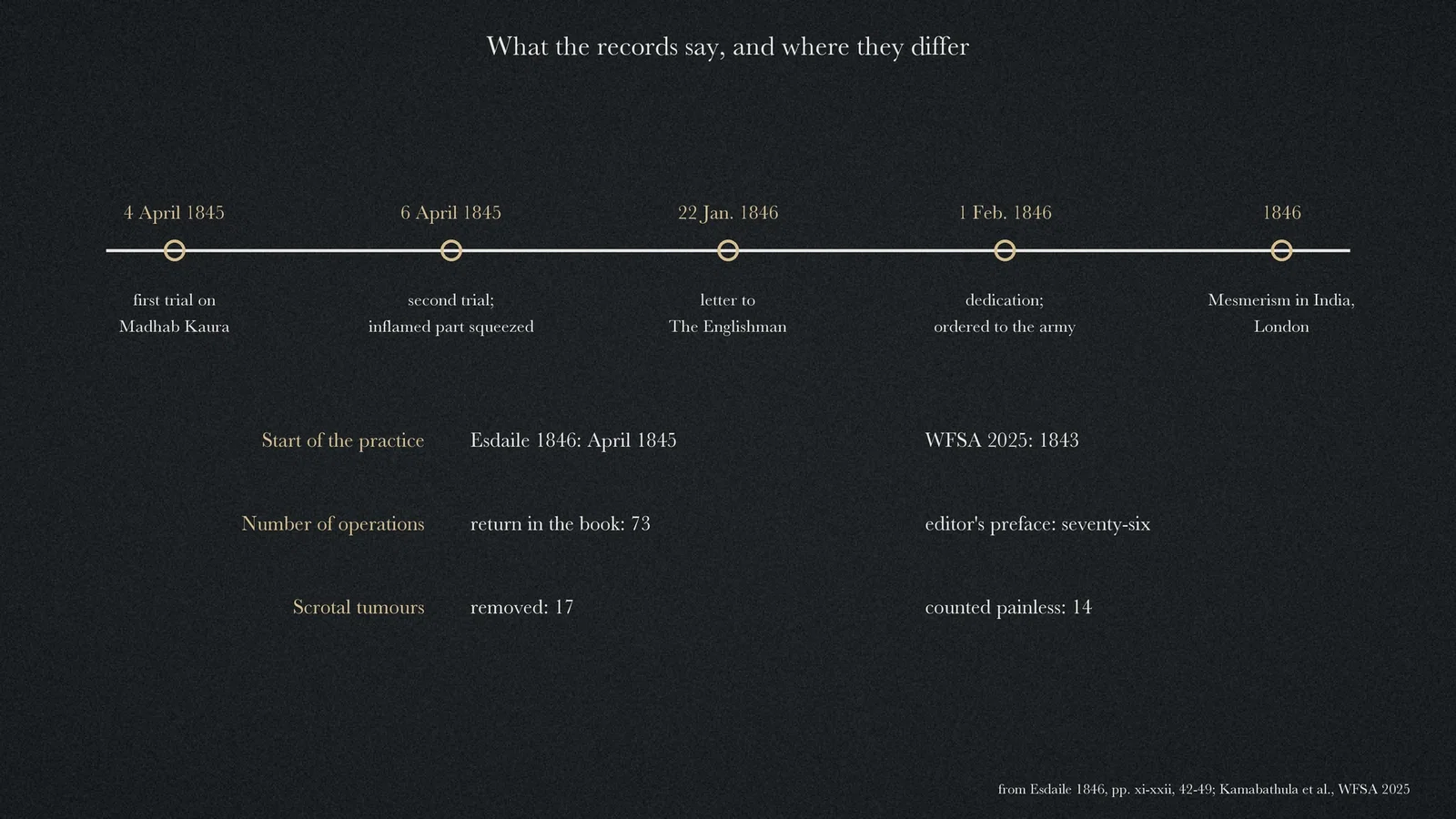
What the record shows
Esdaile's book is a genuine record of an attempt to abolish surgical pain before ether, made with care for detail: dates, hours, witnesses, a printed table. It is also an advocate's record, written by the practitioner and edited by a family member, with numbers that do not quite agree. Read that way, it belongs in the history of pain relief as a serious claim, carefully reported, that could not be independently confirmed from the pages read here.
Sources and reading limits
Read: the front matter, editor's preface, letter to The Englishman, return of operations and first experiments (pp. 42-50) of Esdaile's 1846 book; the WFSA article in full; the abstracts of Raj 2024 and Ernst 1995.
Not covered: the rest of Esdaile's cases; the reports of the Calcutta Mesmeric Hospital; the 1846 government committee report; the full texts of Raj and Ernst; any account by a patient. The patient's words reach us only through Esdaile. This article follows the book's date of April 1845 and reports the WFSA date of 1843 as a conflict.
Two illustrations are page images from the 1846 book; two are drawn from it.
- Esdaile J. Mesmerism in India, and its practical application in surgery and medicine. London: Longman, Brown, Green, and Longmans; 1846. Internet Archive
- Kamabathula S, Muppana BV, Bala Bhaskar S. The journey of anaesthesia in India. World Federation of Societies of Anaesthesiologists; 2025 (UIA40). PDF
- Raj K. When Scottish medicine hospitalized Indian magic: Dr James Esdaile's mesmeric surgery in mid-nineteenth-century Bengal. Br J Hist Sci. 2024;57(3):325-47. DOI
- Ernst W. 'Under the influence' in British India: James Esdaile's Mesmeric Hospital in Calcutta, and its critics. Psychol Med. 1995;25(6):1113-23. DOI
Continue exploring
Related reading connects shared questions and contexts; it does not by itself establish historical influence.
- 1836: Lafargue's Morphine Inoculation and Martin-Solon's Caution
- 1779: Mesmer's Animal Magnetism, from Fluid to Test
- 1829: Cloquet's Surgical Report, What Was Seen and What Followed
Anesthesia Epochs · The Source Room · About & Editorial Method
Published November 2, 2026. Sources and reading limits are stated above. Illustrations are labelled as original source images or AI-made. Historical accounts are educational; they are not current treatment instructions.