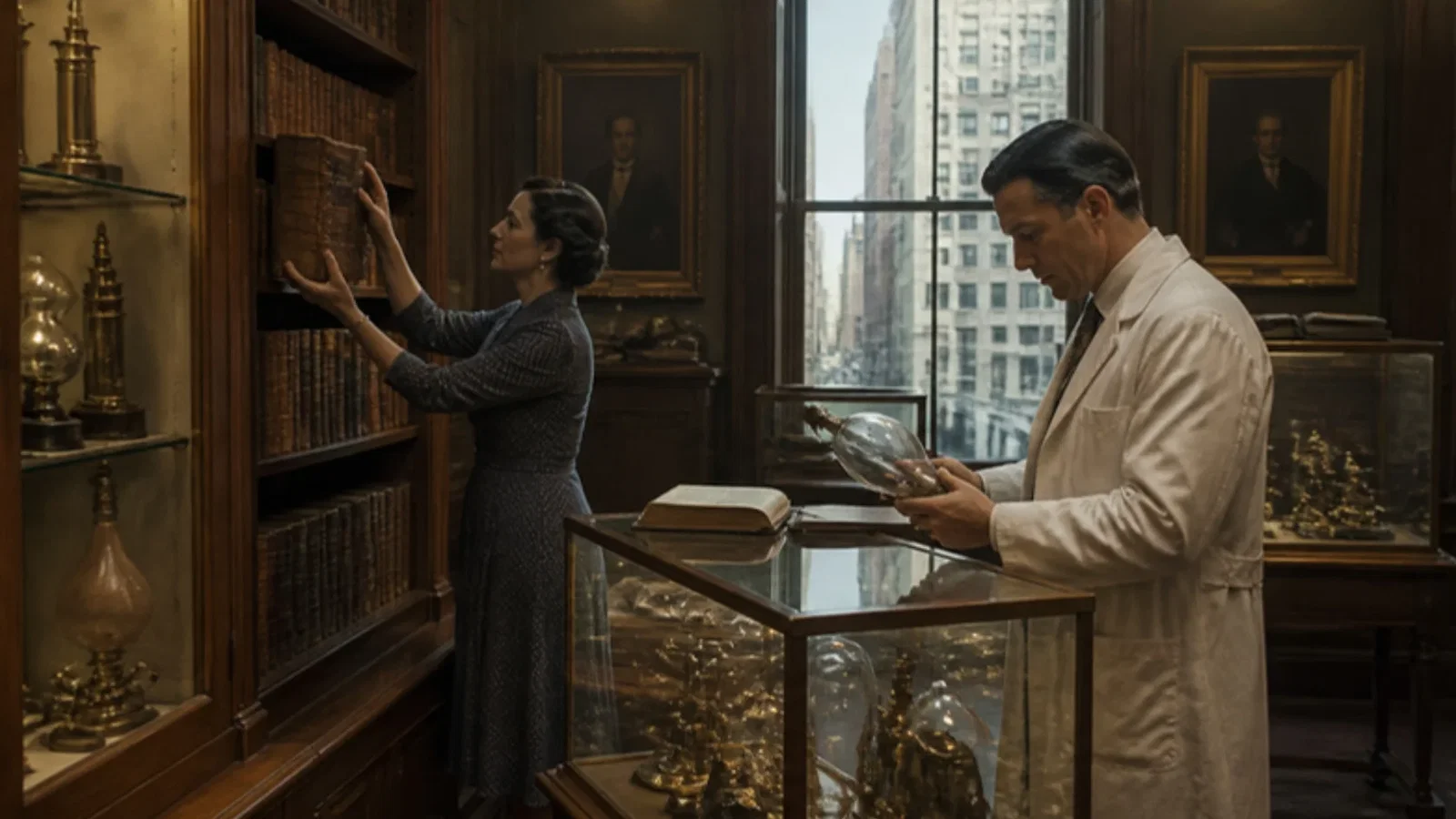
Room 1503, 745 Fifth Avenue: John Snow's desk copy, a Morton inhaler and twenty-nine cases.
Reading Library · Anesthesia Epochs · 中文版
Watch the education video (for clinicians)
1940: The ASA Library and Museum — John Snow's Desk Copy · Anesthesia Epochs Education Series
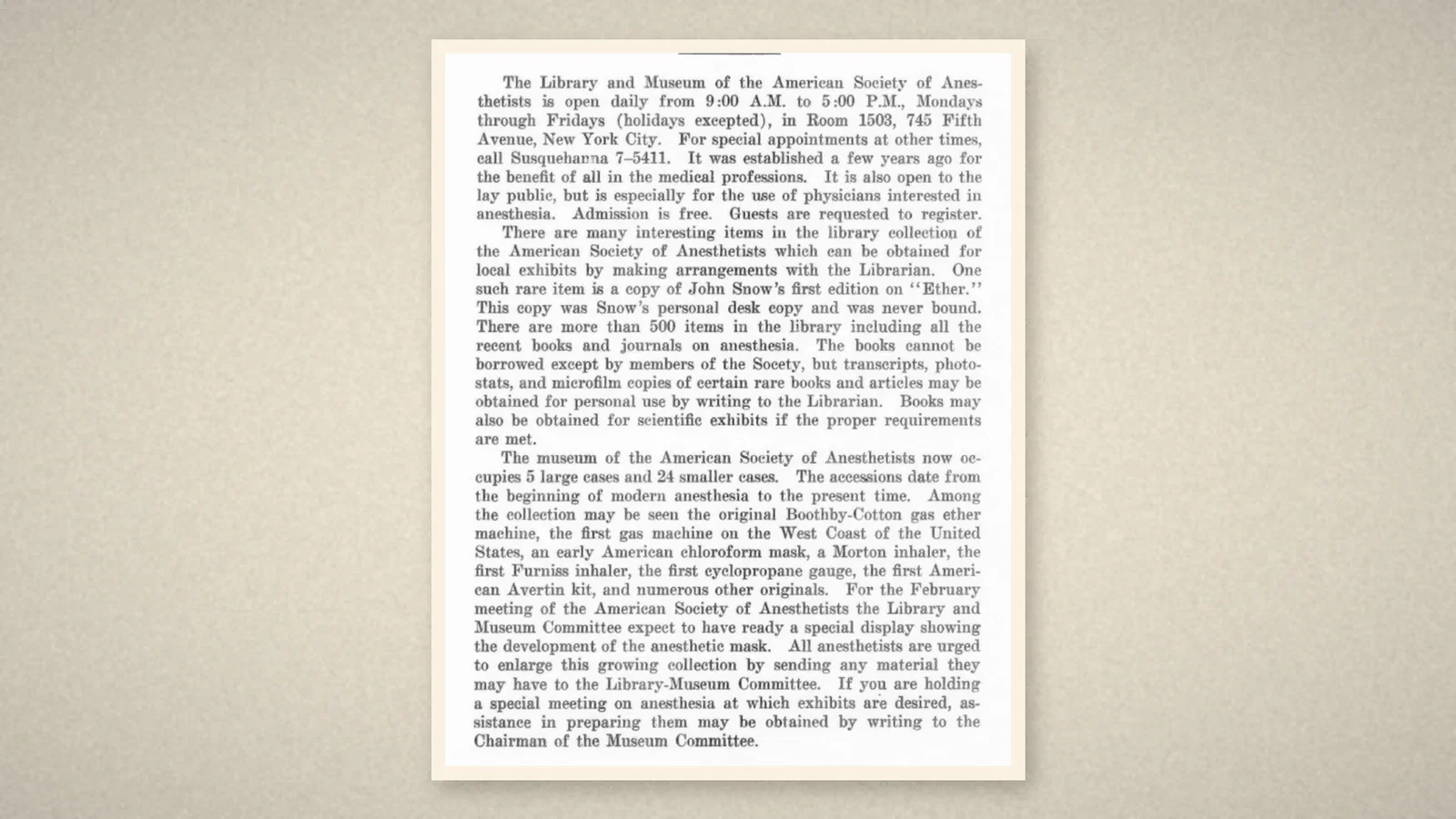
A specialty that wants to be taken seriously keeps its own history: its books, its instruments, the record of who did what first. In 1940 the American Society of Anesthetists had just launched its journal, Anesthesiology. In its second and third numbers the journal printed two short notices about something the Society already had: a library and a museum in a single room on Fifth Avenue.
A room on Fifth Avenue
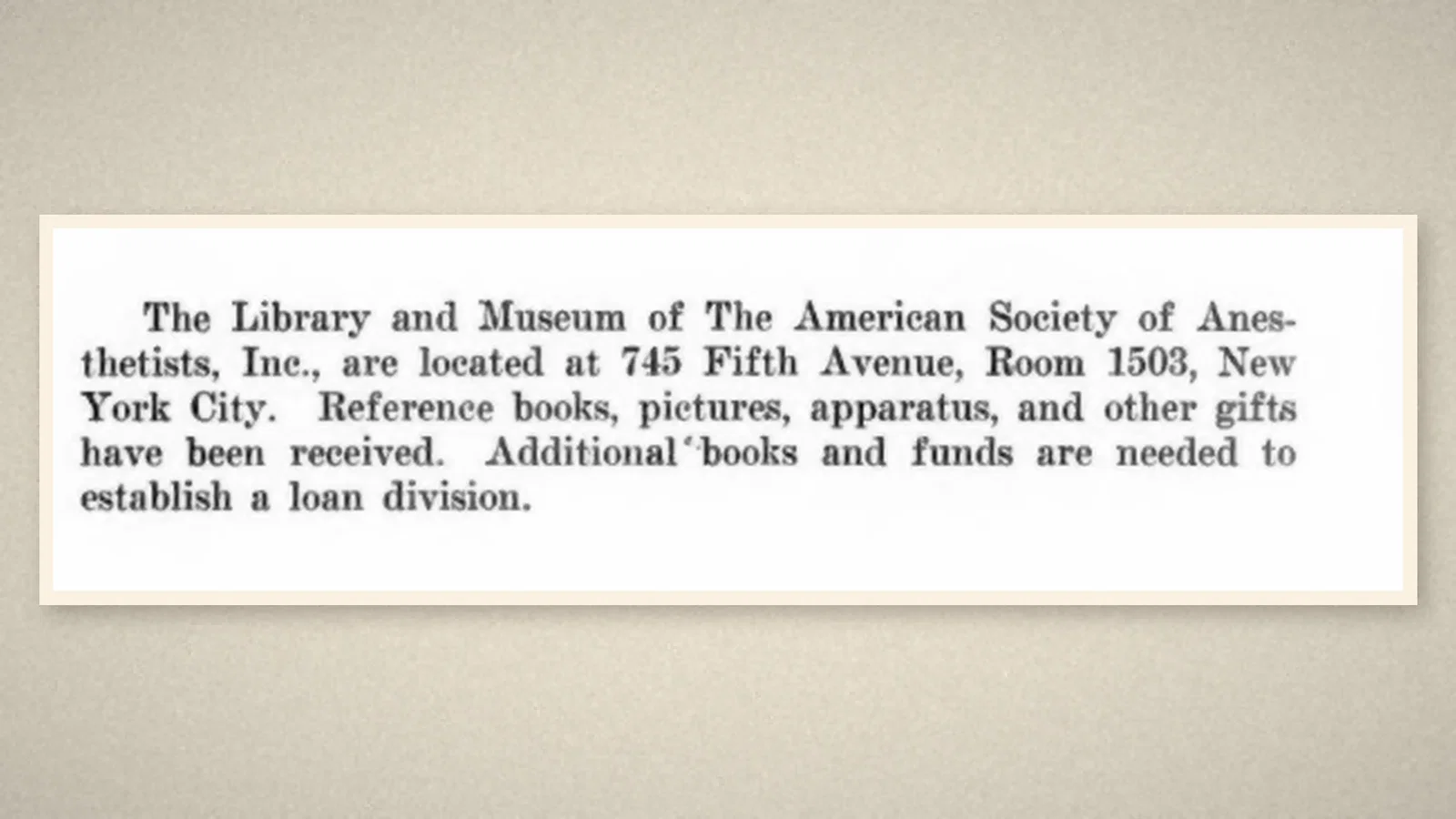
In September 1940 the first notice was brief. "The Library and Museum of The American Society of Anesthetists, Inc., are located at 745 Fifth Avenue, Room 1503, New York City. Reference books, pictures, apparatus, and other gifts have been received." What was lacking was money and more books: "Additional books and funds are needed to establish a loan division." [2, p. 226]
In November the journal gave a fuller description. The Library and Museum was "open daily from 9:00 A.M. to 5:00 P.M., Mondays through Fridays (holidays excepted), in Room 1503, 745 Fifth Avenue, New York City", with appointments at other times by telephone. "It was established a few years ago for the benefit of all in the medical professions. It is also open to the lay public, but is especially for the use of physicians interested in anesthesia. Admission is free. Guests are requested to register." [1, p. 299]
The library
Items from the library could be lent for local exhibits by arrangement with the Librarian. The notice singled out one: "a copy of John Snow's first edition on 'Ether.' This copy was Snow's personal desk copy and was never bound." [1, p. 299] Beyond such rarities, "there are more than 500 items in the library including all the recent books and journals on anesthesia". Only members of the Society could borrow books, but anyone could write for "transcripts, photostats, and microfilm copies of certain rare books and articles" for personal use. [1, p. 299] Even in 1940 the Society was thinking about access as much as possession, copying rare works so that they could travel when the originals could not.
The museum
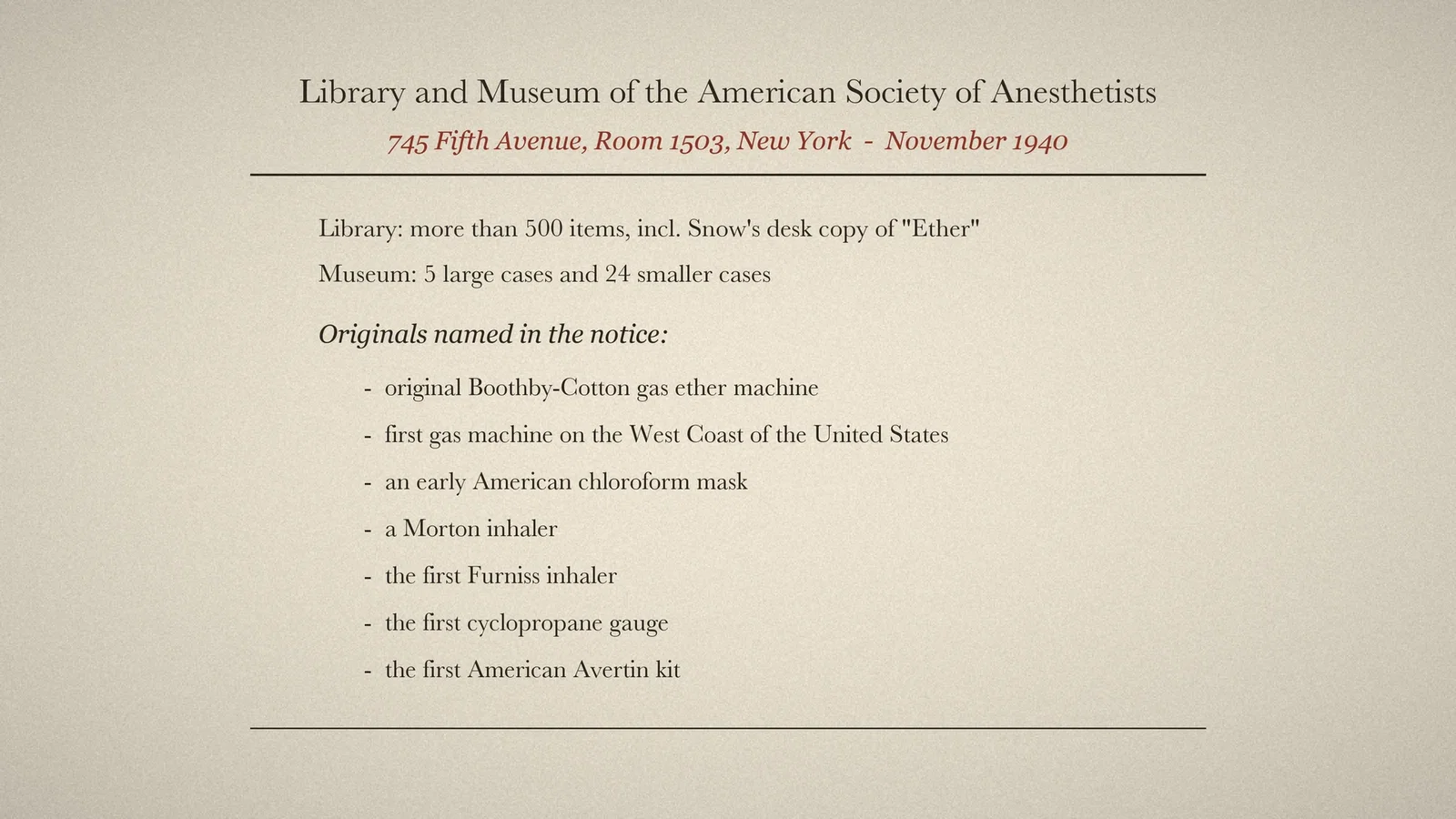
"The museum of the American Society of Anesthetists now occupies 5 large cases and 24 smaller cases. The accessions date from the beginning of modern anesthesia to the present time." The notice named some of its originals: "the original Boothby-Cotton gas ether machine, the first gas machine on the West Coast of the United States, an early American chloroform mask, a Morton inhaler, the first Furniss inhaler, the first cyclopropane gauge, the first American Avertin kit, and numerous other originals". [1, p. 299] The list runs from Morton's inhaler to the cyclopropane gauge and the avertin kit.
The collection was meant to be used and to grow. For the Society's February meeting the Library and Museum Committee planned "a special display showing the development of the anesthetic mask". "All anesthetists are urged to enlarge this growing collection by sending any material they may have to the Library-Museum Committee", and those holding meetings on anaesthesia could ask the Chairman of the Museum Committee for help with exhibits. [1, p. 299]
What the record shows
By 1940 American anaesthetists had a free, public library and museum of their own: a single room in Manhattan with more than five hundred items, John Snow's unbound desk copy, a Morton inhaler and twenty-nine cases of apparatus, offering microfilm copies by post and asking every member to send in what they had. The Society's new journal told its readers where to find it.
Sources and reading limits
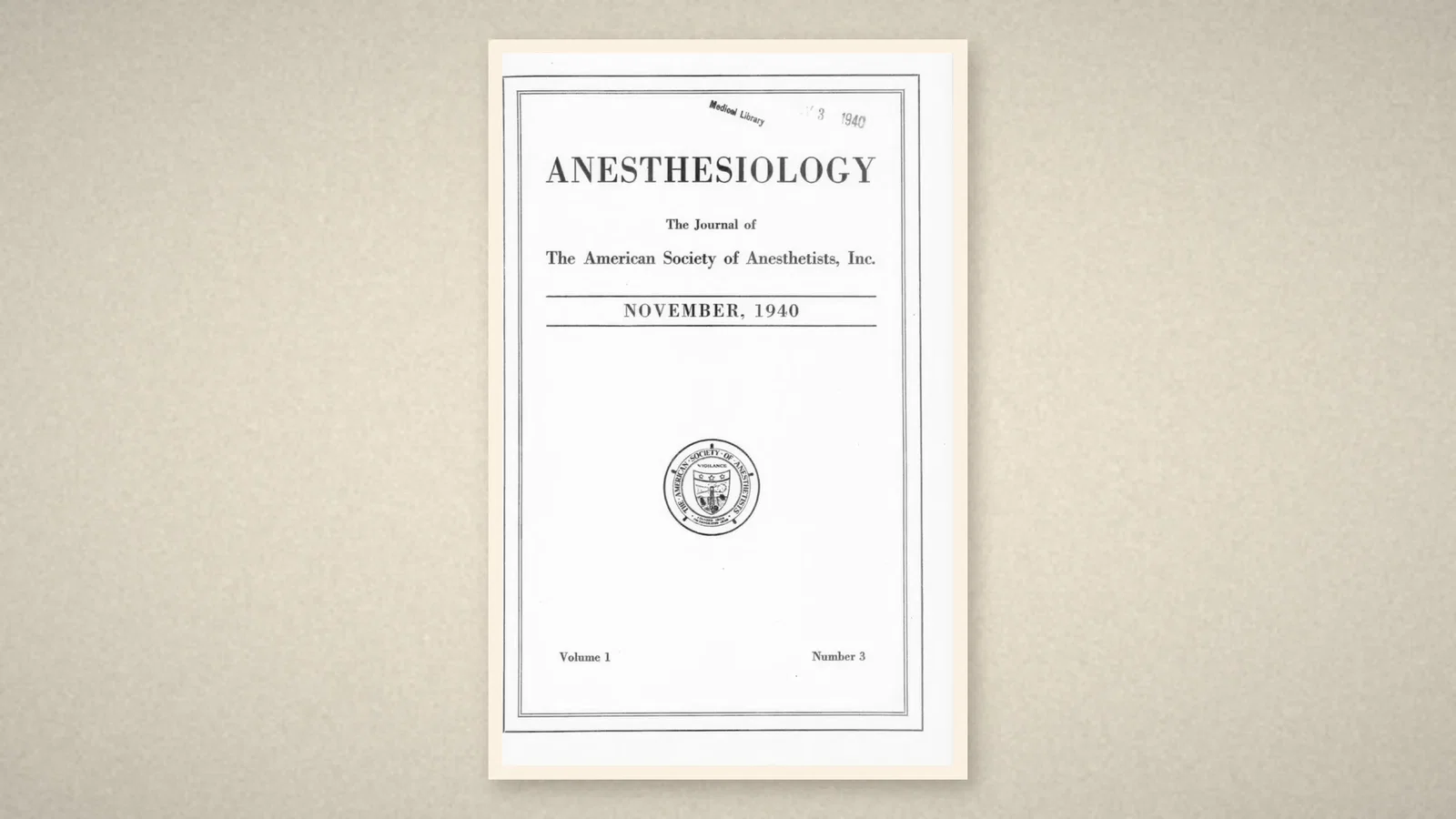
Read: Anesthesiology, September 1940, p. 226, and November 1940, p. 299, with the November cover.
Not covered: the minutes of the New York Society of Anesthetists for 1932–1933, the Regents' charter of 1950, the published histories of the Wood Library-Museum and the WLM and ASA timelines are not covered. The 1940 notices say only that the Library and Museum was "established a few years ago"; they do not name Paul M. Wood as its donor or give the year 1933. Wood's donation, numbers of treatises and instruments, the 1950 charter, the Park Ridge building of 1963 and the move of 2014 are therefore not described here, and this article does not itself identify the 1940 collection with today's Wood Library-Museum; that link rests on later histories that were not read here.
Three illustrations are crops of the 1940 journal; one is a typeset summary of the November notice, not a facsimile.
- The Library and Museum of the American Society of Anesthetists [notice]. Anesthesiology. 1940;1(3):299. Internet Archive
- The Library and Museum of the American Society of Anesthetists [notice]. Anesthesiology. 1940;1(2):226. Internet Archive
Continue exploring
Related reading connects shared questions and contexts; it does not by itself establish historical influence.
- 1983: Calmes Helps Bring Historians Together in the Anesthesia History Association
- 1941: The American Board of Anesthesiology Becomes a Separate Board
- 1935: Geoffrey Kaye Counts the Patients Who Died Under Anaesthesia
Anesthesia Epochs · The Source Room · About & Editorial Method
Published November 2, 2026. Sources and reading limits are stated above. Illustrations are labelled as original source images or AI-made. Historical accounts are educational; they are not current treatment instructions.