The grading dispute in the BMJ Supplement, 1949: a motion, two letters and the Department of Health for Scotland's count.
Reading Library · Anesthesia Epochs · 中文版
Watch the education video (for clinicians)
1949: Scotland's Anaesthetists — Consultants and S.H.M.O.s · Anesthesia Epochs Education Series
When hospital specialists entered the National Health Service, each had to be graded: consultant, or senior hospital medical officer (S.H.M.O.). For anaesthetists the grading was a test of where the specialty stood. In the second half of 1949 the British Medical Journal Supplement recorded the argument as it happened: a motion at the BMA's annual meeting, letters from aggrieved doctors, and, at the end of the year, the first count from Scotland. All three come from the same volume of the Supplement. [1; 2; 3]
"No appropriate grading at all"
At the Annual Representative Meeting reported on 2 July 1949, Dr F. M. Rose of Preston moved a motion deprecating the arbitrary action of the regional hospital boards in assessing the status of hospital medical staffs. Nothing had caused greater disquiet, Rose said, than the method that had created so many anomalies, "particularly in the case of general-practitioner specialists and in some of the categories like anaesthetists, who had received no appropriate grading at all". [1, p. 18] P. A. McCallum of Torquay said that many were alarmed at the idea of becoming senior hospital medical officers "and remaining as such, possibly for the rest of their lives"; it was an indignity and could mean a loss of £1,000 a year or more. The motion, amended to assure the Central Consultants and Specialists Committee of support should it advise members to refuse to sign contracts, was carried. [1, p. 18]
Two letters, two complaints
On 17 September the Supplement printed letters on grading side by side. J. C. Prestwich of Southsea called the S.H.M.O. grade "divide and rule". In that town two general surgeons of about forty, both over twelve years qualified, had been graded S.H.M.O., while "an anaesthetist, only six years qualified, is graded as a consultant (good luck to him)". Prestwich asked whether the grading committees had been told that a certain proportion of consultants "must be downgraded". [2, p. 138]
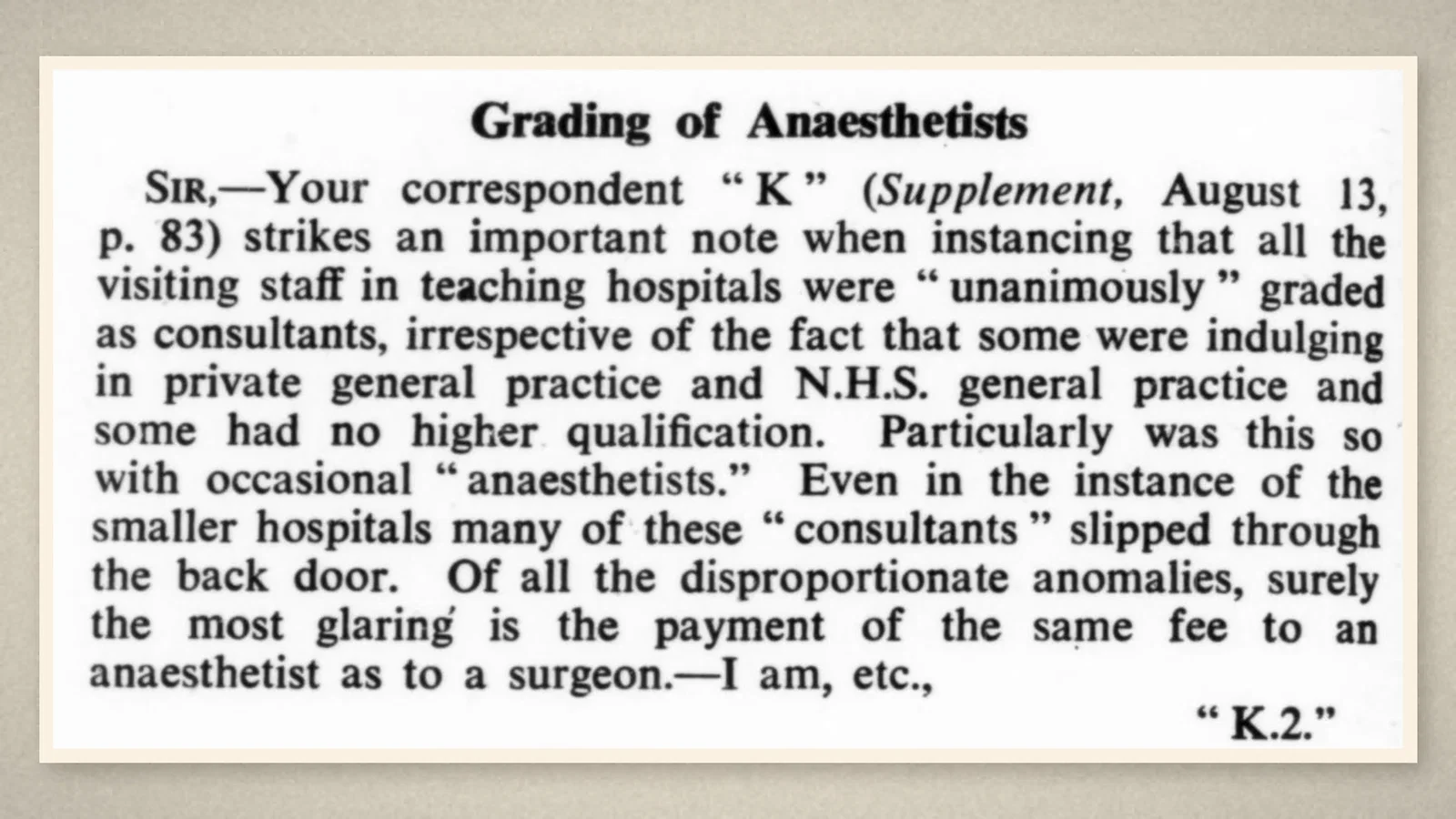
In the same column a correspondent signing "K.2." complained of the opposite. In teaching hospitals all the visiting staff had been graded consultants unanimously, even though some were in general practice and some had no higher qualification; "Particularly was this so with occasional 'anaesthetists'". And "of all the disproportionate anomalies, surely the most glaring is the payment of the same fee to an anaesthetist as to a surgeon". [2, p. 138] One letter used an anaesthetist as the example of a grade too high, the other complained that an anaesthetist was paid like a surgeon. Neither gave figures.
The count from Scotland
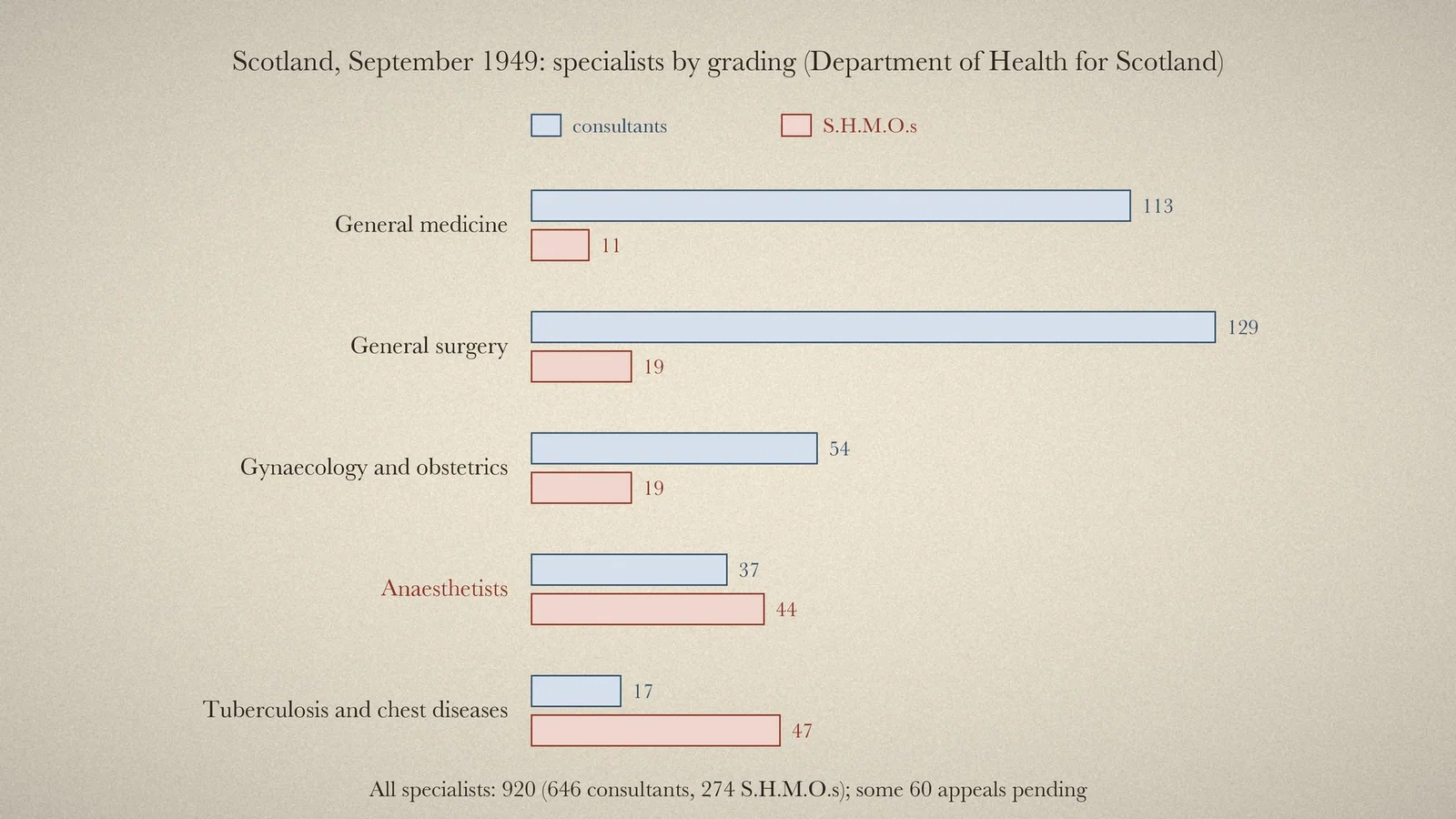
The figures came on 24 December, in a memorandum issued by the Department of Health for Scotland. Its tables were built on returns from the five Scottish regional hospital boards in September 1949, covering every specialist then in contract with them, both consultants and S.H.M.O.s. Year of birth, grading, specialty, hospital group and type of contract were recorded for each, transferred to punched cards and analysed. [3, p. 268] The total was 920 specialists: 646 consultants and 274 S.H.M.O.s. Some 60 appeals against grading were still pending. [3, p. 268]
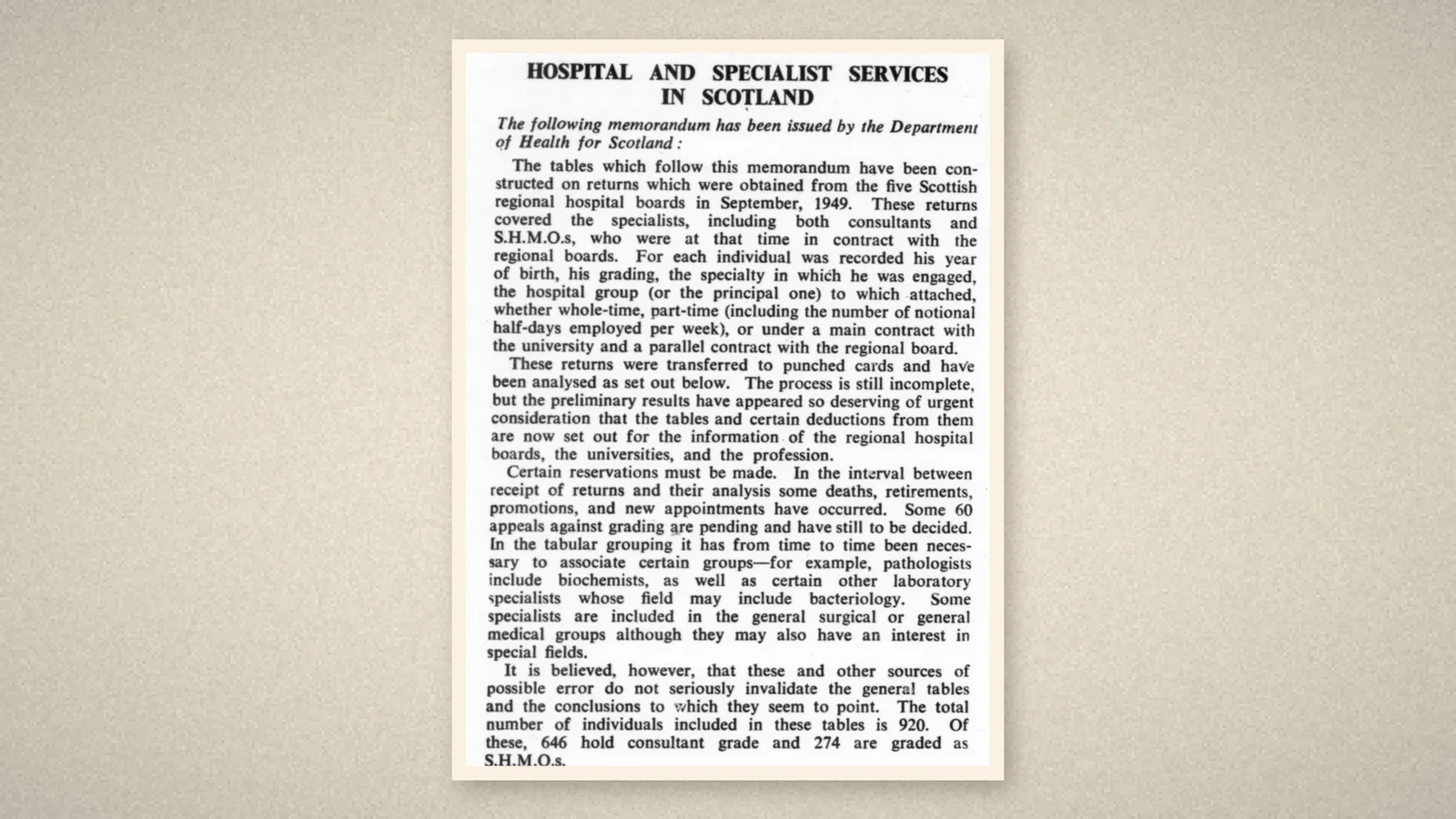
Table V gave the anaesthetists: 81 in all, 37 consultants and 44 S.H.M.O.s. [3, p. 269] In general medicine the figures were 113 consultants and 11 S.H.M.O.s; in general surgery, 129 and 19; in gynaecology and obstetrics, 54 and 19. Only tuberculosis and chest diseases (17 and 47) and infectious diseases (4 and 5) had, like anaesthesia, more S.H.M.O.s than consultants. [3, p. 269] Among the anaesthetists the S.H.M.O.s were concentrated among the younger specialists: of those born in 1910–1914, 6 were consultants and 10 S.H.M.O.s; of those born in 1915–1919, 2 and 10; the two born in 1920 or later were both S.H.M.O.s. [3, p. 269]
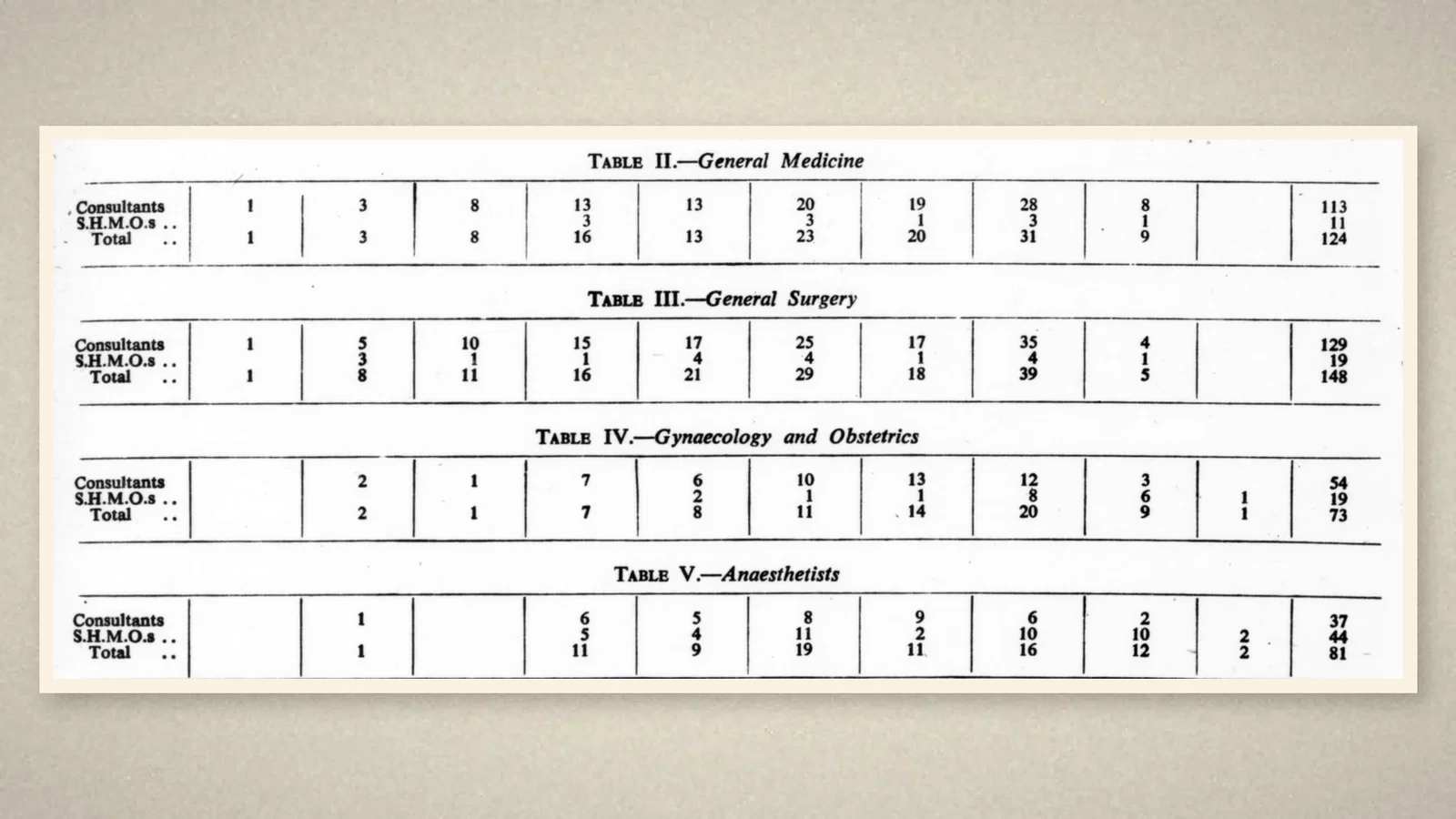
The memorandum itself does not comment on anaesthesia. Its concern was the future: it estimated that about 30 specialist posts would fall vacant each year in Scotland, so that an output of not more than 30 trained registrars a year would fill them, and it questioned whether the numbers in training were justified by their prospects. [3, p. 268–269]
What the record shows
In the summer of 1949 a BMA speaker could say that anaesthetists had received no appropriate grading at all, and letter writers argued in both directions. By December one region of the new service had counted: in Scotland, anaesthetists were the only one of the large specialties in which S.H.M.O.s outnumbered consultants. The table does not say why, and appeals were still pending. It records where the specialty stood at the start of the National Health Service.
Sources and reading limits
Read: the British Medical Journal Supplement for 1949 (volume 2), the report of the Annual Representative Meeting (2 July, p. 18), the correspondence of 17 September (p. 138) and the Department of Health for Scotland memorandum and tables (24 December, pp. 268–269).
Not covered: the Spens Committee's report on the remuneration of consultants and specialists, the grading committees' records, the outcome of the 60 appeals, and comparable figures for England and Wales were not read. The letter from "K" of 13 August, to which "K.2." replied, was not read. The memorandum gives numbers only; the reasons for the anaesthetists' grading are not stated in it and are not supplied here. Nothing in what was read describes how S.H.M.O.s were paid in figures, so no salary is given.
Three illustrations are crops of the 1949 pages; one is drawn from Tables II–V and VIII.
- Annual Representative Meeting: The senior hospital medical officer. Br Med J Suppl. 1949 Jul 2;2:18. Internet Archive
- Prestwich JC. Grading of hospital staff; "K.2." Grading of anaesthetists [correspondence]. Br Med J Suppl. 1949 Sep 17;2:138. Internet Archive
- Department of Health for Scotland. Hospital and specialist services in Scotland. Br Med J Suppl. 1949 Dec 24;2:268–269. Internet Archive
Continue exploring
Related reading connects shared questions and contexts; it does not by itself establish historical influence.
- 1946: The First Number of Anaesthesia
- 1935: London Holds the Diploma in Anaesthetics Examination
- 1948: The RCS Faculty of Anaesthetists Holds Its Opening Meeting
Anesthesia Epochs · The Source Room · About & Editorial Method
Published November 2, 2026. Sources and reading limits are stated above. Illustrations are labelled as original source images or AI-made. Historical accounts are educational; they are not current treatment instructions.