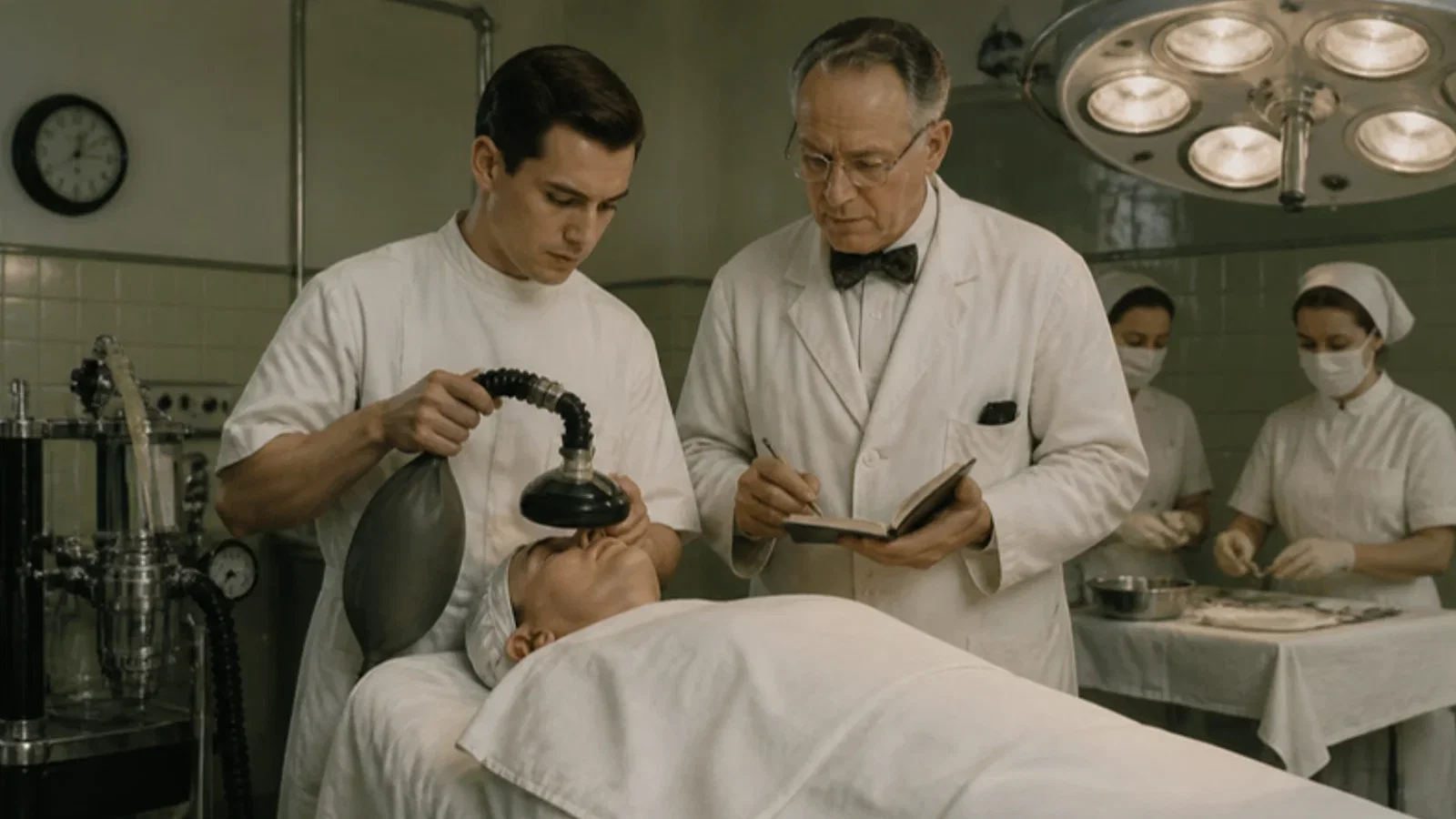
From a society motion in 1955 to a Medical Council rule: the South African Medical Journal's reports of 1958 and C. S. Jones's survey of 1959.
Reading Library · Anesthesia Epochs · 中文版
Watch the education video (for clinicians)
1959: South Africa's Interns — Fifty Supervised Anaesthetics · Anesthesia Epochs Education Series
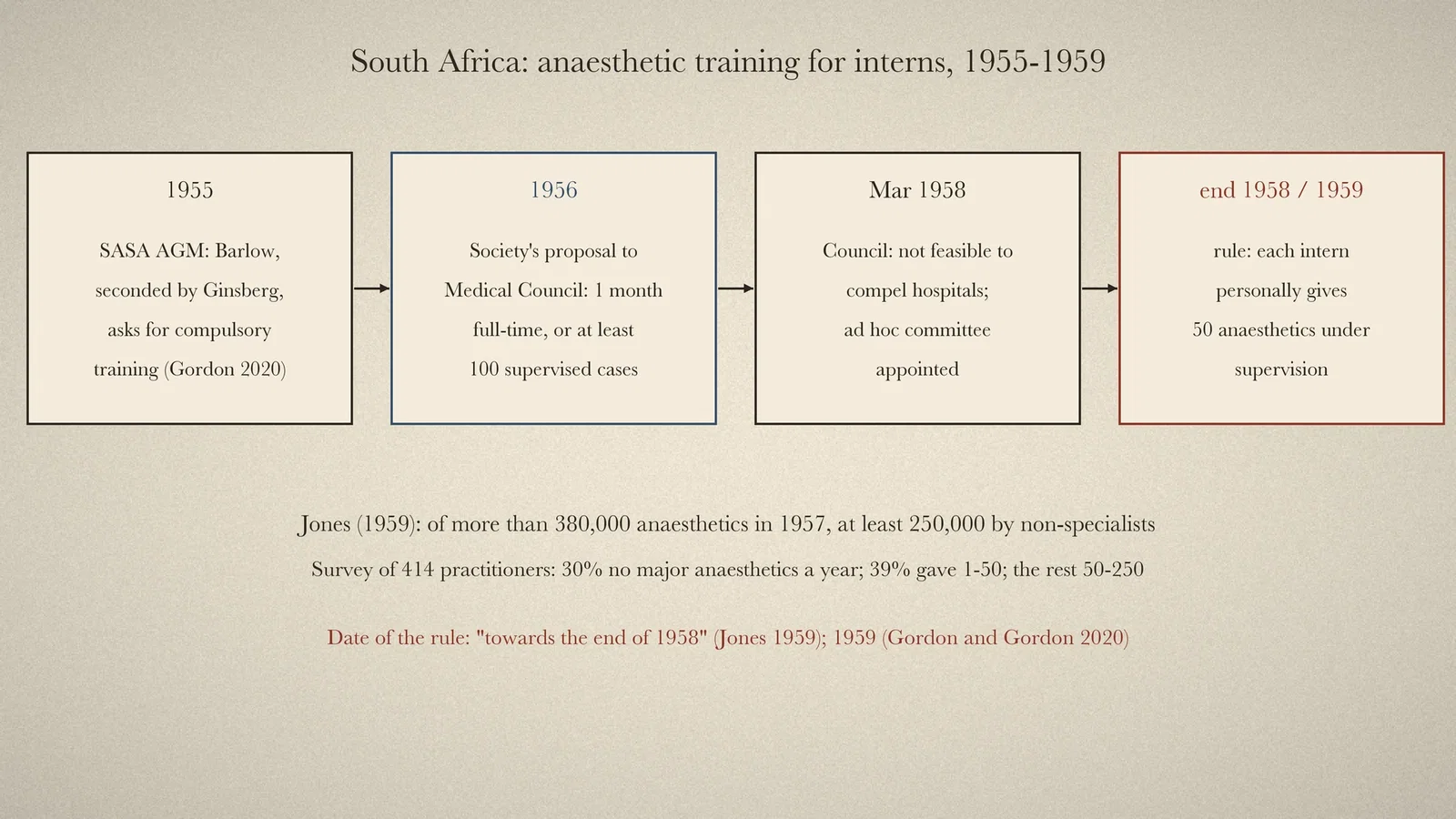
In South Africa in the 1950s most anaesthetics were given by doctors who were not specialists in anaesthesia. The South African Society of Anaesthetists (SASA) spent several years asking the Medical and Dental Council to make every new doctor give anaesthetics under supervision before registration. This article follows that request through the South African Medical Journal of 1958 and 1959, with a modern account by Gordon and Gordon (2020) for the parts the journal does not cover.
The Society's request
According to Gordon and Gordon, Mollie Barlow and Hilde Ginsberg were colleagues at Coronation Hospital, Johannesburg, from 1949 to 1953, and their collaboration "led to a dramatic decrease in on-table deaths" and in postoperative mortality, which was attributed to better training and personal supervision of juniors. [4, p. 1090] At the Society's annual general meeting in 1955, Barlow, seconded by Ginsberg, proposed that the Medical and Dental Council be asked to institute compulsory teaching in anaesthetics for interns. [4, p. 1090]
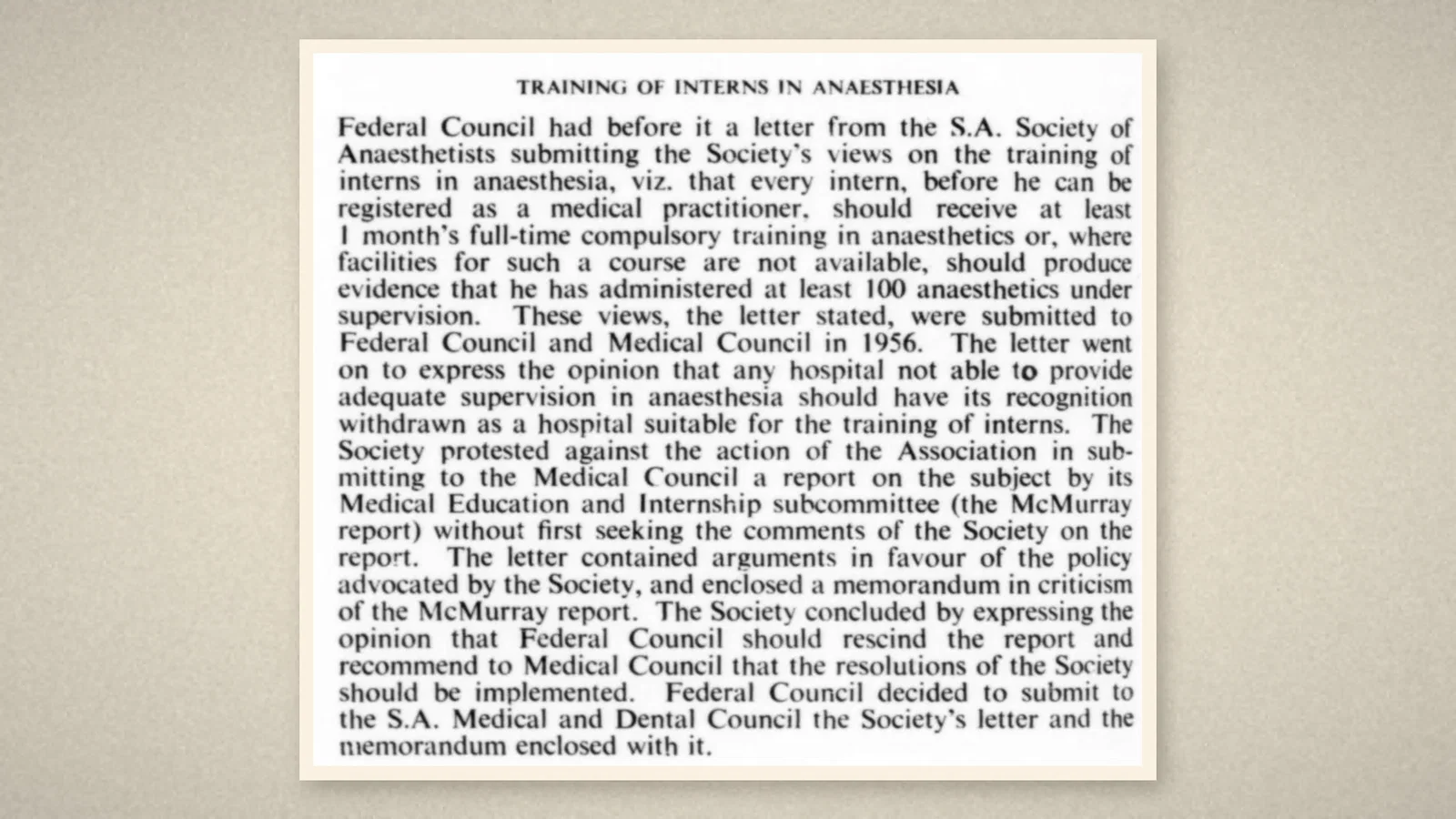
The Society's proposal appears in the journal in May 1958, in a report of the Federal Council of the Medical Association. SASA had written that every intern, "before he can be registered as a medical practitioner", should receive at least one month's full-time compulsory training in anaesthetics or, where that was not available, should show evidence of having given at least 100 anaesthetics under supervision; these views had been submitted to the Federal Council and the Medical Council in 1956. [2, p. 502] The Society added that any hospital unable to provide adequate supervision in anaesthesia should lose its recognition for intern training, and protested that the Association had sent the Medical Council a report on the subject, the McMurray report, without first consulting it. [2, p. 502]
The Council hesitates
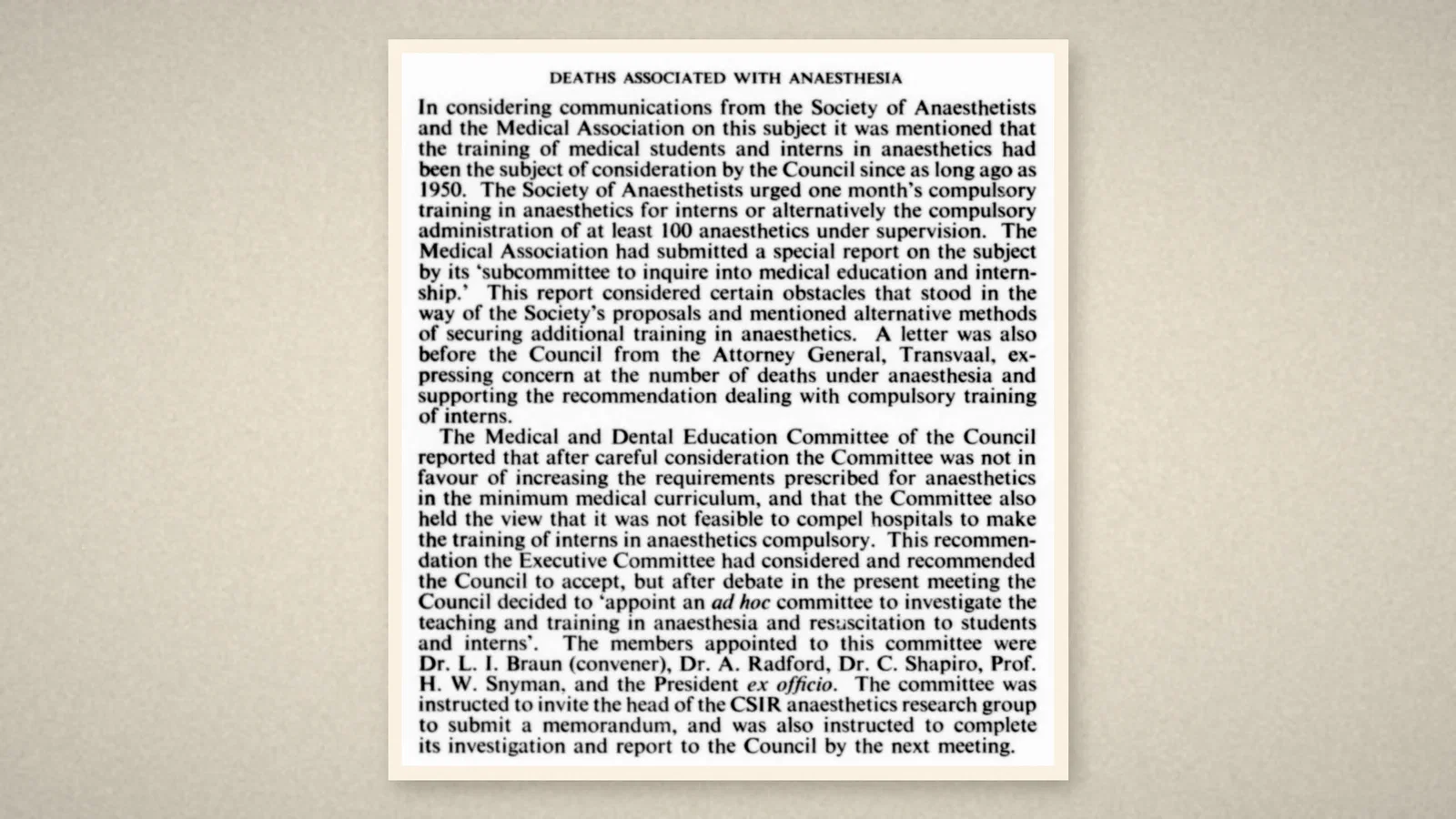
The Medical and Dental Council met in Cape Town on 10-13 March 1958. [1, p. 383] Under the heading "Deaths associated with anaesthesia", the journal reported that the training of students and interns in anaesthetics had been before the Council "since as long ago as 1950". The Society's proposal of a month's training or 100 supervised anaesthetics was before it, as was a letter from the Attorney General of the Transvaal "expressing concern at the number of deaths under anaesthesia" and supporting compulsory training of interns. [1, p. 384] The Council's education committee advised against raising the requirements in the medical curriculum and held that it was "not feasible to compel hospitals" to make intern training in anaesthetics compulsory; after debate the Council instead decided to "appoint an ad hoc committee" to investigate teaching and training in anaesthesia and resuscitation. [1, p. 384]
The rule
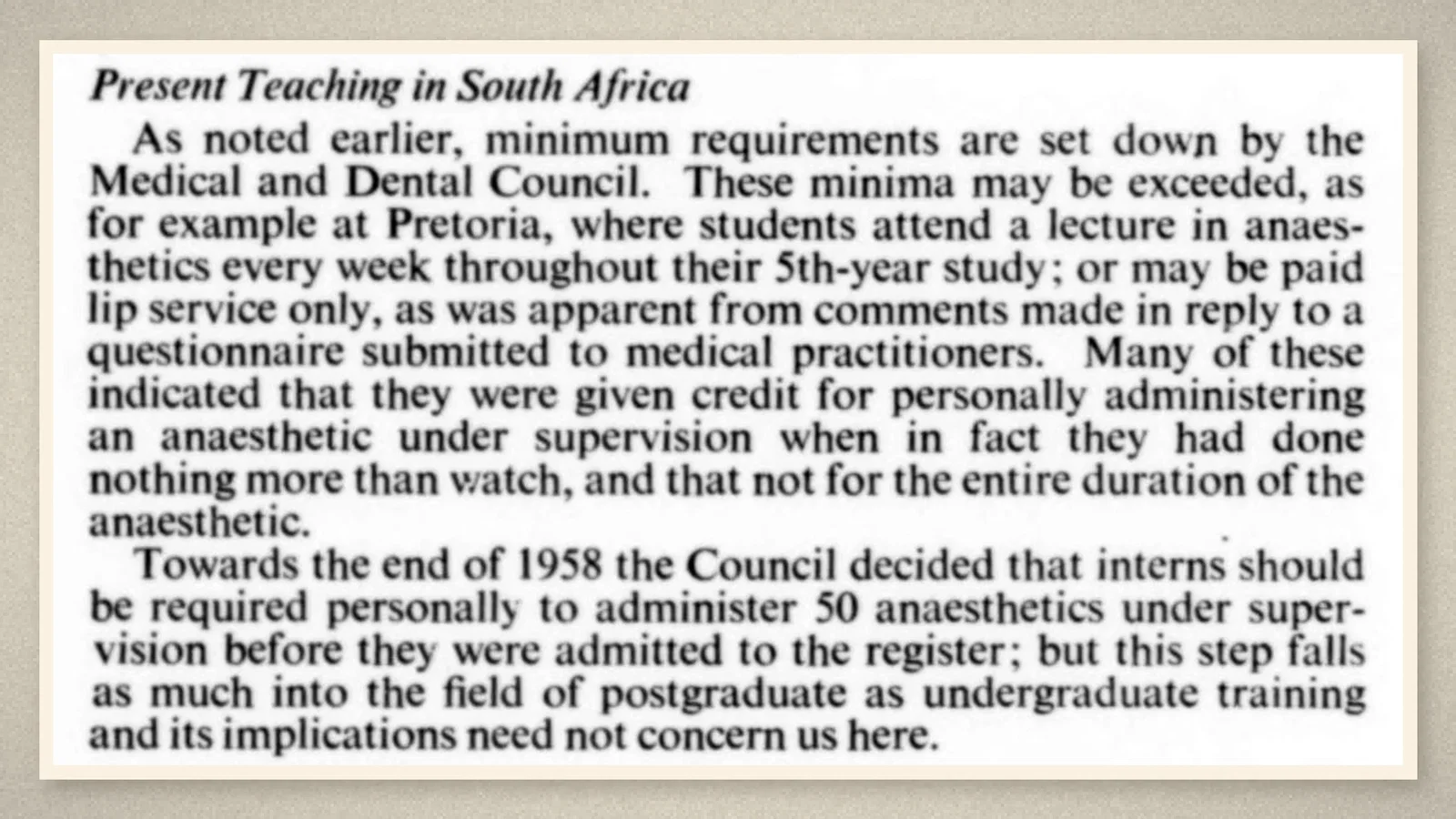
In September 1959 C. S. Jones, head of the department of anaesthesia at Groote Schuur Hospital and the University of Cape Town, wrote that "towards the end of 1958 the Council decided that interns should be required personally to administer 50 anaesthetics under supervision before they were admitted to the register". [3, p. 798] Gordon and Gordon date the rule to 1959 and quote the SASA president of the time calling it "a great step forward in improving the standard of anaesthesia throughout the country". [4, p. 1090] The number fixed was half of what the Society had asked for.
Jones explained why it mattered. Answers to a questionnaire sent to medical practitioners showed that many doctors had been given credit as students for personally administering an anaesthetic under supervision when they had done "nothing more than watch". [3, p. 798] Of more than 380,000 anaesthetics given in South Africa in 1957, at least 250,000 "were administered by non-specialists", and soon, under the new rule, all graduates would be required to give anaesthetics during their internship. [3, p. 798] Of the 414 practitioners who replied, 30% had given no anaesthetics for major surgery in a year, 39% between 1 and 50, and the rest between 50 and 250. [3, p. 799]
Jones's paper also belongs to its time. In an epilogue on the less developed areas of Africa Jones proposed "specially trained African anaesthetic technicians", supervised by a specialist, to provide a cheap service for African patients. [3, p. 799] Written in the apartheid era, the proposal assumed separate services by race; it is reported here as part of the record.
What the record shows
The Society asked in 1955 and 1956; the Council hesitated in 1958, with deaths under anaesthesia before it; by the end of 1958 or in 1959 it required 50 supervised anaesthetics from every intern. Behind the number lay a plain fact recorded by Jones: most anaesthetics in the country were given by doctors who were not specialists.
Sources and reading limits
Read: SAMJ, 5 April 1958, pp. 383-384; 10 May 1958, p. 502; 19 September 1959, pp. 797-799 (C. S. Jones); Gordon and Gordon, SAMJ 2020, on Barlow, Ginsberg and the rule.
Not covered: the Council's resolution itself was not found; the SAMJ issues of September to December 1958 were searched without finding the report of the meeting that adopted it. The two dates for the rule, the end of 1958 (Jones) and 1959 (Gordon and Gordon), are both reported. The 1955 AGM motion and the president's comment are known only from Gordon and Gordon, who cite SASA minutes. The fall in deaths at Coronation Hospital is their attribution, not a measured effect of the rule, and no effect of the rule on mortality is claimed here.
One illustration is drawn from the sources; three are crops of SAMJ pages.
- Half-yearly meeting of the South African Medical and Dental Council: deaths associated with anaesthesia. S Afr Med J. 1958;32:383-4. Internet Archive
- Federal Council: training of interns in anaesthesia. S Afr Med J. 1958;32:502. Internet Archive
- Jones CS. The undergraduate teaching of anaesthesia. S Afr Med J. 1959;33:797-9. Internet Archive
- Gordon C, Gordon PC. Handmaidens and pioneers: three female anaesthetists and their contribution to anaesthesia in South Africa. S Afr Med J. 2020;110(11):1088-92. SciELO
Continue exploring
Related reading connects shared questions and contexts; it does not by itself establish historical influence.
- 1941–2002: Three White Women Anaesthetists in Johannesburg, and Black Women Kept Out
- 1943: The South African Society of Anaesthetists Forms in Wartime
- 1911: Hewitt on How Anaesthetics Entered the Medical Curriculum
Anesthesia Epochs · The Source Room · About & Editorial Method
Published November 2, 2026. Sources and reading limits are stated above. Illustrations are labelled as original source images or AI-made. Historical accounts are educational; they are not current treatment instructions.