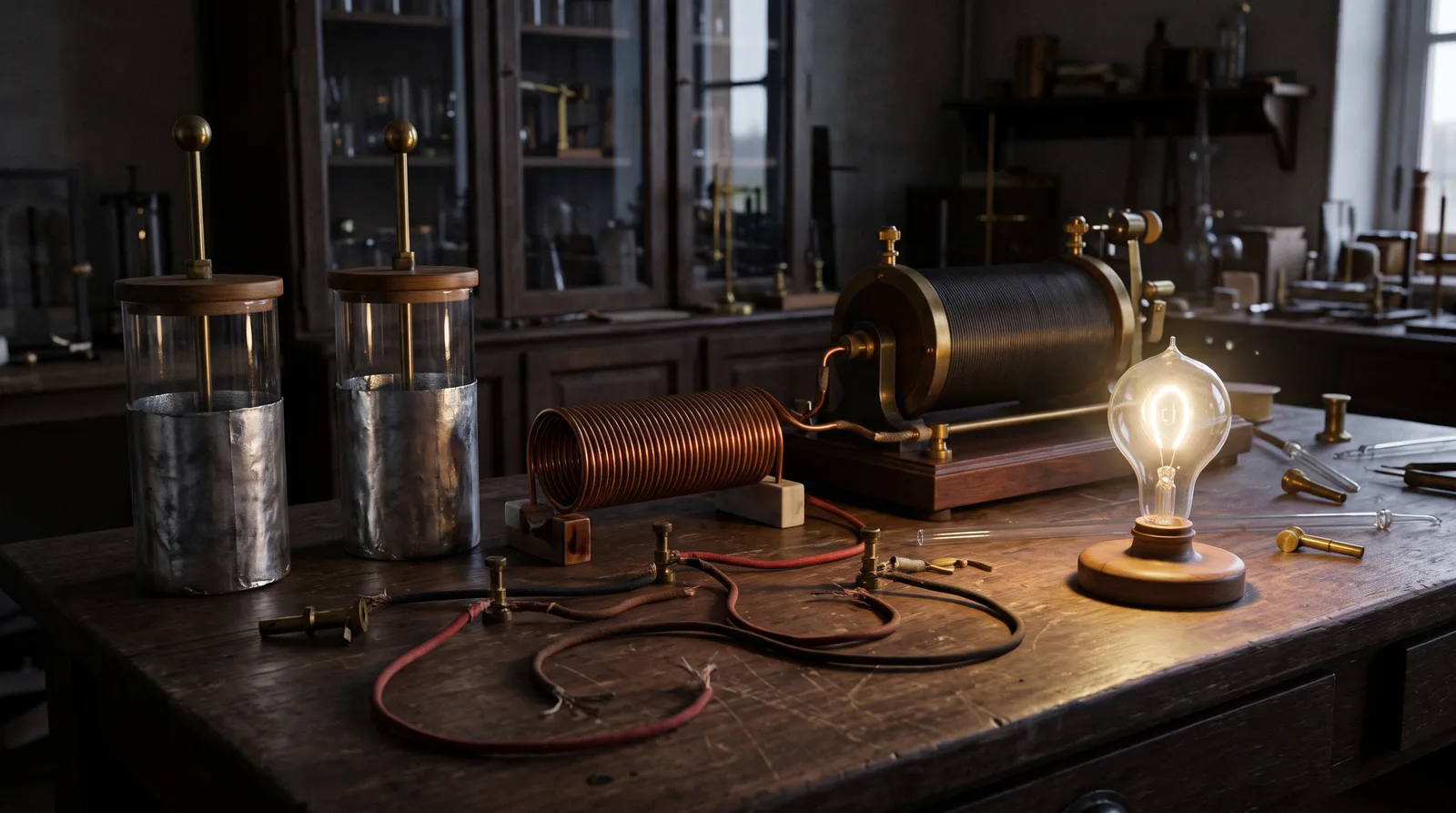
In a note presented to the Académie des sciences on 20 March 1893, Jacques-Arsène d’Arsonval reported that alternating current of very high frequency, shown publicly in 1892, could light a lamp held between two people and pass through the body without exciting nerve or muscle, with analgesia where the electrodes touched the skin.
Reading Library · Anesthesia Epochs · 中文版
Watch the education video (for clinicians)
1892: D'Arsonval's High-Frequency Currents — Lamps Lit, No Twitch · Anesthesia Epochs Education Series
An incandescent lamp that draws one ampere is held between two people who complete the circuit. The filament glows white; the two people feel no shock and their arms do not jerk. That is how Jacques-Arsène d'Arsonval described the apparatus in a note presented to the Académie des sciences on 20 March 1893, adding something more startling: with an alternator in place of the induction coil, d'Arsonval took currents of more than 3 amperes through the body and felt nothing but warmth in the hands. [1, p. 631]
Demonstrations like this have found their way into anaesthesia timelines. The 2024 timeline of the Australian Society of Anaesthetists files 1892 under "early experiments on electrotherapy producing electronarcosis" and says d'Arsonval demonstrated "anaesthesia-like states" with currents above 10,000 Hz. [4, p. 27] Going back to d'Arsonval's own words gives a narrower and clearer finding: at high enough frequency, current no longer excites nerve and muscle, and analgesia appears where the electrodes touch the skin. [1, pp. 632–633]
A four-page summary
The note, titled "The influence of frequency on the physiological effects of alternating currents", was presented on d'Arsonval's behalf by Bouchard and printed in volume 116 of the Comptes rendus, pages 630 to 633. [1, p. 630] D'Arsonval opens by saying that an electrical flux excites nerves and muscles only by its variation. Having studied single waves of known form, d'Arsonval turned to periodic waves; the systematic research had been pursued "since 1881", its results scattered across short notes that this communication summarises. [1, p. 630]
D'Arsonval first used a simple ironless alternator giving up to ten thousand alternations per second, feeding a du Bois-Reymond sledge coil to keep the intensity constant. [1, p. 630] At low frequencies, the note says, there was neither pain nor muscular contraction, yet the current acted strongly on nutrition, increasing oxygen uptake and carbon dioxide elimination. As the frequency rose, excitation appeared, but from 2,500 to 3,000 alternations per second the current became better and better tolerated at equal intensity; d'Arsonval called these figures the optimum of excitation. [1, pp. 630–631]
A mechanical alternator could not go beyond ten thousand per second. In December 1890, d'Arsonval says, the idea came of using Hertz's vibrator, which reached frequencies of several million per second. [1, p. 631]
Priority, in d’Arsonval’s own words
In public lessons at the Collège de France d'Arsonval showed a "surprising fact": when the number of excitations is very large, nerve and muscle excitation no longer occurs. The note adds that this was communicated to the Société de Biologie on 24 February and 25 April 1891, "therefore earlier than" Tesla's New York publication of 23 May 1891. [1, p. 631]
That is d'Arsonval's claim. A decade later the London physician Chisholm Williams, in a 1903 monograph, put the order the other way round: d'Arsonval showed the result in April 1891, "a few months after the memorable experiment of Tesla". [2, pp. 5–6] The 1891 Société de Biologie notes are not quoted here, so the priority question is left open and both statements are kept side by side.
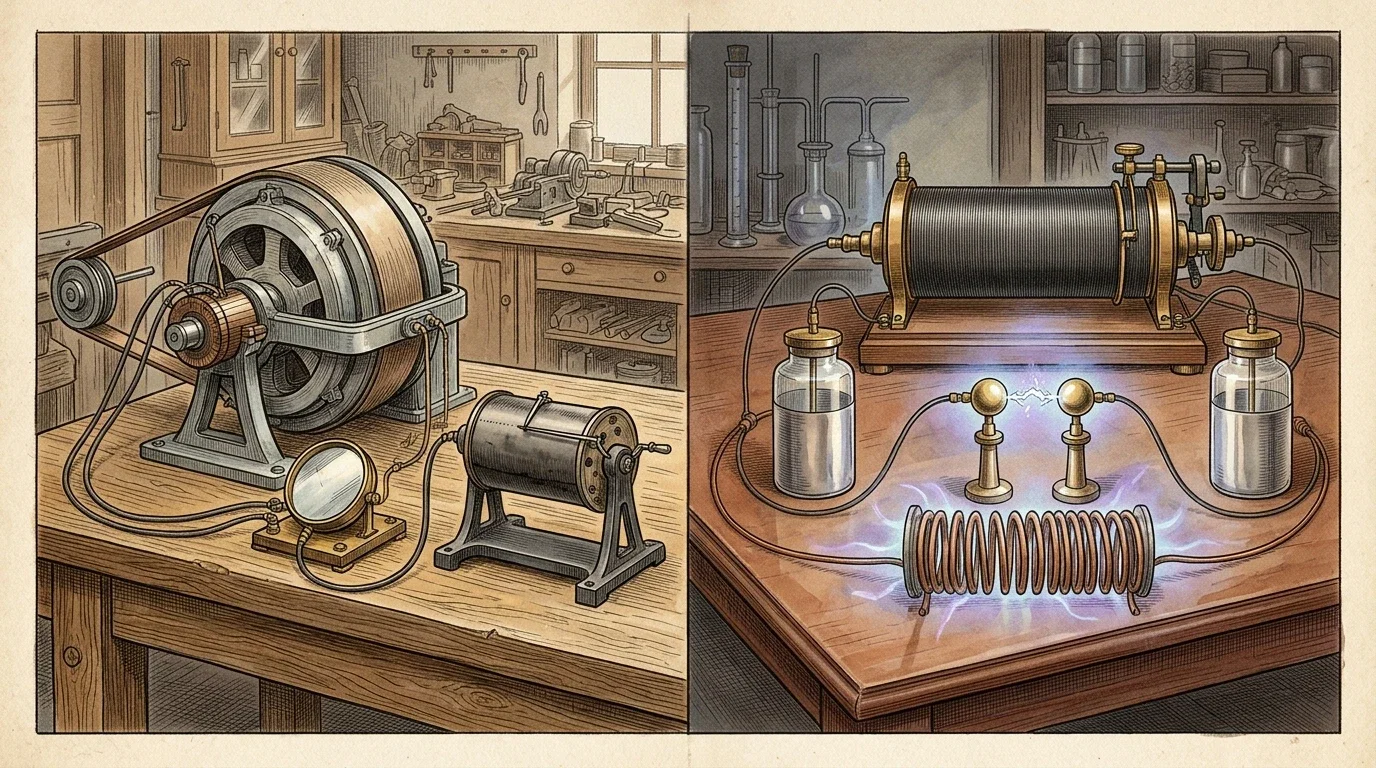
Why the lamp glowed and the people felt nothing
The apparatus in the 1893 note is simple: two Leyden jars in cascade, their inner coatings connected to a powerful Ruhmkorff coil, their outer coatings joined by a solenoid of 10 to 15 turns of thick copper wire; taking current from the ends of the solenoid gives a very energetic oscillating current. [1, p. 631] The one-ampere lamp sat between two people in that circuit. [1, p. 631] In a footnote d'Arsonval rejects the explanation that the high-frequency current lighting the lamp is really far smaller than it seems: heating a platinum wire immersed in petroleum, d'Arsonval found the same temperature rise as with a direct current of equal effective intensity. [1, p. 631] The same footnote dates the public demonstration: these were experiments d'Arsonval had shown "last year, at Easter" at the Société de Physique, that is, in 1892. [1, p. 631]
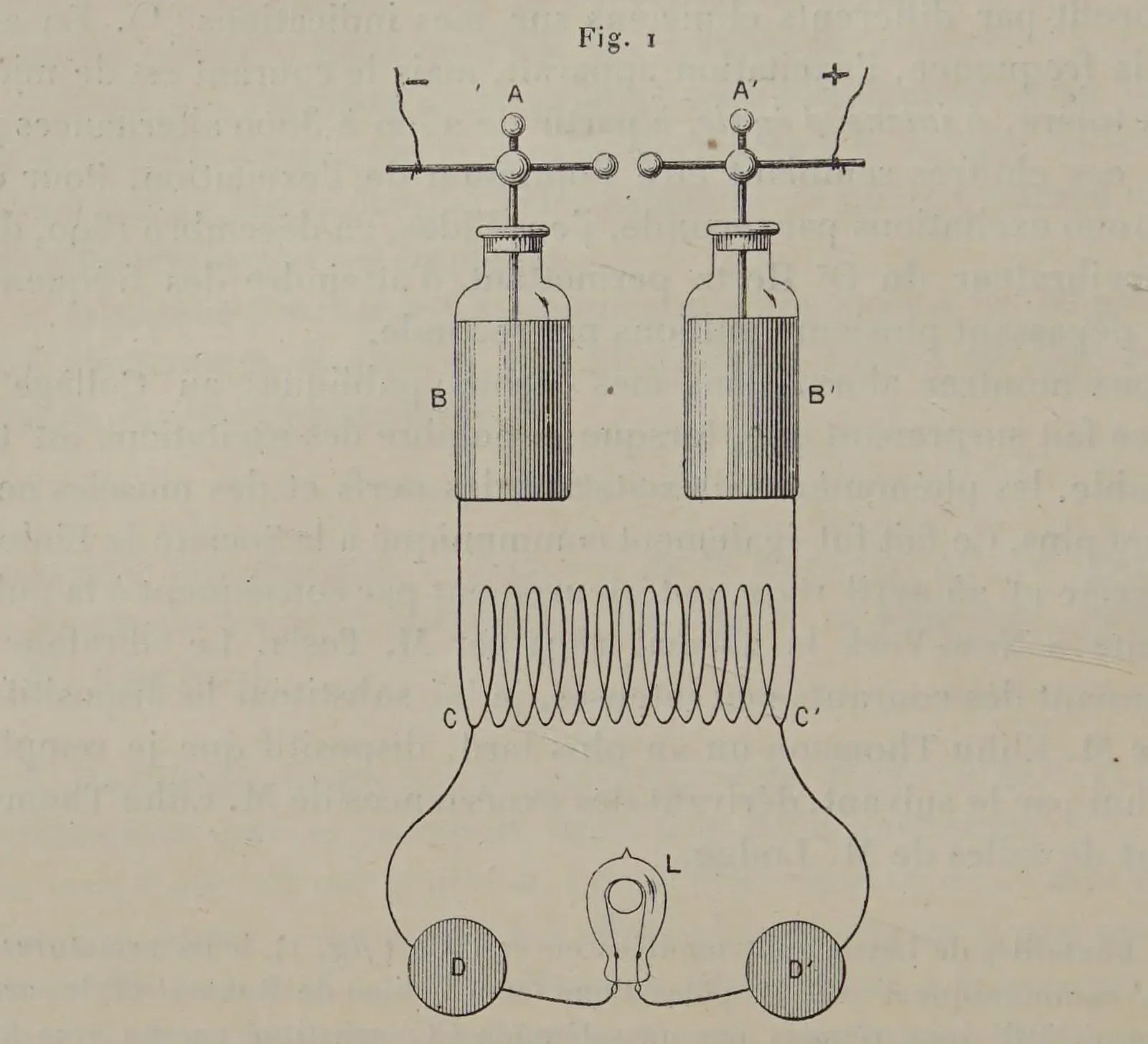
Williams in 1903 turned the demonstration into a recipe: put one or several persons in the external circuit, interpose a few incandescent lamps of 125 volts and 1 ampere, and the filaments light without the persons feeling the slightest sensation. [2, p. 113] Williams also quotes the doubt of the British electrotherapist Lewis Jones, who found d'Arsonval's estimate of 3 amperes through each lamp "almost incredible", since a current of that size from any source would destroy life and burn the tissues. [2, p. 114] Williams reports d'Arsonval's statement that currents ten times weaker would be extremely dangerous if the frequency were lowered from 500,000–1,000,000 per second to the 100 of industrial alternating current. [2, pp. 115–116]
One number, two versions
The two sources disagree about where excitation peaks. D'Arsonval in 1893 wrote 2,500 to 3,000 per second; [1, p. 631] Williams in 1903 wrote "2,500 or 5,000 vibrations per second". [2, p. 117] Williams also describes muscle contractions fusing into tetanus at twenty to thirty excitations per second, [2, p. 117] whereas the 1893 note says low frequencies gave neither pain nor contraction. [1, p. 630] The two passages may describe different apparatus and conditions, so this article does not merge them into one tidy "frequency ladder" that neither author wrote.
Analgesia under the electrodes
D'Arsonval lists four observations when the current is applied directly: no action on sensibility or contractility; analgesia at the points where the electrodes are applied; general vasodilatation with a fall in blood pressure and sweating; and increased bodily combustion without a rise in core temperature. [1, p. 632] D'Arsonval also describes a second mode: making the current circulate around the body, with the person placed inside the solenoid. [1, p. 632] Williams's later book already illustrates a couch for auto-condensation and a cage for auto-conduction. [2, figs. 36–39]
D'Arsonval's explanation had two layers. The first was an analogy: motor and sensory nerves, like the acoustic and optic nerves, are tuned to certain vibration periods and do not respond when the frequency is too low or too high. The second was, in d'Arsonval's words, a new example of the inhibition phenomena to which Brown-Séquard had drawn physiologists' attention. [1, p. 633] Williams spells out the evidence for inhibition: under these currents excitability to other stimuli falls, local anaesthesia appears at the point of penetration and may last from one to twenty minutes, and a dog's arterial pressure drops by a few centimetres. [2, p. 118]
For anaesthesia history this is the point to read carefully. The analgesia in the 1893 note is local, at the electrode contacts; the subject stays awake, and the author does not claim that surgery could be done this way. [1, pp. 632–633]
Why "electronarcosis" is the wrong label
The same ASA timeline has a separate 1902 entry for the French biologist Stéphane Leduc, who used unidirectional "chopped" direct current to produce a narcotic-like state in animals and tried it as self-experiment with the cathode on the forehead, reaching a "dream-like" state, conscious but unable to move. [4, p. 32] That was a transcranial route aimed at the central nervous system, different from d'Arsonval's high-frequency alternating current in waveform, electrode placement and effect.
Calling 1892 the start of "electronarcosis" is therefore a later timeline grouping two lines of work under one heading. A more accurate statement of d'Arsonval's contribution is that d'Arsonval made frequency a controllable physiological variable, showing that current of high enough frequency could pass through the body without exciting nerve or muscle, with brief analgesia at the electrodes. [1, pp. 631–633]
A short biography
According to Vayre's 2007 biography, d'Arsonval was born on 8 June 1851 at the family manor of La Borie, worked early on beside Claude Bernard, and became titular professor in 1894 at the age of 43. [3, p. 62]
Sources and reading limits
Read: the complete four-page note of 20 March 1893 in the Internet Archive scan of that week’s Comptes rendus, with its page images (the footnote on p. 631 is followed as printed); the history chapter (pp. 1–10) and the physiological-properties chapter (pp. 113–120) of Williams’s 1903 monograph, with its list of illustrations; Vayre’s 2007 biography; pages 27 and 32 of the 2024 ASA timeline.
Not covered: d’Arsonval’s 1891 Société de Biologie notes, the 1892 Archives de physiologie and Bulletin de l’Académie de médecine papers, the Comptes rendus note of 27 June 1892, and the 1893–1894 Annales d’électrobiologie papers that Williams cites; Brenni’s 2010 and Reif-Acherman’s 2017 articles.
- d'Arsonval A. Influence de la fréquence sur les effets physiologiques des courants alternatifs. Comptes rendus hebdomadaires des séances de l'Académie des sciences. 1893;116(12):630–633 (session of 20 March 1893). Issue scan.
- Williams C. High-Frequency Currents in the Treatment of Some Diseases. London/New York: Rebman; 1903. Internet Archive.
- Vayre P. Docteur Jacques Arsène d'Arsonval (1851-1940): de la biophysique à l'Académie de chirurgie. e-mémoires de l'Académie Nationale de Chirurgie. 2007;6(2):62–71. PDF.
- Australian Society of Anaesthetists. History of Anaesthesia Timeline. October 2024, p. 27 (ASA-0310) and p. 32 (ASA-0366). PDF.
Continue exploring
Related reading connects shared questions and contexts; it does not by itself establish historical influence.
- 1912: Perthes Lets an Electric Current Find the Nerve
- 1924: Berger Records the Human Brain's Electrical Rhythm
Anesthesia Epochs · The Source Room · About & Editorial Method
Published November 2, 2026. Sources and reading limits are stated above. Illustrations are labelled as original source images or AI-made. Historical accounts are educational; they are not current treatment instructions.