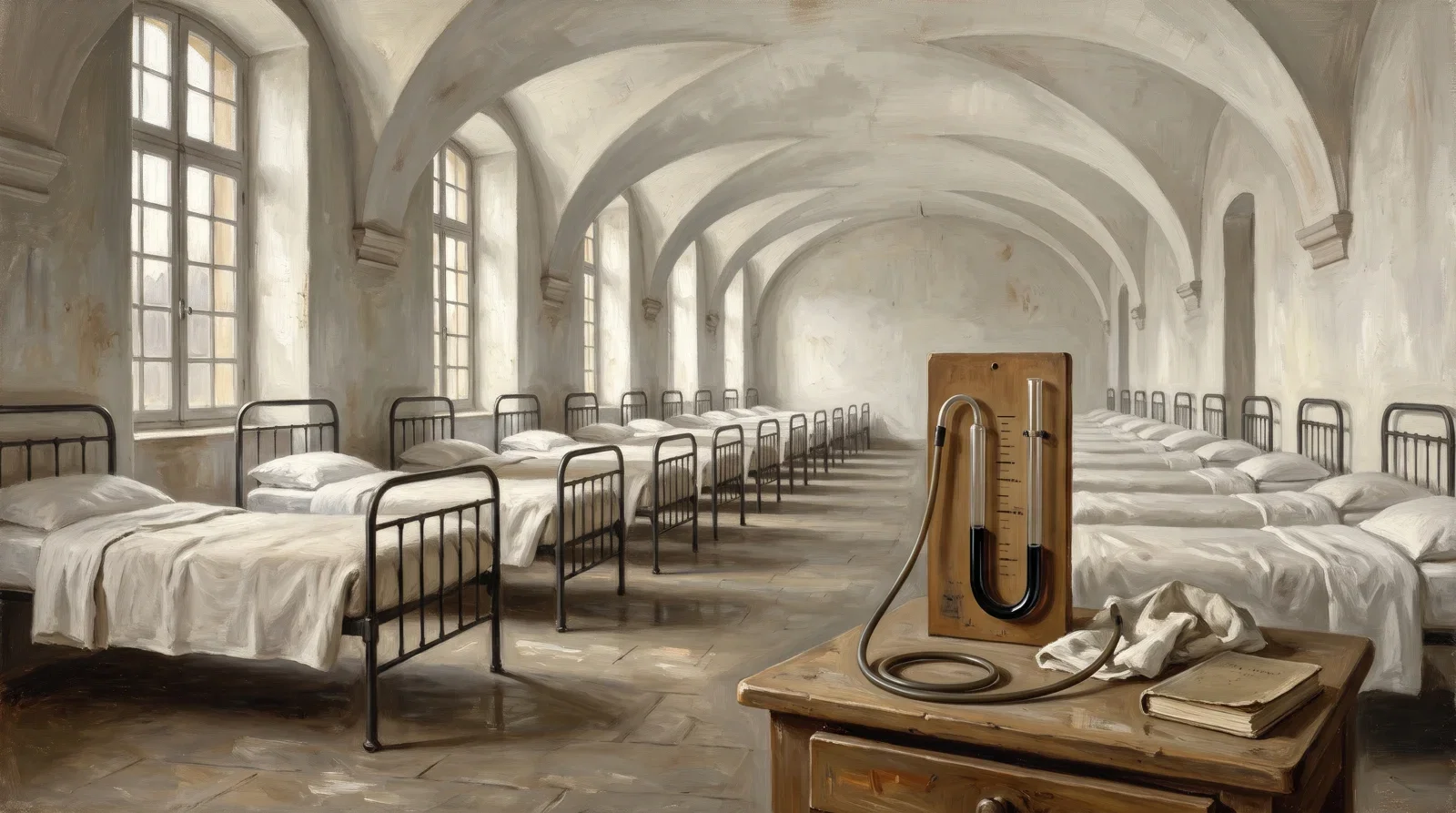
At the Hôtel-Dieu de Lyon, Faivre attached a mercury haemodynamometer to arteries during three amputations and found a mean pressure of 12 cm; Gibson later called it unjustifiable.
Reading Library · Anesthesia Epochs · 中文版
Watch the education video (for clinicians)
1856: Faivre's Haemodynamometer — Human Arterial Pressure at Lyon · Anesthesia Epochs Education Series
How high is the pressure of the blood in a living person's arteries? Physiologists had long measured it in horses and dogs by opening an artery onto a tube or a mercury gauge. The Australian Society of Anaesthetists (ASA) timeline records the moment it was done in people: under 1856, "First direct monitoring of human arterial blood pressure", by the French surgeon Dr Jean Faivre, who "measured both brachial and femoral pressures in a patient (an amputee)" with a mercury manometer. [3, p. 18]
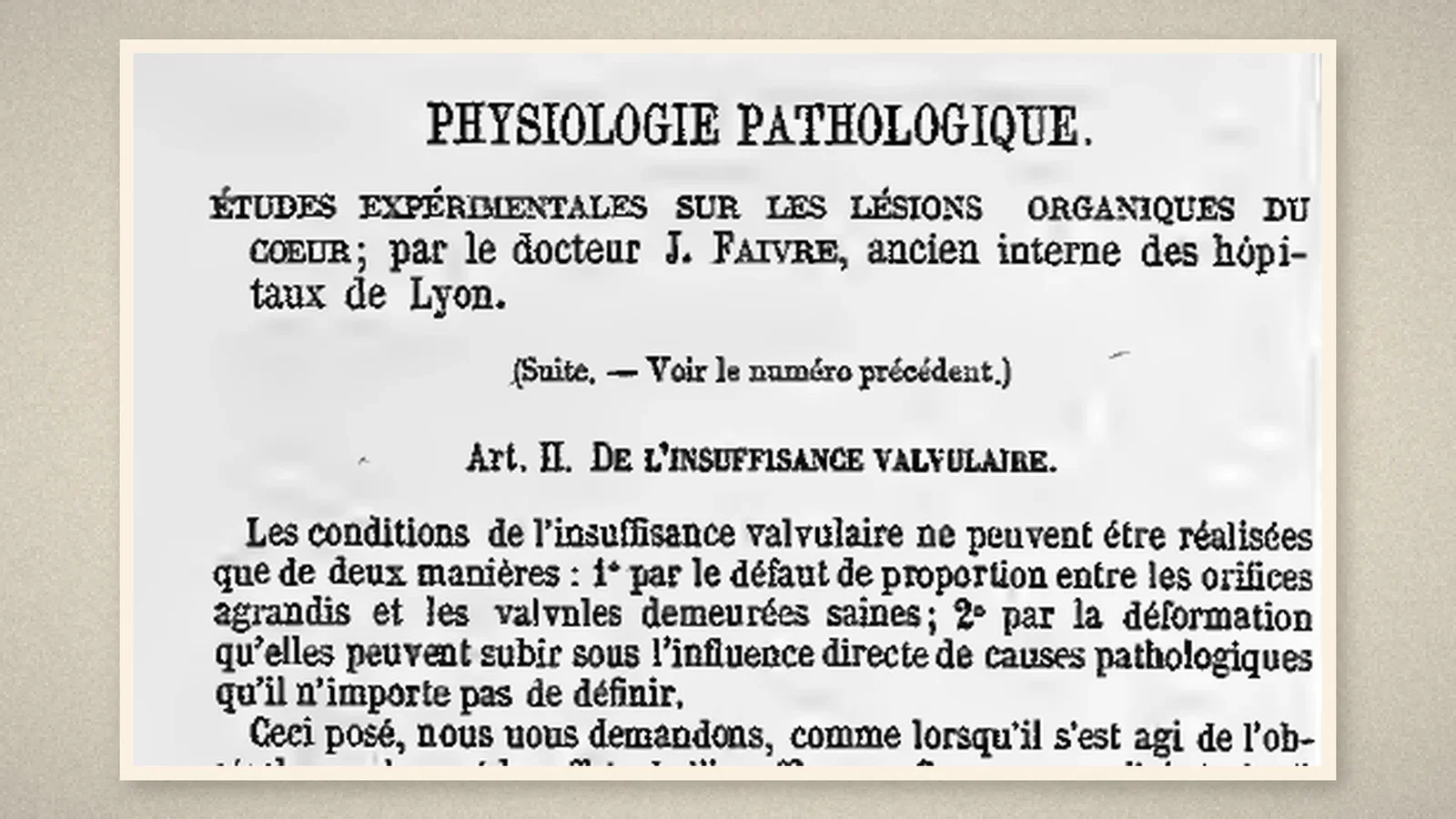
This article reads Faivre's own words. They appear in the Gazette médicale de Paris for 1856, in the continuation of a serial article, "Études expérimentales sur les lésions organiques du cœur" (Experimental studies on organic lesions of the heart), "by Dr J. Faivre, former intern of the hospitals of Lyon". [1, p. 726]
Why Faivre wanted the number
The article was about the heart valves. Working on animals at the Lyon veterinary school with "my friend M. Chauveau", Faivre wanted to show what each valve protected by comparing the pressures in the four vascular systems around the heart. Poiseuille had shown with the haemodynamometer that blood in the arteries of animals stood under a constant pressure. But, Faivre wrote, "MM. Poiseuille, Ludwig, Spengler and Valentin have explored it only in animals", and never in the pulmonary vessels. "I have tried to fill this double gap." [1, p. 727]
The method
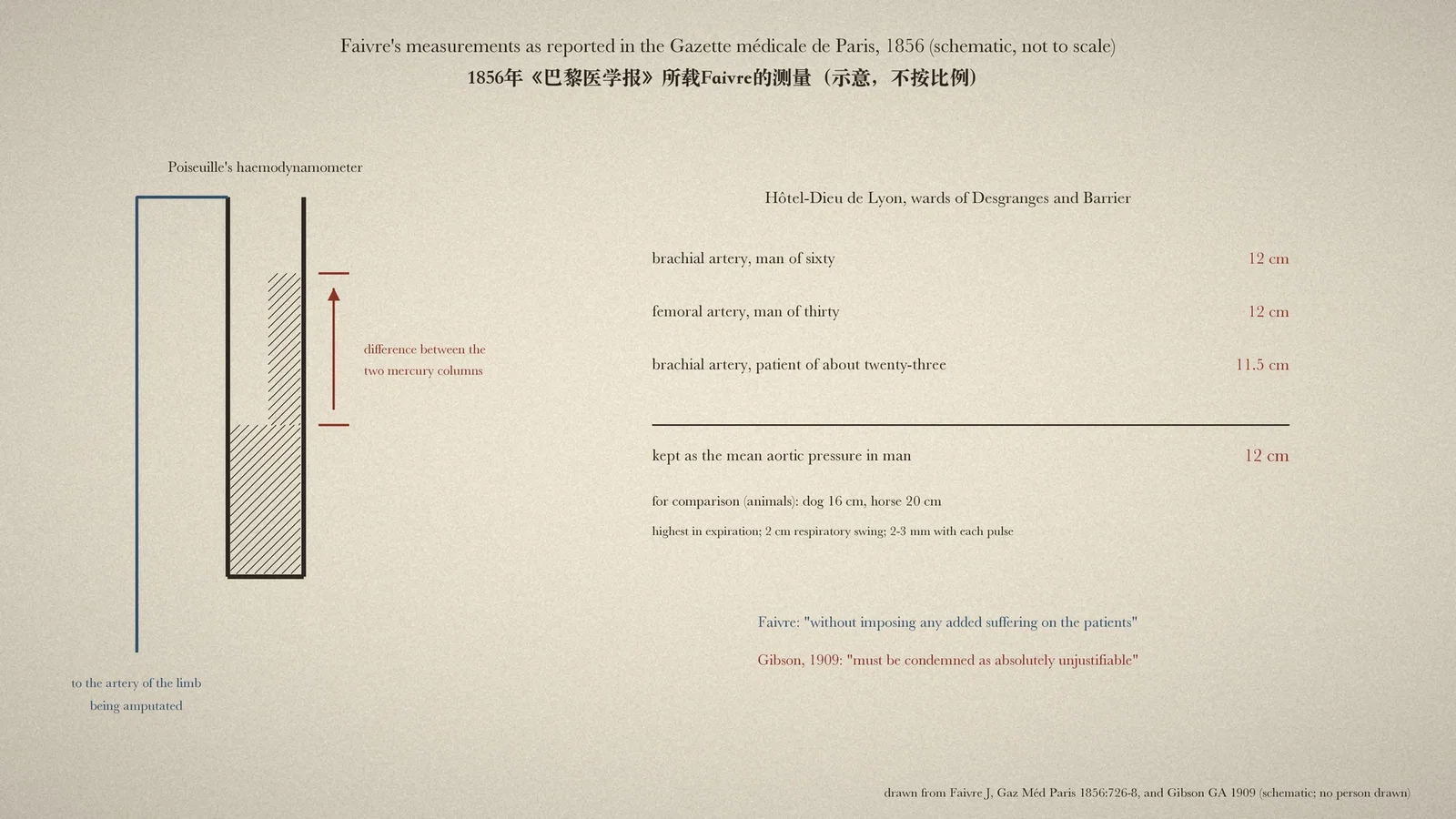
The human half of the gap was, in Faivre's words, the easy one. "Nothing is easier than to arrive in man at a knowledge of the pressure borne by the arterial blood. One need only take advantage of an amputation of the arm or the thigh, and attach M. Poiseuille's haemodynamometer to the arteries of those limbs." The surgeons Desgranges and Barrier had promised to tell Faivre of the first such occasions on the wards of the Hôtel-Dieu de Lyon, and in Barrier's service Faivre was able, "without imposing any added suffering on the patients", to make the experiment twice. [1, p. 727]
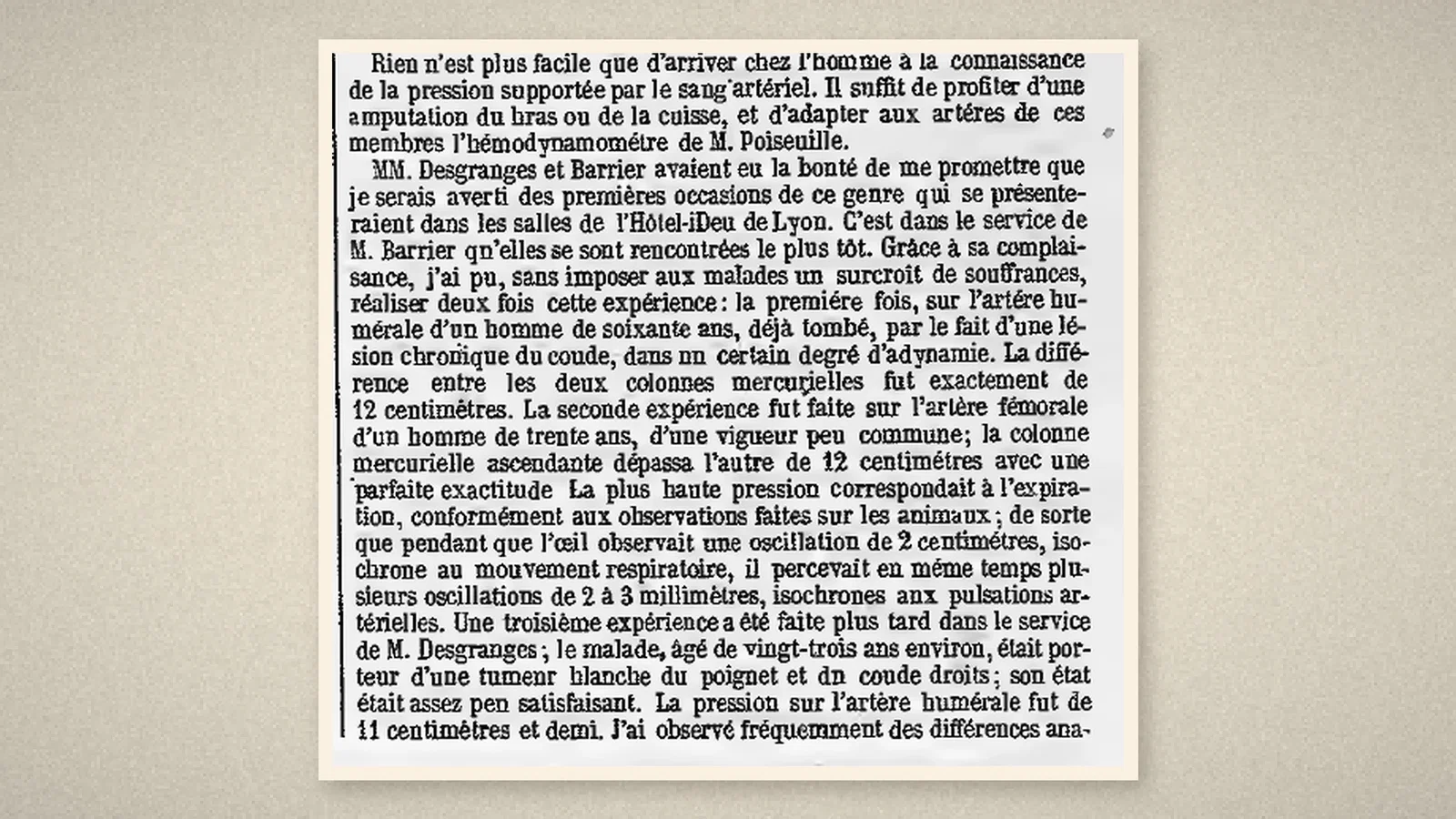
On the brachial artery of a man of sixty, weakened by a chronic disease of the elbow, the difference between the two mercury columns was exactly 12 centimetres. On the femoral artery of an unusually vigorous man of thirty, the rising column exceeded the other by 12 centimetres "with perfect exactness". The highest pressure came with expiration, as in animals: the eye saw a swing of about 2 centimetres with each breath and, on top of it, small oscillations of 2 to 3 millimetres with each pulse. A third measurement, later, in Desgranges's service, on a patient of about twenty-three in poor condition, gave 11.5 centimetres on the brachial artery. [1, p. 727]
The conclusion
Reasoning that a very weak patient had read half a centimetre low and a very strong one might read as much high, Faivre wrote, "I keep the figure 12 as the mean of the aortic pressures in man." Two conclusions followed: that in man the aortic pressure was nearly the same in everyone, as within each animal species; and that 12 centimetres was lower than had been presumed by analogy with animals, in which Faivre had found 16 in the dog and 20 in the horse. [1, p. 728]
A later verdict
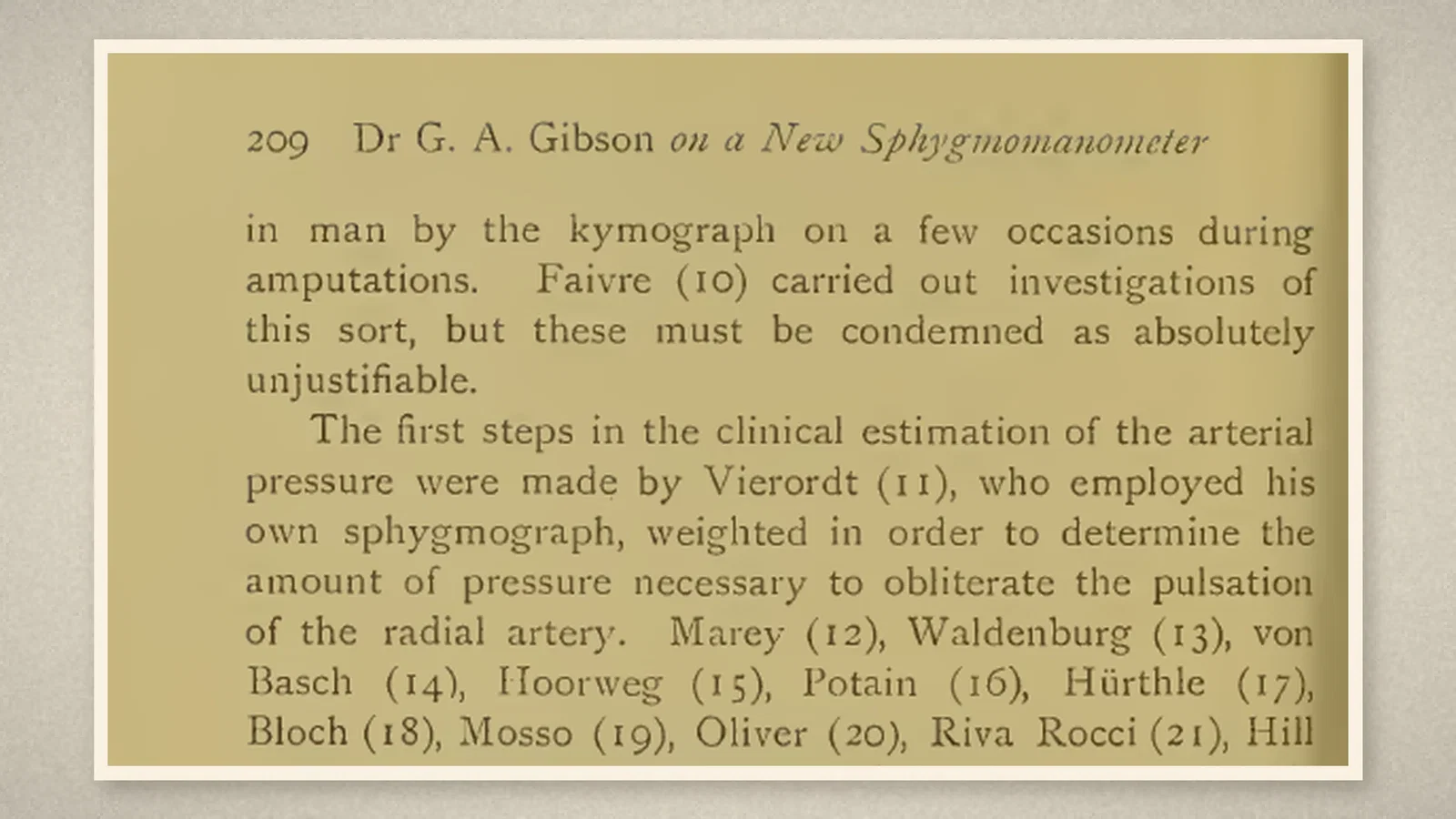
Half a century later the measurements were remembered differently. In January 1909 G. A. Gibson, introducing a new sphygmomanometer to a society in Edinburgh, began with history: Hales's horse, Poiseuille's and Ludwig's mercury manometer, and arterial pressure "obtained from the limbs in man by the kymograph on a few occasions during amputations". Then a single sentence: "Faivre carried out investigations of this sort, but these must be condemned as absolutely unjustifiable." The clinical story, for Gibson, began instead with Vierordt and the indirect methods that followed. [2, pp. 208-9]
What the record shows
Faivre's report gave a number and a method that could not be repeated. Faivre presented the measurements as costing the patients nothing, because the limb was already being removed; Gibson, writing when cuffs had made such measurements unnecessary, called them unjustifiable. The two judgements belong side by side, and together they show that a measurement in a person raises a question that a measurement in a horse does not.
Sources and reading limits
Read: Faivre's article in the Gazette médicale de Paris 1856, pp. 726-8 (the heading and the whole second article as far as the pulmonary pressures), BIU Santé copy on the Internet Archive; Gibson's 1909 paper in full; the ASA timeline entry for 1856.
Not covered: the earlier instalment of Faivre's serial; the version cited elsewhere as Gazette médicale de Lyon 1856; the joint work of Chauveau and Faivre on the heart; Poiseuille's own papers. The ASA speaks of one patient with brachial and femoral readings; Faivre reports three patients, two brachial and one femoral. The ASA gives the first name Jean; the article prints "J. Faivre". The ASA's "First direct monitoring" is quoted as the ASA's. Faivre's statement that no added suffering was imposed is Faivre's, and Gibson's condemnation is Gibson's. The patients are described only by the ages and conditions Faivre gives. The animal experiments are mentioned only as context. Translations from French are the article's.
Three illustrations are crops of the Gazette (pp. 726 and 727) and of Gibson (p. 209); one is drawn from the two texts.
- Faivre J. Études expérimentales sur les lésions organiques du cœur (suite). Art. II. De l'insuffisance valvulaire. Gazette médicale de Paris. 1856;3e sér. 11:726-8. Internet Archive
- Gibson GA. A new sphygmomanometer. Read before the Society, Edinburgh, 11 January 1909: pp. 208 ff. Internet Archive
- Australian Society of Anaesthetists. Anaesthesia history timeline. 2024. ASA
Continue exploring
Related reading connects shared questions and contexts; it does not by itself establish historical influence.
- 1897: Hill and Barnard Measure Blood Pressure with an Armlet and Dial
- 1881: von Basch Reads Blood Pressure When the Pulse Stops
- 1896: Riva-Rocci's Cuff Sphygmomanometer, Tested in a Munich Thesis
Anesthesia Epochs · The Source Room · About & Editorial Method
Published November 2, 2026. Sources and reading limits are stated above. Illustrations are labelled as original source images or AI-made. Historical accounts are educational; they are not current treatment instructions.