
On 22 May 1943 JAMA printed 'Demerol—A New Synthetic Analgesic' by Robert C. Batterman of New York University and C. K. Himmelsbach of the US Public Health Service. With wartime demand for morphine and the opium supply under threat, the piperidine compound synthesised in 1939 by Eisleb and Schaumann could be made from available chemicals and had just been released by the Food and Drug Administration. One of a group of spasmolytic compounds, it unexpectedly showed a morphine-like central action, with analgesia, spasmolysis and sedation; in 338 surgical patients needing general or spinal anaesthesia it was as satisfactory a preanaesthetic agent as morphine. The authors judged it a satisfactory substitute for morphine that could lead to habituation, though with less liability to physical dependence. In August Morris J. Nicholson's review of regional anaesthesia in the New England Journal of Medicine quoted Rovenstine and Batterman's conclusions on its use before anaesthesia.
Reading Library · Anesthesia Epochs · 中文版
Watch the education video (for clinicians)
1939: Demerol — Analgesia and Dependence · Anesthesia Epochs Education Series
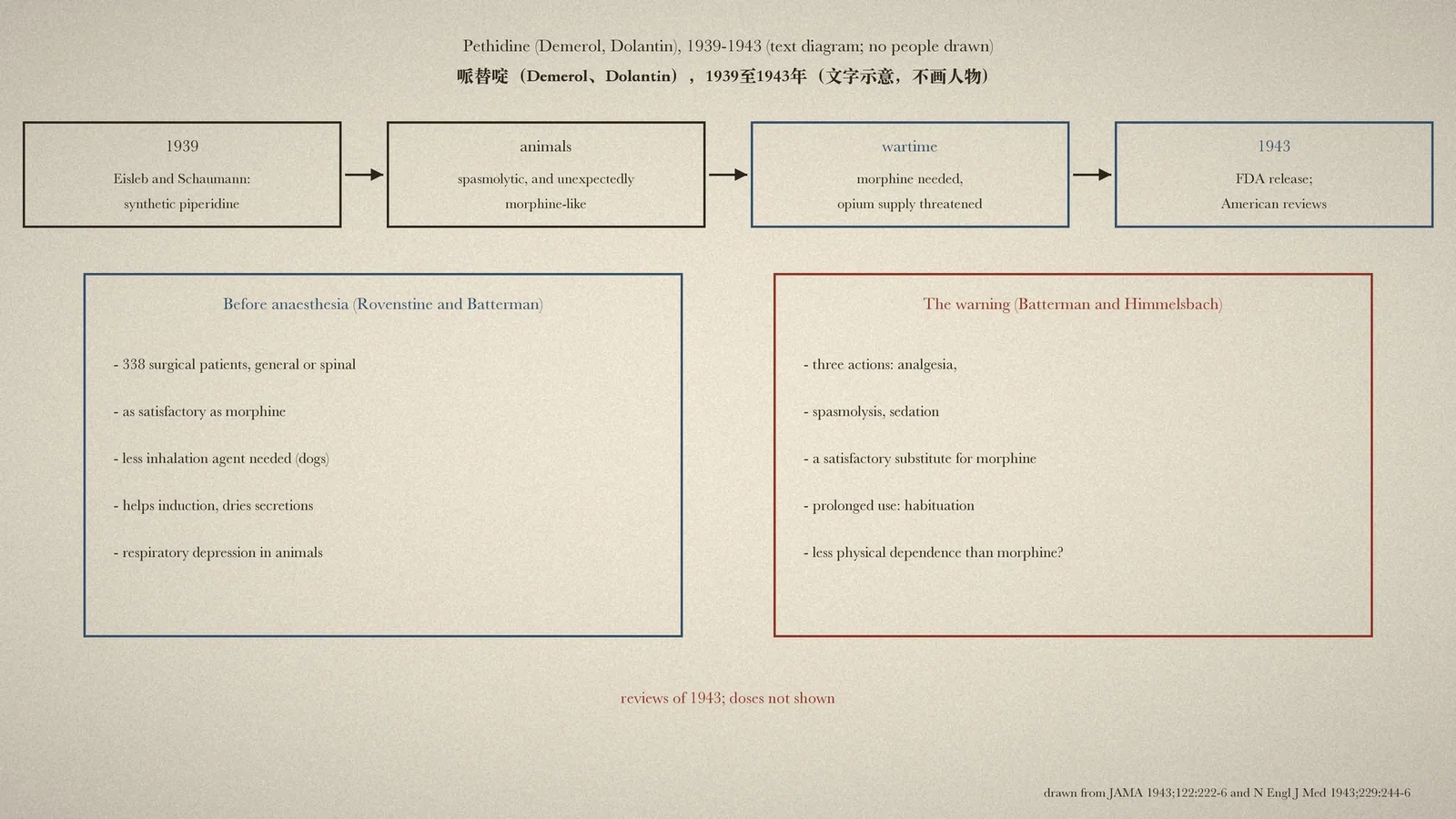
Pethidine, sold as Dolantin in Germany and Demerol in the United States, was made as a drug against smooth-muscle spasm and turned out to act like morphine. The German papers of 1939 are not in hand for this article. What is in hand are two American reviews of 1943, written when war made morphine scarce, and they show how quickly the drug moved into anaesthesia, and how early the warning about habit came with it. [1, p. 222][2, p. 245]
Why a review in wartime
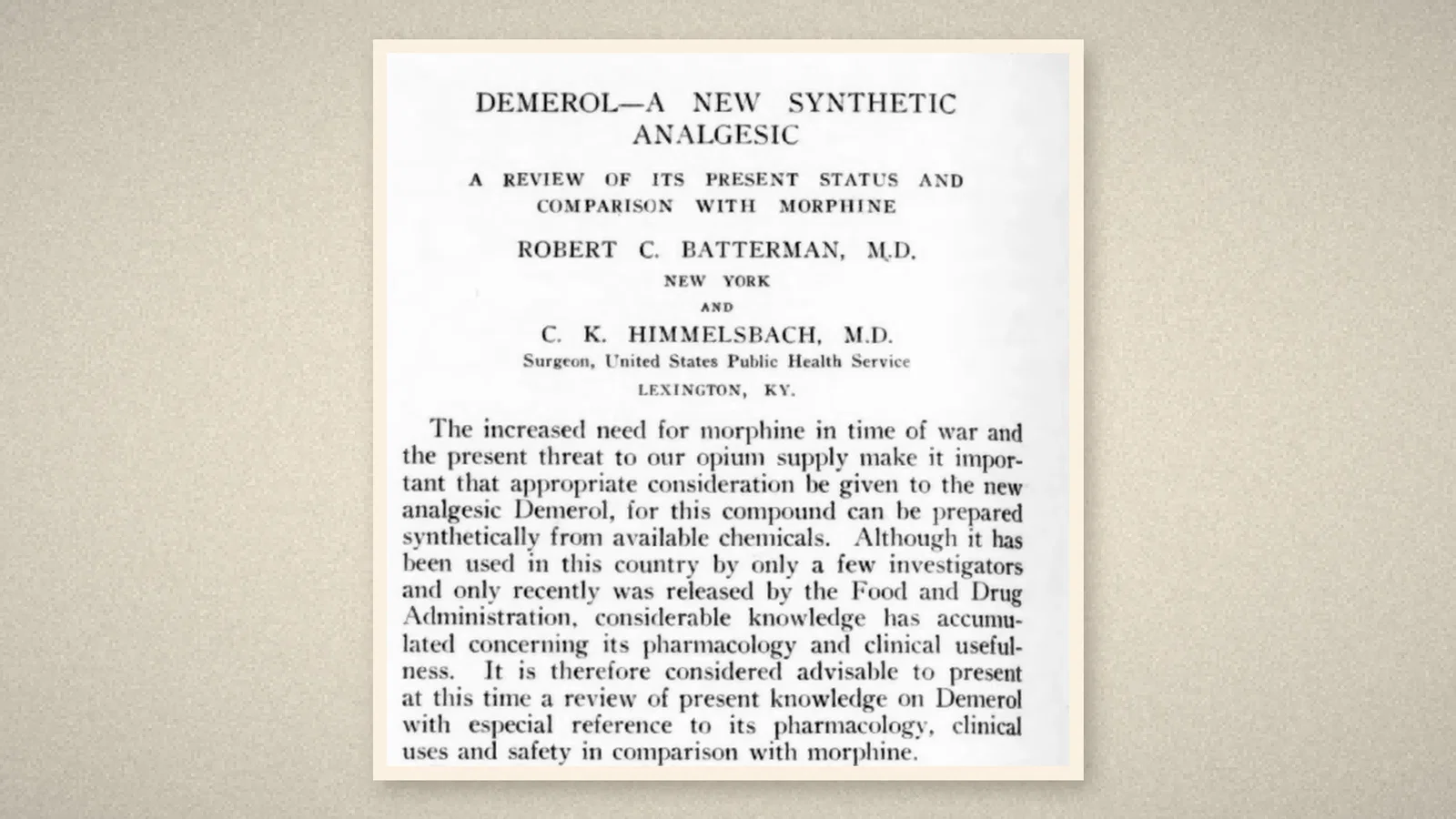
"Demerol—A New Synthetic Analgesic" appeared in JAMA on 22 May 1943. Its authors were Robert C. Batterman of the Department of Therapeutics, New York University, and C. K. Himmelsbach, a surgeon of the United States Public Health Service at Lexington, Kentucky. The opening explains the timing: "The increased need for morphine in time of war and the present threat to our opium supply" made the new analgesic important, because it "can be prepared synthetically from available chemicals". Few American investigators had used it, and the Food and Drug Administration had only recently released it. [1, p. 222]
A spasmolytic that acted like morphine
The compound, a piperidine ester, "was synthesized in 1939 by Eisleb and Schaumann". It was one of a large group of piperidine compounds with spasmolytic properties, and it looked enough like atropine to have mild atropine-like effects. The surprise was "the unexpected finding that the drug had a morphine-like effect on the central nervous system of animals", with analgesia comparable to morphine. The reviewers summed up three main actions: analgesia, spasmolysis and sedation. In patients it relieved colicky pain quickly and did not cause constipation. [1, p. 222][1, p. 223]
Before the anaesthetic
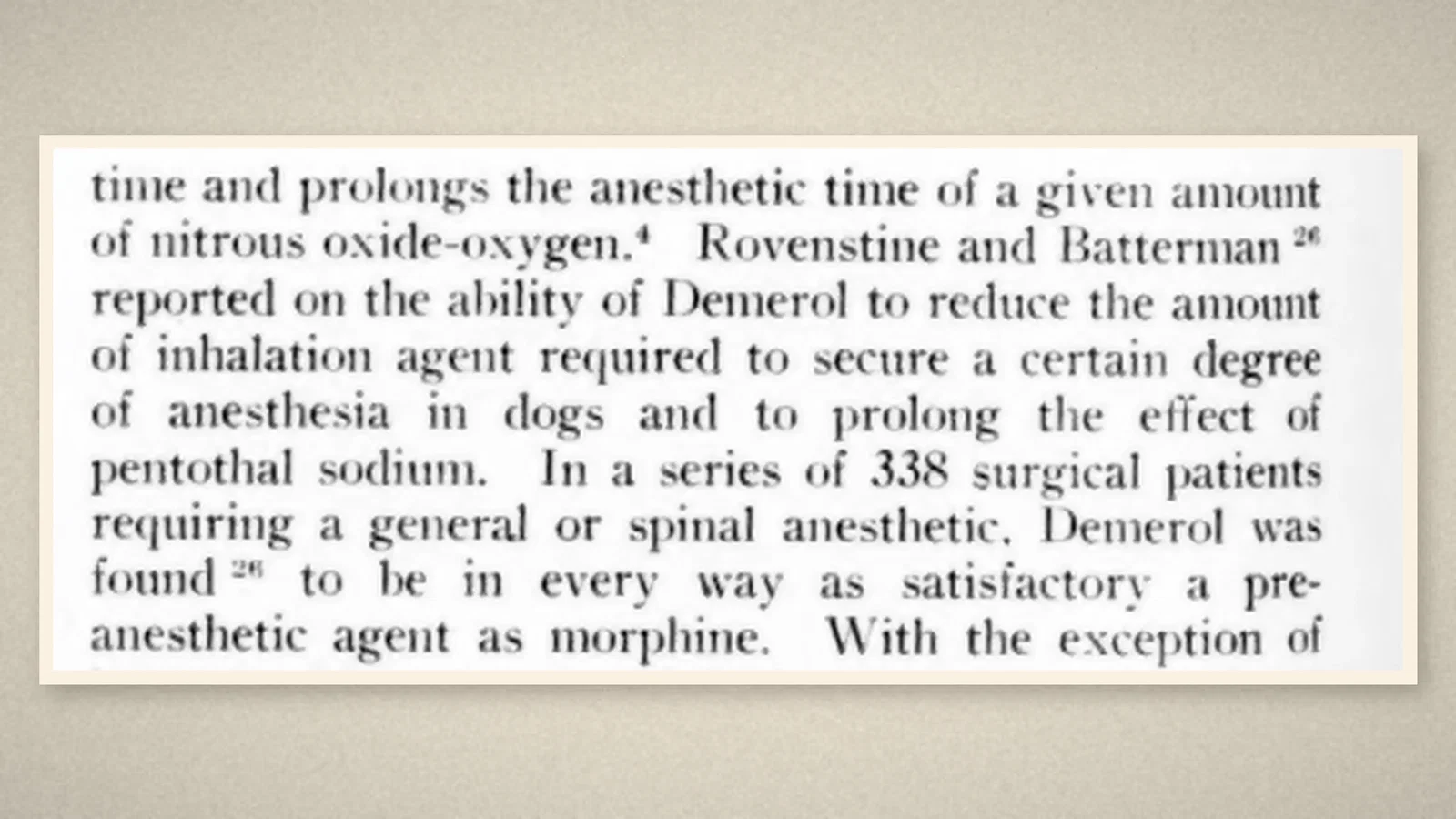
The anaesthetic use came fast. Rovenstine and Batterman reported that Demerol reduced the amount of inhalation agent needed for a given depth of anaesthesia in dogs and prolonged the effect of pentothal sodium. "In a series of 338 surgical patients" needing general or spinal anaesthesia, it was found to be in every way as satisfactory a preanaesthetic agent as morphine. Respiratory depression was unusual in people, except in hypersensitive persons such as those with advanced cerebral arteriosclerosis; but every investigator had seen transitory respiratory depression in animals, and large intravenous doses could kill by respiratory paralysis. [1, p. 224]
In August 1943 Morris J. Nicholson of Boston included the drug in a review of regional anaesthesia for the New England Journal of Medicine. "In 1939, Eisleb and Schaumann" had introduced it, and it had properties like atropine and morphine. Nicholson quoted Rovenstine and Batterman's conclusions: psychic sedation "not surpassed by morphine", less depression of respiration than comparable amounts of morphine, easier induction, better drying of secretions, less nausea and vertigo, and the same saving of anaesthetic agent as morphine gave. [2, p. 244][2, p. 245][2, p. 246]
The habit question
The JAMA review gave separate sections to tolerance and addiction. "With any drug possessing morphine-like action on the central nervous system", addiction had to be considered. Some subjects found the effect pleasant and wanted to repeat it; others found it disagreeable. [1, p. 225]
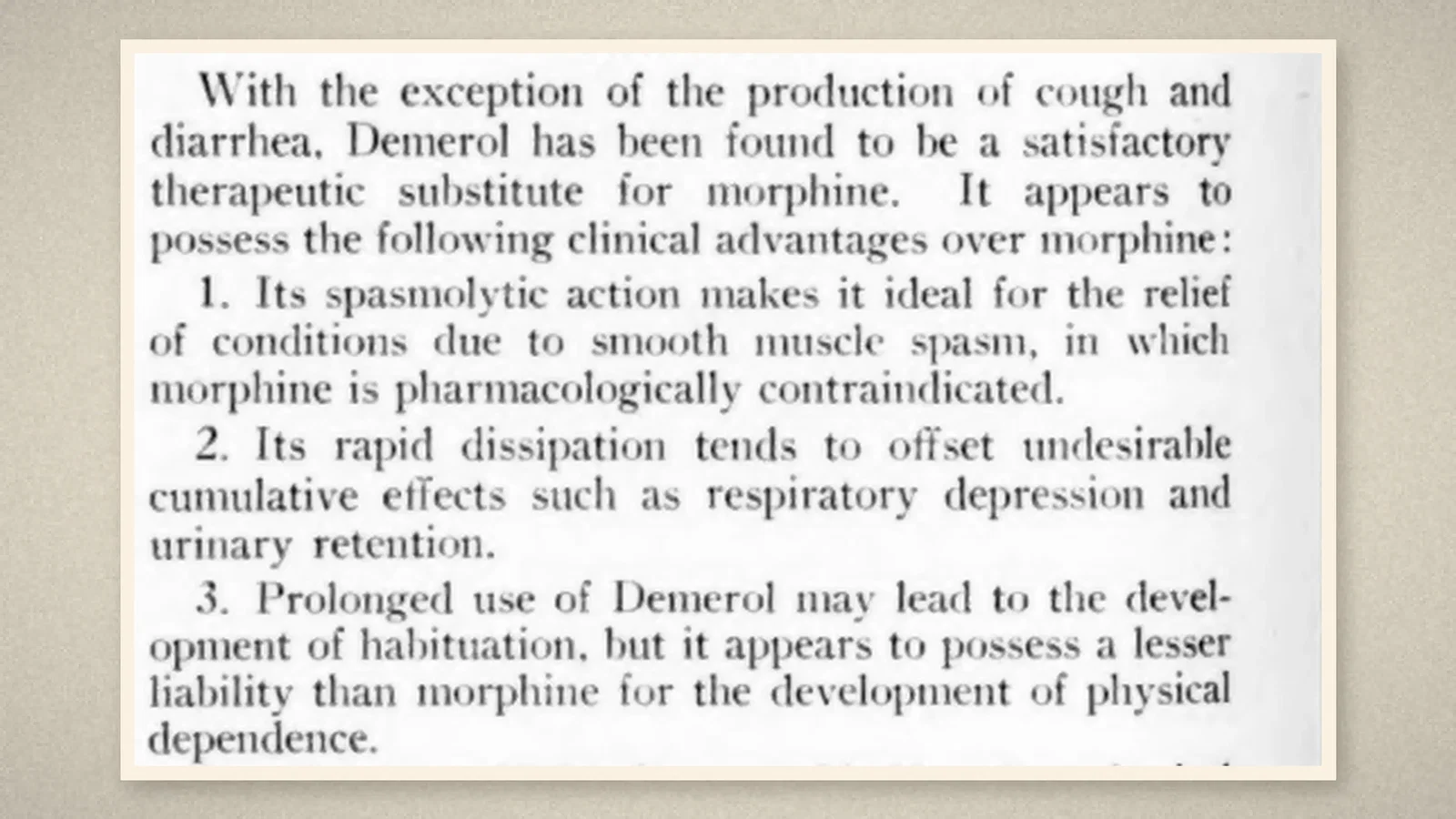
The conclusion was balanced. Apart from cough and diarrhoea, Demerol "has been found to be a satisfactory therapeutic substitute for morphine". But prolonged use "may lead to the development of habituation", although it appeared to carry a lesser liability than morphine for physical dependence. The authors also set an upper limit on the amount to be given. [1, p. 226]
What the record shows
A drug chosen for one property and valued for another. Pethidine came into American practice under wartime shortage, and within months it was being given before anaesthesia as a replacement for morphine. The same review that welcomed it already said that it could form a habit. How the risk compared with morphine in the end is outside these pages.
Sources and reading limits
Read: Robert C. Batterman and C. K. Himmelsbach, "Demerol—A New Synthetic Analgesic: A Review of Its Present Status and Comparison with Morphine", JAMA 22 May 1943, pp. 222-226, in full (tables skimmed); Morris J. Nicholson, "Regional Anesthesia", New England Journal of Medicine 5 August 1943, from p. 244, the opening and the section on new drugs (pp. 245-246).
Not covered: Eisleb and Schaumann's paper in the Deutsche medizinische Wochenschrift of 1939 and the other German clinical papers the reviews cite; Schaumann's later pharmacological paper; Rovenstine and Batterman's own paper in Anesthesiology (the Internet Archive copy is lending-only and was not opened); later use of pethidine in anaesthesia and later reports of addiction.
Limits: some timelines date this topic to 1937; the reviews give 1939, the year of the German paper, and an earlier laboratory date is not established here. Everything about the German work is second-hand through the 1943 reviews. Eisleb's and Schaumann's first names were not printed in the pages read. Doses, dose limits and potency ratios are not repeated, and the page crops leave them out. The name pethidine (meperidine) is used for the compound the reviews call Demerol and Dolantin.
Three illustrations are crops of JAMA, 22 May 1943 (pp. 222, 224 and 226); one is a text diagram drawn from the two reviews, with no people drawn and no doses shown.
- Batterman RC, Himmelsbach CK. Demerol—a new synthetic analgesic: a review of its present status and comparison with morphine. JAMA. 1943;122(4):222-6. Internet Archive
- Nicholson MJ. Regional anesthesia. N Engl J Med. 1943;229(6):244-9. Internet Archive
Continue exploring
Related reading connects shared questions and contexts; it does not by itself establish historical influence.
- 1916: Freund and Speyer Make Oxycodone from Thebaine
- 1914: The Harrison Act Brings Opium and Coca Under Control
- 1817: Sertürner Publishes 'Ueber das Morphium'
Anesthesia Epochs · The Source Room · About & Editorial Method
Published November 3, 2026. Sources and reading limits are stated above. Illustrations are labelled as original source images or AI-made. Historical accounts are educational; they are not current treatment instructions.