
Peter A. Cheng of Torrance, California, showed a blunt-nosed epidural needle graduated in centimetres, with a sliding flange to grip it through the ligaments; a hospital trade journal listed it in February 1958, and a naval hospital later reported more than a thousand blocks with it.
Reading Library · Anesthesia Epochs · 中文版
Watch the education video (for clinicians)
1958: Cheng's Graduated Epidural Needle — A Ruler on the Needle · Anesthesia Epochs Education Series
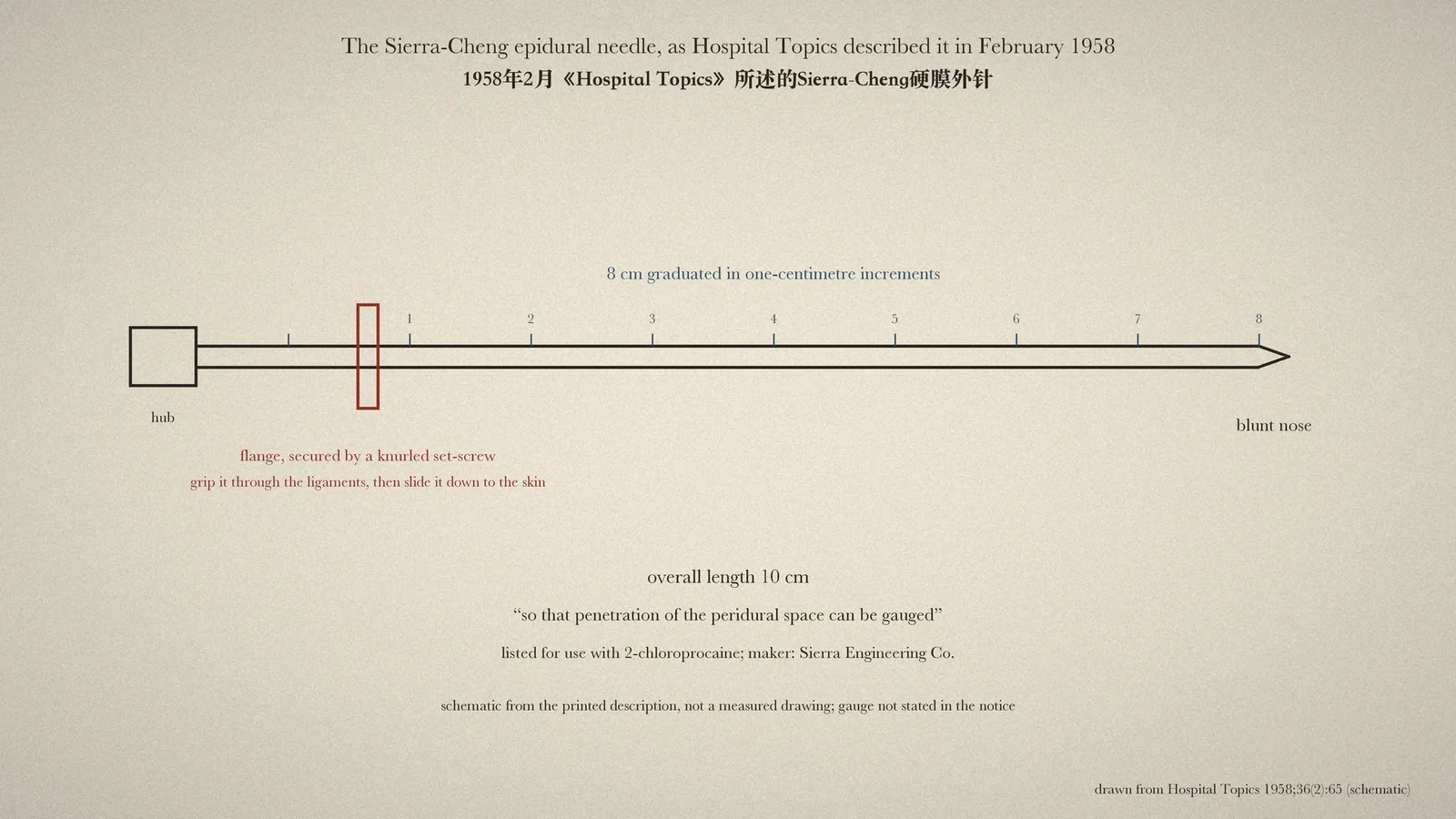
Finding the epidural space is a matter of millimetres, and for most of its early history the operator had nothing on the needle to count them by. In 1958 Peter A. Cheng, an anaesthesiologist at Harbor General Hospital in Torrance, California, put a scale on it. The needle was described in Anesthesiology that summer, in an editorial "Current Comment" titled "Blunt-tip needle for epidural anesthesia". This article reads that description, and also how the needle first reached other clinicians: a product notice and a meeting photograph in a hospital trade journal, and a large evaluation by a naval hospital four years later. [4][1][2][3]
The notice
The February 1958 issue of Hospital Topics listed it as item 447 in its Buyer's Guide. "New Sierra-Cheng epidural needle is intended for use with the anesthetic agent 2-Chloroprocaine hydrochloride. The needle is blunt-nosed, with an over-all length of 10 cm., of which 8 cm. is graduated in one-centimeter-increments so that penetration of the peridural space can be gauged." A flange, "secured by a knurled set-screw", gave the operator something to grip while the needle went through the supraspinous and interspinous ligaments, and could then be slid down the needle until it touched the skin. The maker was Sierra Engineering Co. [1]
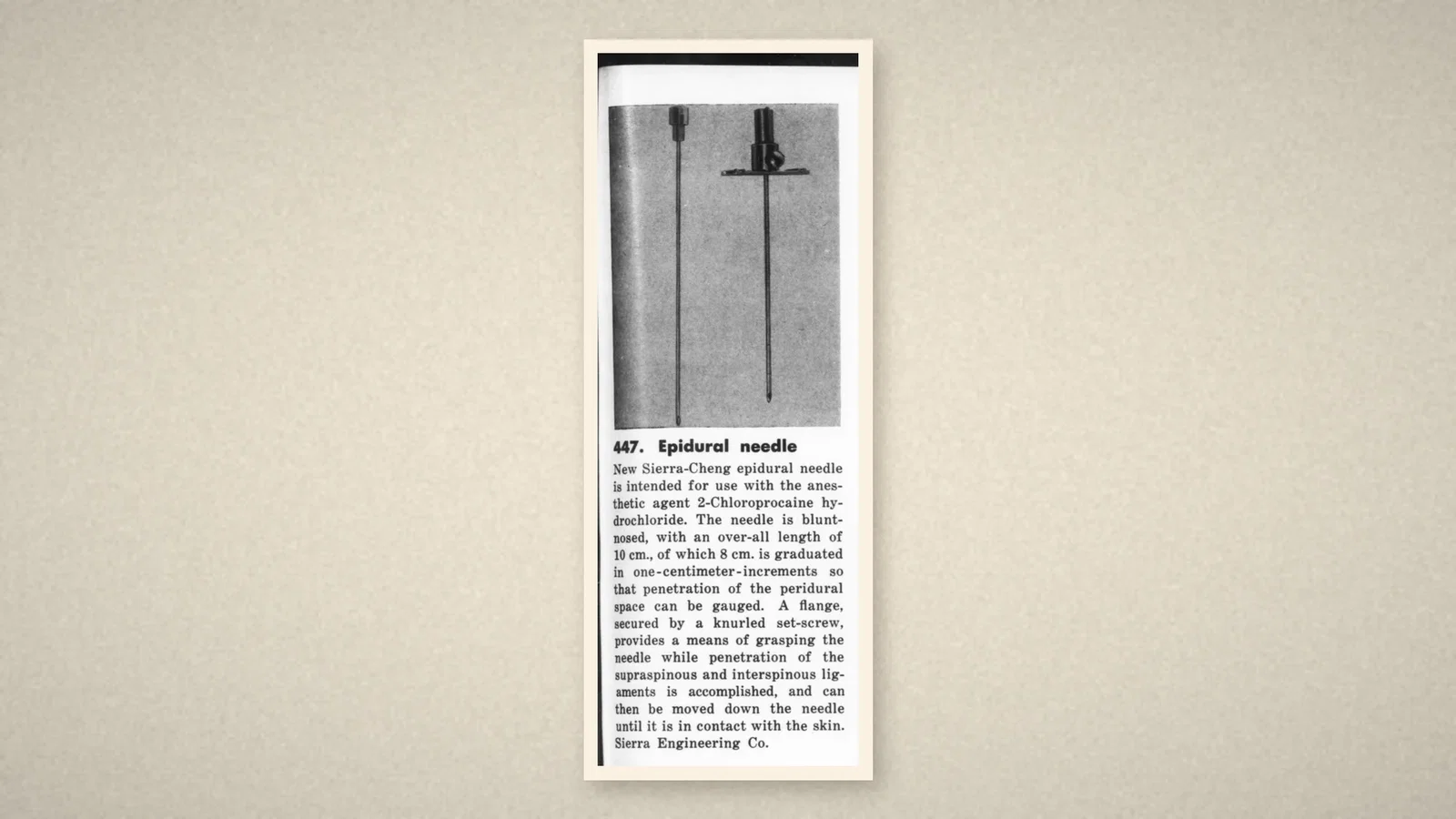
The photograph above the text shows two parts side by side: a plain needle and one carrying the flange near the hub. The notice gives no gauge, and the drawing at the top of this article follows the words, not a measured specimen.
The exhibit
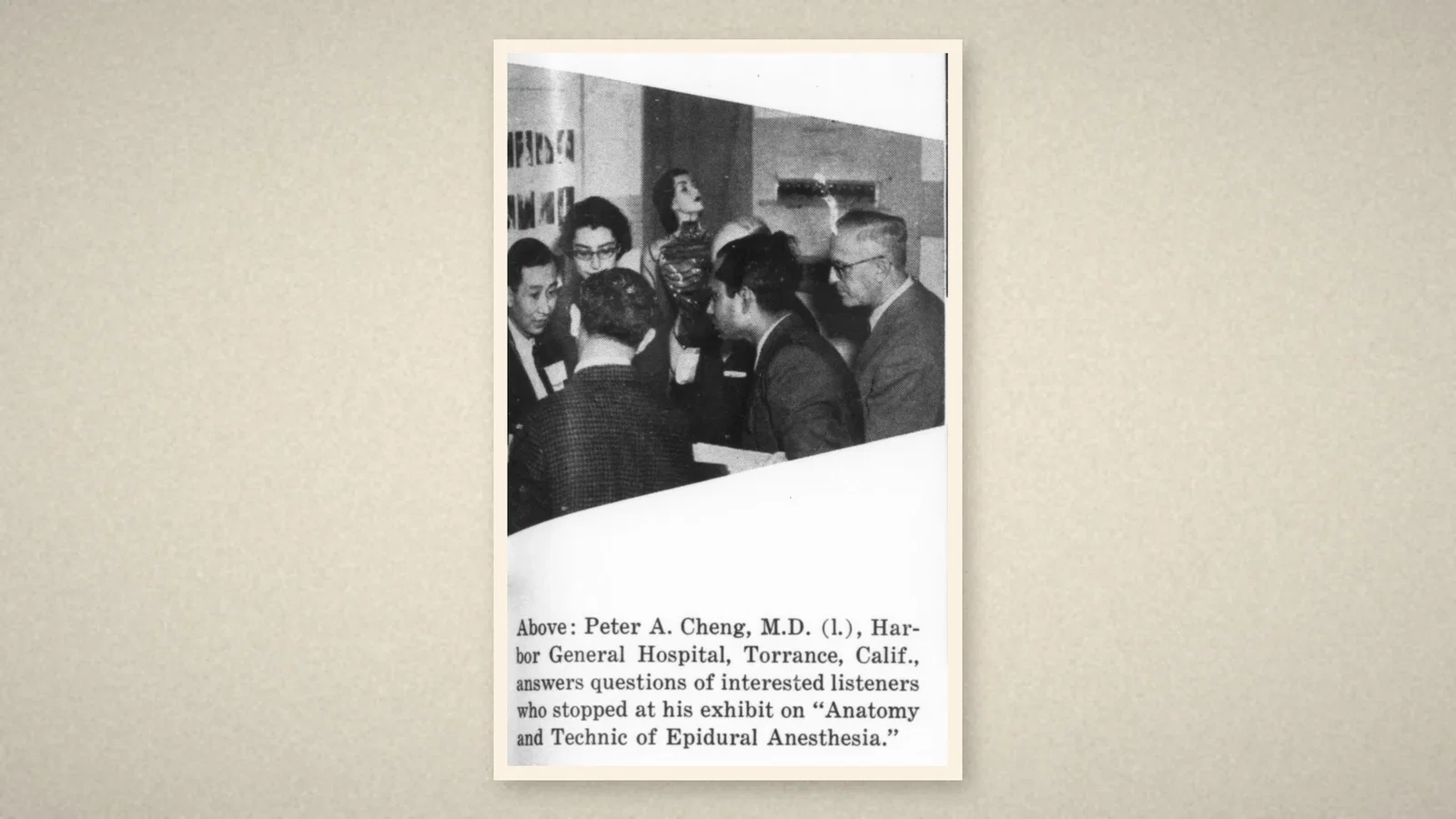
The same issue reported the New York State Society of Anesthesiologists' eleventh annual postgraduate assembly, held in New York City in mid-December. Among its photographs is one of "Peter A. Cheng, M.D. (l.), Harbor General Hospital, Torrance, Calif.", answering questions from listeners at an exhibit titled "Anatomy and Technic of Epidural Anesthesia". Cheng was teaching the technique, not only selling a needle. [1]
Why a blunt, marked needle
The notice states the purpose of the scale plainly: to let the operator gauge penetration of the peridural space. The San Diego team described below said why they took it up: to avoid the usual disadvantages of epidural block, "inadvertent subarachnoid tap, difficulty in finding the space, and time loss". With the flange set and the centimetres visible, the operator could see how deep the needle was at each step. Jordan Francke's 2023 essay names Cheng, "a California-based physician", as "the first to propose adding centimeter markers to the needle design in 1958"; that priority is Francke's statement, and this article does not test it. [3]
The description in Anesthesiology
The piece appeared in the July-August 1958 issue under "Current Comment", the section edited by Stuart C. Cullen, and is written about Cheng rather than by Cheng. It opens with the problem: "Dr. Peter A. Cheng of Wilmington, California, believes that the principle disadvantage of epidural anesthesia is the unintentional and unrecognized puncture of the dura", a risk that had limited the method's use "even in skilled hands". [4, p. 556]
To design a needle that would not puncture the dura, Cheng studied the epidural space and the underlying dura and arachnoid in the cadaver and in patients during neurosurgical operations; with the hospital machine shop, a blunt-tip needle was made from a conventional spinal needle, then refined after tests and made commercially available. In fresh cadavers and then in patients, the needle was advanced through the epidural space until it met the vertebral body, without puncturing the dura, and the position was confirmed by X-ray films taken in different planes; a sharp spinal needle passed along the same track punctured the dura. In patients the test was not done above the second and third lumbar interspace, the Comment notes, for fear of a compression injury to the spinal cord. [4, p. 556]
The needle itself: "The point is blunt and rounded." A directional oval opening just behind the tip, "as in the Huber needle", let a catheter pass and gave some control over the spread of a single injection. "The shaft is marked in centimeters and millimeters from the tip, to estimate depth of insertion", and a flange, which could be unlocked and slid along the shaft, gave a firm grip and then held the needle steady once it lay in the epidural space. [4, p. 556]
The technique is set out in six steps. A sharp, short-bevelled needle first opens the skin and the outer ligaments. The epidural needle goes in through that track, with the index finger as a stop; the stylet is removed and a few drops of fluid placed in the hub as a negative pressure test; then the operator holds the flange with thumb and index finger of both hands, the other fingers resting on the patient's back "for guidance and support", and advances slowly. Once in the space, the needle "may safely be advanced 2-3 mm. without danger of dural puncture, being sure that the whole orifice of the needle tip is in the epidural space"; the flange is slid down to the skin and screwed tight, and a catheter can be passed for continuous anaesthesia. [4, p. 557]
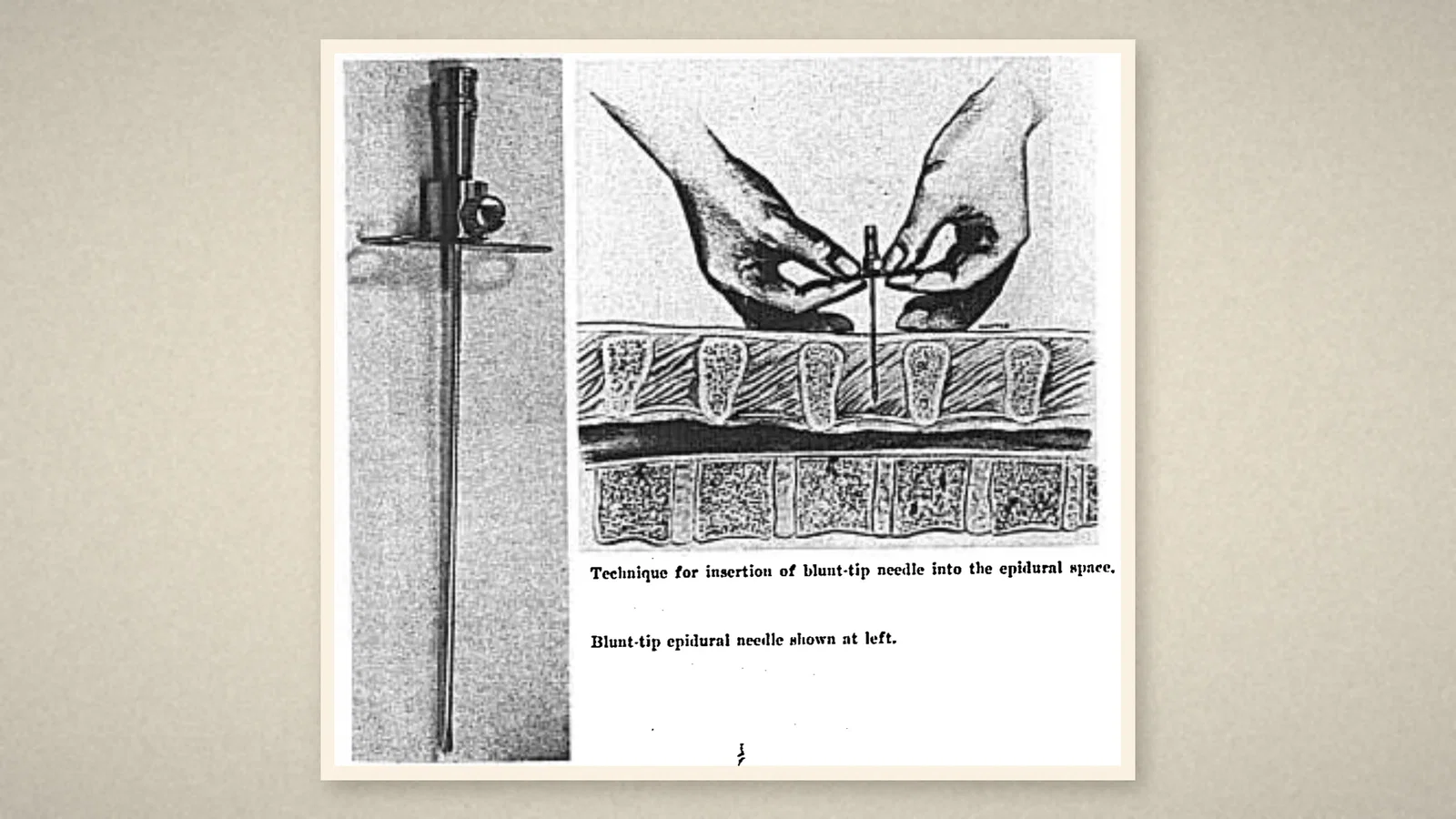
The Comment lists the six advantages Cheng saw, among them no puncture of the dura during insertion above the third lumbar interspace, easy handling with the flange, a scale "for reinsertion of the needle", and a flange that stops the needle going further during injection or catheter insertion. It ends with a caution: "In using any needle, whether sharp or dull, a great degree of care should be exercised to avoid dural puncture", and with this needle too the dura may be punctured if the needle is pushed suddenly against the vertebral body. [4, p. 558]
A thousand blocks
The needle was used widely enough to be studied. In 1962 J. M. Sheehan, I. V. Wright and B. M. Shepard of the US Naval Hospital in San Diego, which performed about 3500 spinal anaesthetics a year, reported 1002 single-dose lumbar epidurals given over ten months with "the blunt-tipped needle, described by Cheng". As the 1963 abstract in the Journal-Lancet records, they found the technique "both easy and rapid"; without a test dose it took no more time and was no more difficult than a spinal, and they judged omitting the test dose safe. The main drawback was postoperative backache or soreness at the injection site, which most patients accepted. [2]
What the record shows
The centimetre scale now on epidural needles is easy to take for granted. In 1958 it arrived as a practical device from a clinician in California, sold with a sliding flange and shown at a teaching exhibit, and within four years it had been tested in more than a thousand patients. The article keeps those dated pieces, with the 1958 description of how the needle was meant to be used.
Sources and reading limits
Read: the Current Comment in Anesthesiology 1958;19(4):556-9, in full; Hospital Topics, February 1958, the meeting report and Buyer's Guide; the 1963 Journal-Lancet abstract of Sheehan, Wright and Shepard; Francke's 2023 essay.
Not covered: the full 1962 paper by Sheehan and colleagues; later presentations on the Cheng needle; any paper signed by Cheng.
Limits: the 1958 Comment is an editorial report in the third person, cited under Cheng's name; it places Cheng in Wilmington, California, while Hospital Topics gives Harbor General Hospital, Torrance. Its account of the cadaver and patient tests is its report of Cheng's work. The trade notice and the Comment agree on a 10 cm needle with 8 cm of graduation; the Comment adds millimetre marks. The date of the exhibit is given as the journal gives it. Depths, volumes and drugs in the sources are not repeated as doses. Francke's priority claim is Francke's.
Three illustrations are page crops from Hospital Topics and Anesthesiology; one is drawn from the sources.
- Buyer's guide: 447. Epidural needle; and NY anesthesiologists hold 11th PG meet. Hospital Topics. 1958 Feb;36(2):26-7, 65. Internet Archive
- An evaluation of the Cheng needle in the administration of 1002 single-dose lumbar epidural anesthetics [abstract of Sheehan JM, Wright IV, Shepard BM. Anesth Analg. 1962;41:552-6]. Journal-Lancet. 1963 Jul;83:292-3. Internet Archive
- Francke J. The danger of using a medical eponym: missing the point of the Tuohy needle. CSA Bulletin. 2023 May 16. CSA
- Blunt-tip needle for epidural anesthesia [Current Comment, Cullen SC, ed.; Cheng PA]. Anesthesiology. 1958;19(4):556-9. DOI
Continue exploring
Related reading connects shared questions and contexts; it does not by itself establish historical influence.
- 1954: Hustead Sands Down the Point of the Tuohy-Flowers Needle
- 1949: Flowers, Hellman and Hingson Run a Tube into the Epidural Space
- 1944: Tuohy Threads a Ureteral Catheter into the Spinal Space
Anesthesia Epochs · The Source Room · About & Editorial Method
Published November 2, 2026; updated November 3, 2026. Sources and reading limits are stated above. Illustrations are labelled as original source images or AI-made. Historical accounts are educational; they are not current treatment instructions.