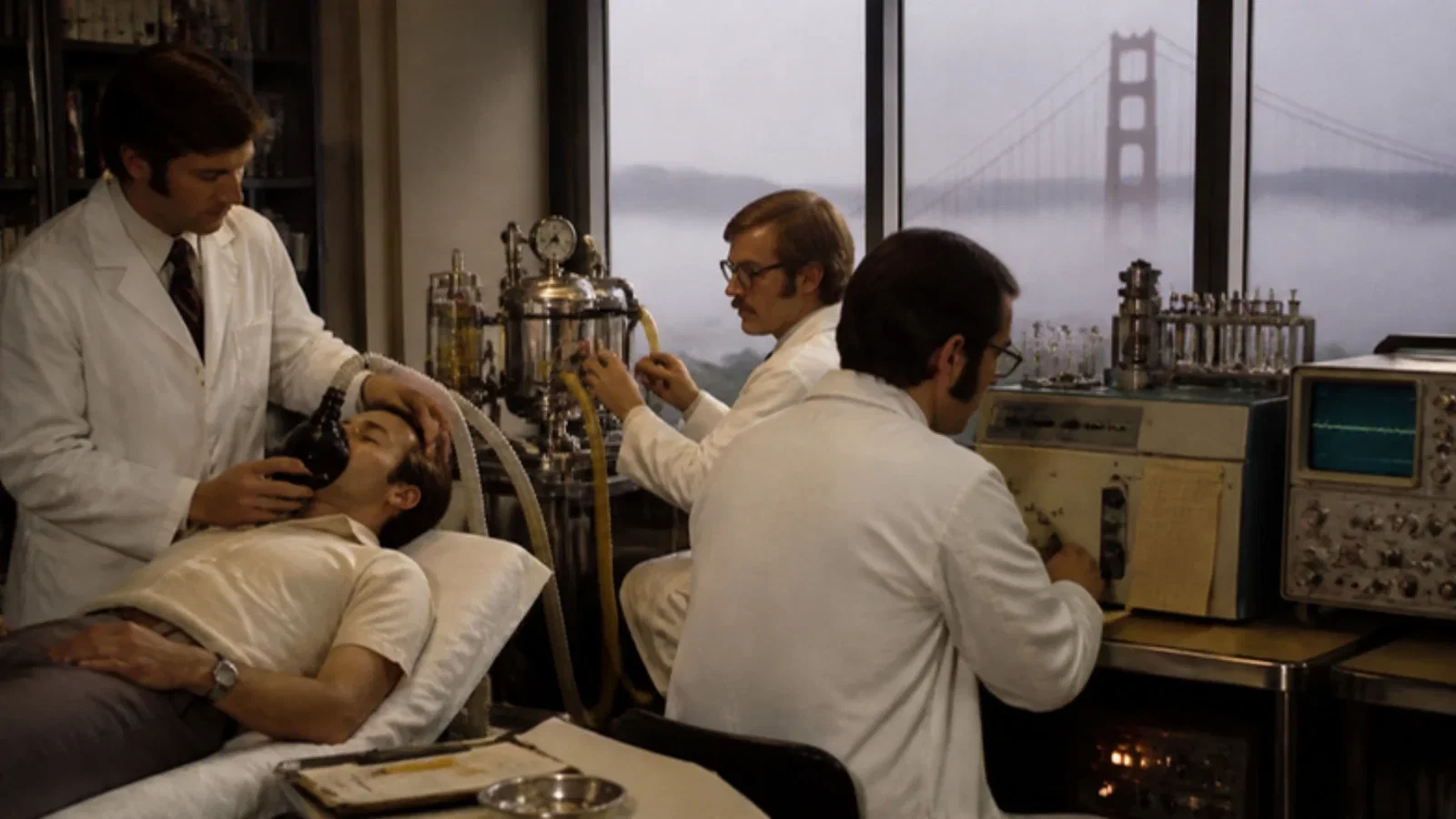
In July 1971 Anesthesiology (vol. 35) printed a paper by Wendell C. Stevens, Edmond I. Eger II and four colleagues of the University of California, San Francisco, presented in part in New York in October 1970 and accepted on 10 March 1971, with support from Ohio Medical Products. Laboratory comparisons had shown that the new agent Forane (Compound 469) did not sensitize the dog myocardium to epinephrine, was not metabolized by the liver in miniature swine, and had a lower blood-gas partition coefficient for more rapid emergence; its only disadvantage was a slightly more pungent odour. In seven unpremedicated healthy male volunteers at constant arterial carbon dioxide tension, myocardial function was maintained while vessels progressively dilated and arterial pressure fell, cardiac output being kept up by heart rate. In May-June 1972 Homi, Eckenhoff and colleagues of Northwestern University, Chicago, reported 100 patients in Anesthesia and Analgesia: Forane, an isomer of enflurane, gave salivation, excitement, coughing or breath-holding and laryngospasm when used alone for induction, and worked better with thiopental and nitrous oxide; cardiac rhythm was particularly stable, and the twitching and seizure-like EEG patterns of enflurane were not seen.
Reading Library · Anesthesia Epochs · 中文版
Watch the education video (for clinicians)
1971: Forane (Isoflurane) — Output Is Not Pressure · Anesthesia Epochs Education Series
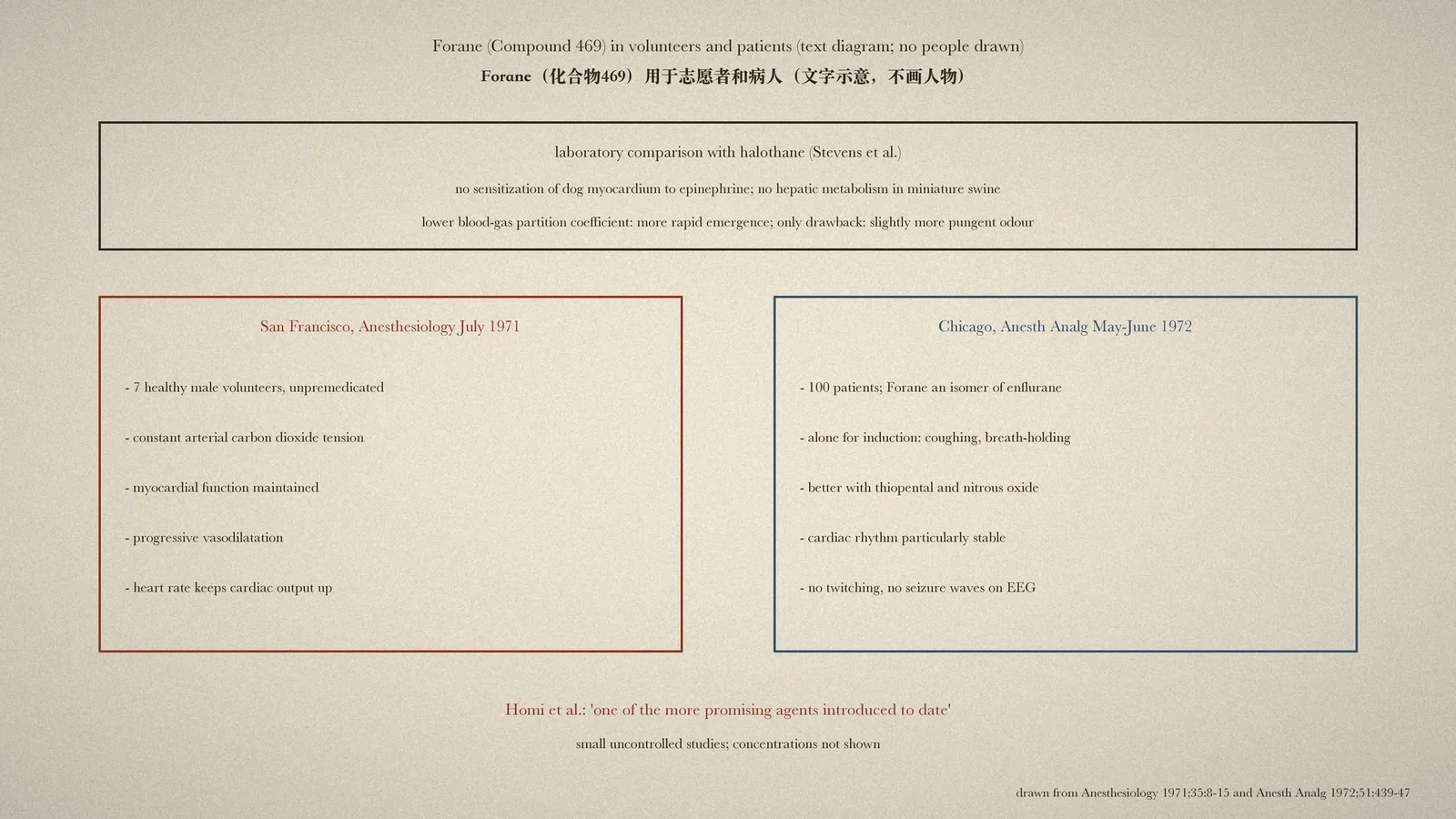
After enflurane, another fluorinated ether entered human study, and it was enflurane's "isomer": the same atoms arranged differently. Two papers record a set of early human observations of the new agent: a volunteer study in San Francisco in 1971 and 100 patients in Chicago in 1972. Its name at the time was Forane, and its code was Ohio Compound 469. [1, p. 8][2, p. 439]
A laboratory comparison with halothane
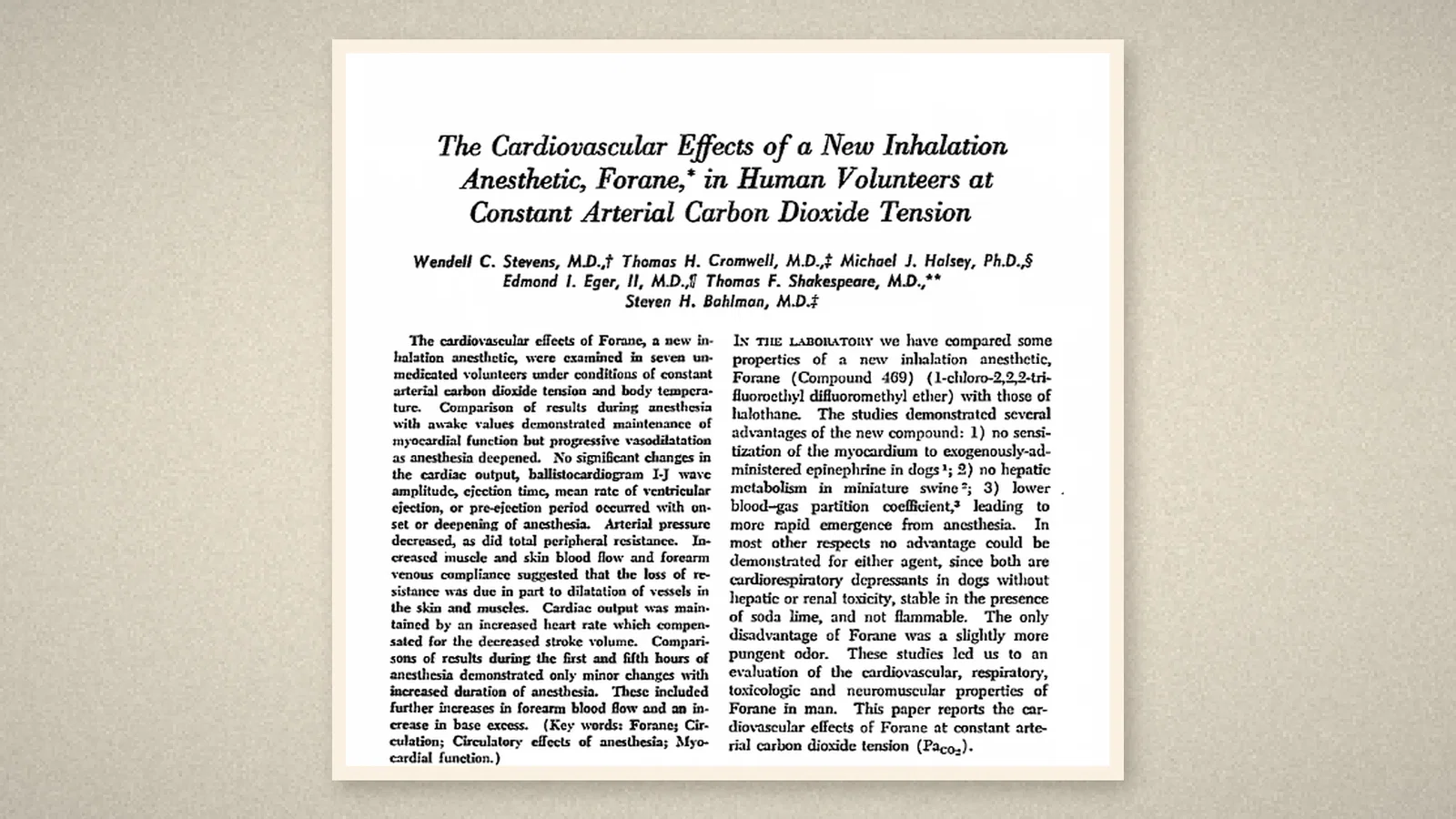
In July 1971 Anesthesiology printed a paper by Wendell C. Stevens, Thomas H. Cromwell, Michael J. Halsey, Edmond I. Eger II and Steven H. Bahlman of the University of California, San Francisco, with Thomas F. Shakespeare of Stanford. It had been presented in part at the American Society of Anesthesiologists' meeting in New York in October 1970 and was accepted on 10 March 1971. The US Public Health Service and Ohio Medical Products, whose trademark Forane was, supported the work in part. [1, p. 8]
The introduction says that the authors had compared Forane with halothane in the laboratory, and that the new agent had several advantages. It did not sensitize the dog myocardium to exogenous epinephrine. It showed no hepatic metabolism in miniature swine. Its lower blood-gas partition coefficient led to more rapid emergence. In most other respects neither agent had an edge, and "the only disadvantage of Forane was a slightly more pungent odor". These studies led them to evaluate it in man. [1, p. 8]
Seven volunteers
Seven healthy male volunteers gave informed consent and breathed Forane without premedication, with arterial carbon dioxide tension and body temperature held constant. The abstract reports that, compared with the awake state, myocardial function was maintained but vessels dilated progressively as anaesthesia deepened. Cardiac output and several indices of contractility did not change significantly. Arterial pressure and total peripheral resistance fell, and muscle and skin blood flow rose. Stroke volume fell, and cardiac output was kept up by a faster heart rate. [1, p. 8]
One hundred patients in Chicago
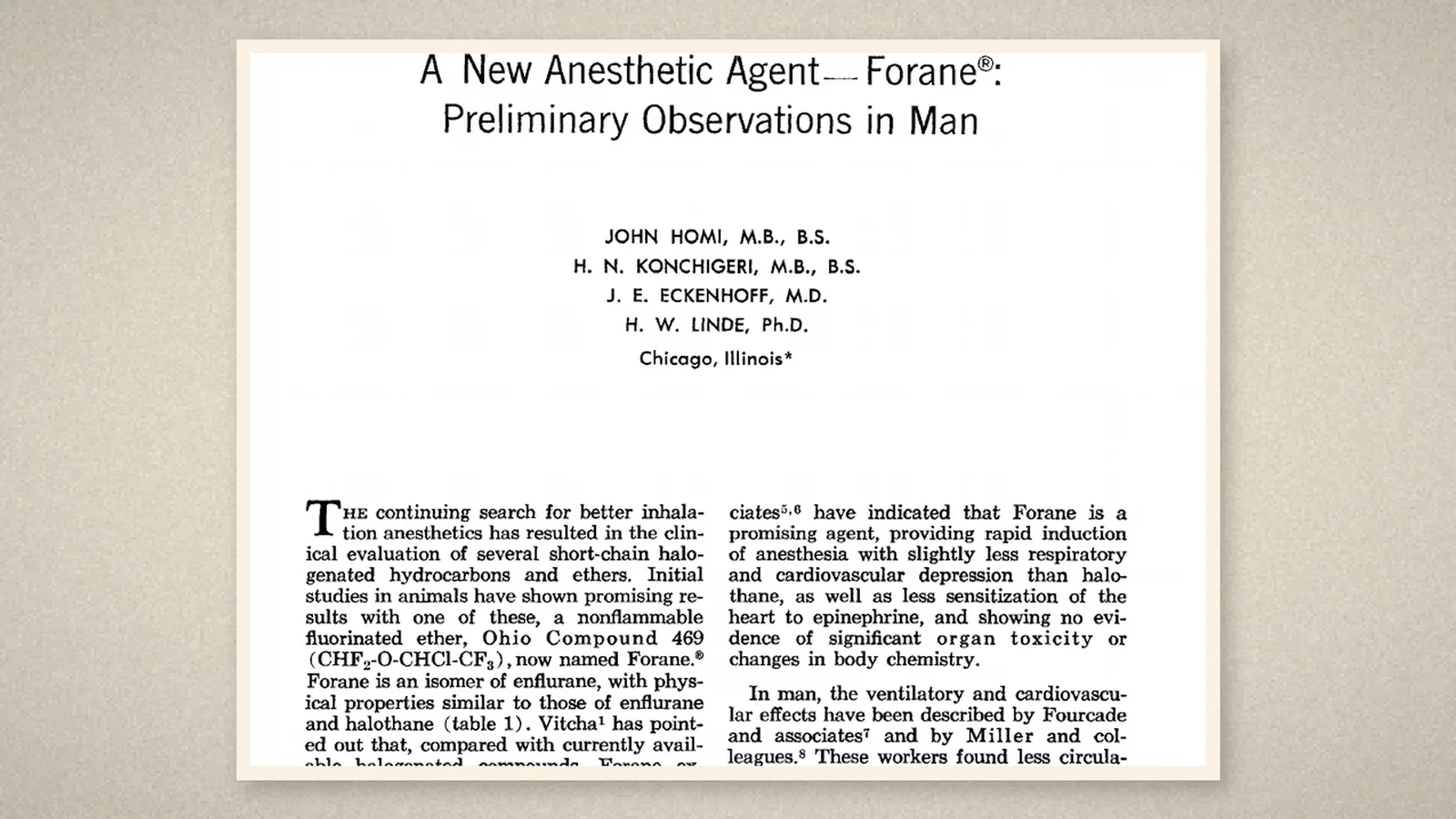
In May-June 1972 Anesthesia and Analgesia printed a paper by John Homi, H. N. Konchigeri, J. E. Eckenhoff and H. W. Linde of Northwestern University Medical School and the Veterans Administration Research Hospital, Chicago. Its title ends with a question mark: "A new anesthetic agent - Forane? Preliminary observations in man". It had been presented in part at the Midwest Anesthesia Residents Conference in Chicago in May 1971. The opening explains that a non-flammable fluorinated ether, "Ohio Compound 469", promising in animals, was now named Forane, and that "Forane is an isomer of enflurane". [2, p. 439]
The authors gave Forane to 100 patients aged 23 to 75, of ASA status I to IV. [2, p. 440] In 20 unpremedicated patients induced with Forane in oxygen there was salivation, excitement, coughing or breath-holding, and laryngospasm. These features were less evident with adequate premedication and with thiopental and nitrous oxide added. [2, p. 441]
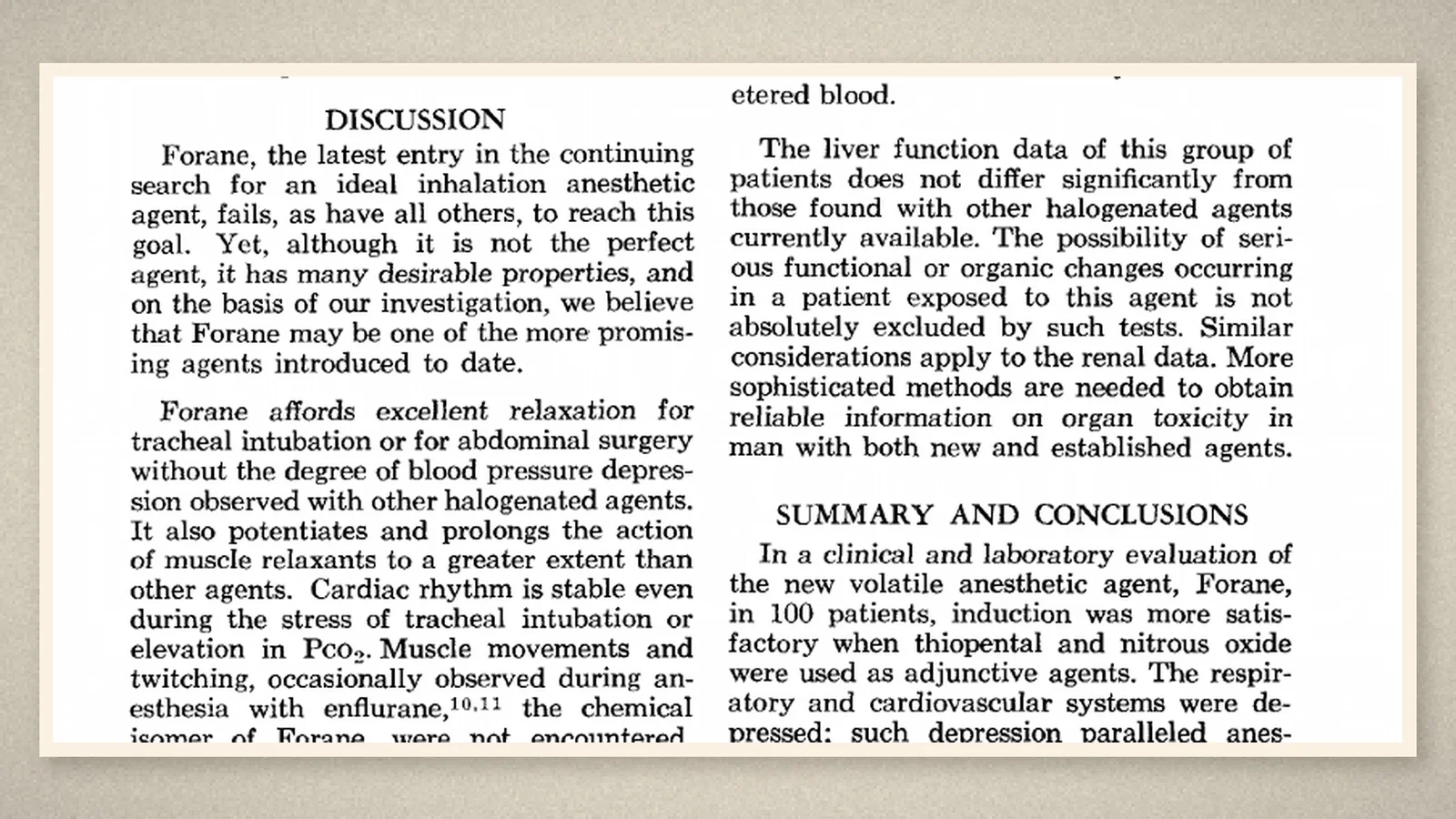
The summary reports that breathing and circulation were depressed in step with depth, but that this was easily controlled by the usual means. Cardiac rhythm was particularly stable, even during intubation or a rise in carbon dioxide. Muscle relaxation was extremely good and relaxants were markedly potentiated. Emergence was generally smooth, though shivering was common. One line of the discussion speaks directly to enflurane: the muscle movements and twitching occasionally seen with enflurane, "the chemical isomer of Forane, were not encountered", and no EEG patterns suggestive of seizure waves were seen. [2, p. 446]
The discussion opens with a measured judgement. Forane, like every other agent, failed to reach the goal of the ideal inhaled anaesthetic. Yet it had many desirable properties, and the authors believed that it "may be one of the more promising agents introduced to date". [2, p. 446]
What the record shows
The difference between two isomers showed up plainly in patients. Forane smelled more pungent and made unpremedicated patients cough and hold their breath at induction, but it did not produce the twitching of its sibling, enflurane. Seven volunteers and a hundred patients make up a set of early human records read here, and neither paper yet uses the later generic name.
Sources and reading limits
Read: Stevens, Cromwell, Halsey, Eger, Shakespeare and Bahlman, Anesthesiology 1971;35:8-15 (title page, abstract, introduction and methods; the results tables and discussion were only skimmed); Homi, Konchigeri, Eckenhoff and Linde, Anesth Analg 1972;51:439-47 (the whole paper, tables skimmed, with page images of pp. 439 and 446 checked). Both are publisher PDFs of the published articles, obtained through institutional access.
Not covered: Terrell's synthesis of the compound (told in an earlier article); the animal studies of Byles, Dobkin and Jones; the earlier observations in man by Fourcade and by Miller that Homi cites; the San Francisco group's companion papers on respiratory and other effects; approval records. The Wood Library-Museum and History of Anaesthesia Society timeline entries were not used as evidence.
Limits: the sources call the agent Forane and Compound 469; the generic name isoflurane does not appear in them. Homi cites earlier observations in man by Fourcade and by Miller that were not read, so this article does not claim that either study read here was the earliest human use. Some timelines date the trials to 1972; Stevens's volunteer paper appeared in July 1971 and had been presented in October 1970. The studies are small and uncontrolled. Concentrations, MAC values and haemodynamic figures are not repeated, and page crops stop before them. Volunteers and patients are not identified.
Three illustrations are crops of Anesthesiology 1971 p. 8 and Anesth Analg 1972 pp. 439 and 446. One is a text diagram drawn from these sources, with no people drawn and no concentrations shown.
- Stevens WC, Cromwell TH, Halsey MJ, Eger EI 2nd, Shakespeare TF, Bahlman SH. The cardiovascular effects of a new inhalation anesthetic, Forane, in human volunteers at constant arterial carbon dioxide tension. Anesthesiology. 1971;35:8-15. DOI
- Homi J, Konchigeri HN, Eckenhoff JE, Linde HW. A new anesthetic agent - Forane: preliminary observations in man. Anesth Analg. 1972;51:439-47. DOI
Continue exploring
Related reading connects shared questions and contexts; it does not by itself establish historical influence.
- 1966: Virtue and Colleagues Report Compound 347, Later Ethrane, in Patients
- 1964: Mushin and Colleagues Find No Excess Liver Damage After Halothane
- 1990: Jones Reports Desflurane in Ten Volunteers
- 1965: Isoflurane Emerges from a Screening Program
Anesthesia Epochs · The Source Room · About & Editorial Method
Published November 3, 2026. Sources and reading limits are stated above. Illustrations are labelled as original source images or AI-made. Historical accounts are educational; they are not current treatment instructions.