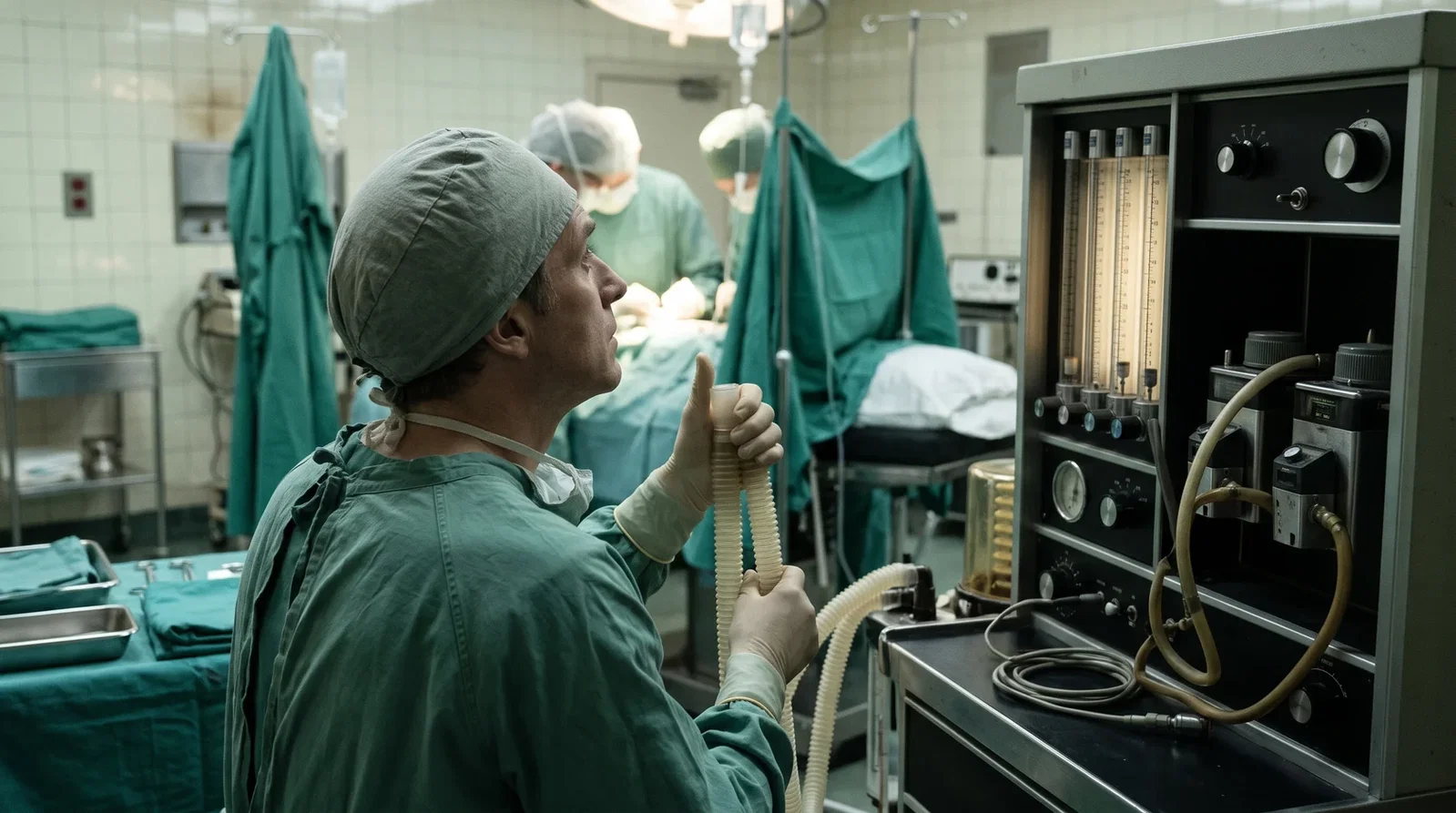
The correspondence pages of Anaesthesia for March 1977 (vol. 32, no. 3, p. 294) carry a short letter from Pierre Foex and A. Crampton Smith of the Nuffield Department of Anaesthetics, University of Oxford, headed 'A test for co-axial circuits' and subheaded 'The Foex-Crampton Smith Manoeuvre'. They had recently had cause to doubt that the structural integrity of a co-axial 'Bain' circuit can be regarded as inevitable: the inner tube, which normally sits within the outer one, may become disconnected at either its proximal, machine, end or its distal, patient, end, the former being the more serious. While the difficulties of a universally applicable test were under discussion, one author inserted an index finger into the patient end of the circuit, occluding the inner tube, and the other, who was gazing at the rotameters, saw the bobbins descend slightly and then recover as the finger was withdrawn. The letter is written in mock-formal style, debating the question of primacy and reporting that statistical analysis of a single observation is in progress; it closes by thanking one colleague for noting that the test also establishes the integrity of the rotameter tubes and another for pointing out that the plunger of a small syringe is more hygienic than a professorial finger. Immediately above it on the same page is a manufacturer's letter warning that co-axial circuits should not be used with demand-flow dental anaesthesia machines or with demand-valve Entonox systems.
Reading Library · Anesthesia Epochs · 中文版
Watch the education video (for clinicians)
1977: The Foex–Crampton Smith Test for Co-axial Circuits · Anesthesia Epochs Education Series
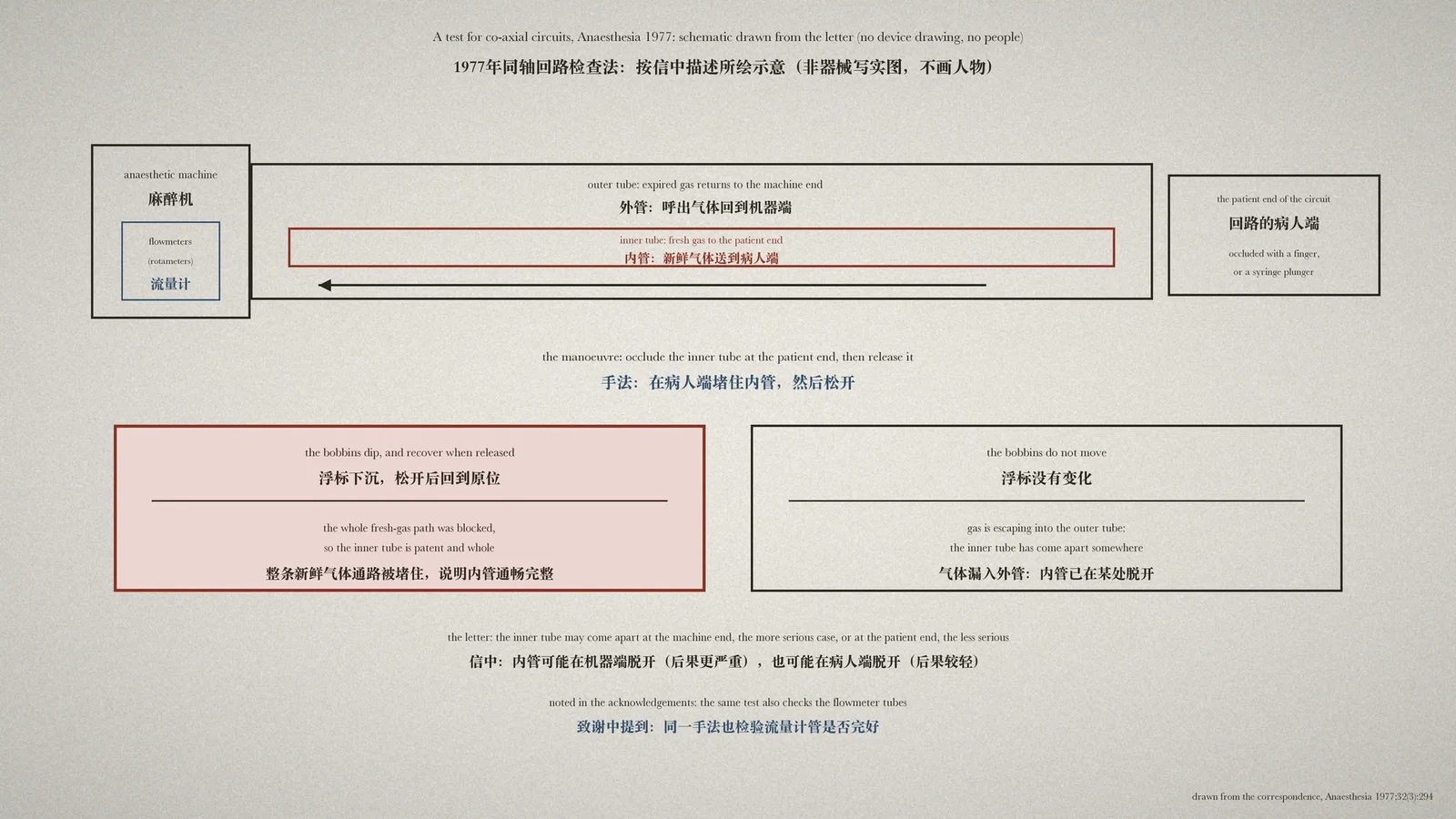
A co-axial circuit puts one tube inside another: fresh gas travels down the inner tube to the patient, and expired gas returns along the outer one to the machine. The advantage is plain, since the expired gases leave the circuit next to the machine rather than beside the patient, which makes connecting a pollution control system very much simpler. The difficulty lies in the same place: the inner tube cannot be seen. If it comes apart, nothing on the outside shows it. In March 1977 the correspondence pages of Anaesthesia, vol. 32, no. 3, p. 294, carried a short letter from Pierre Foex and A. Crampton Smith of the Nuffield Department of Anaesthetics, University of Oxford, headed "A test for co-axial circuits". This article reads that page. [1, p. 294]
The problem: a tube you cannot see
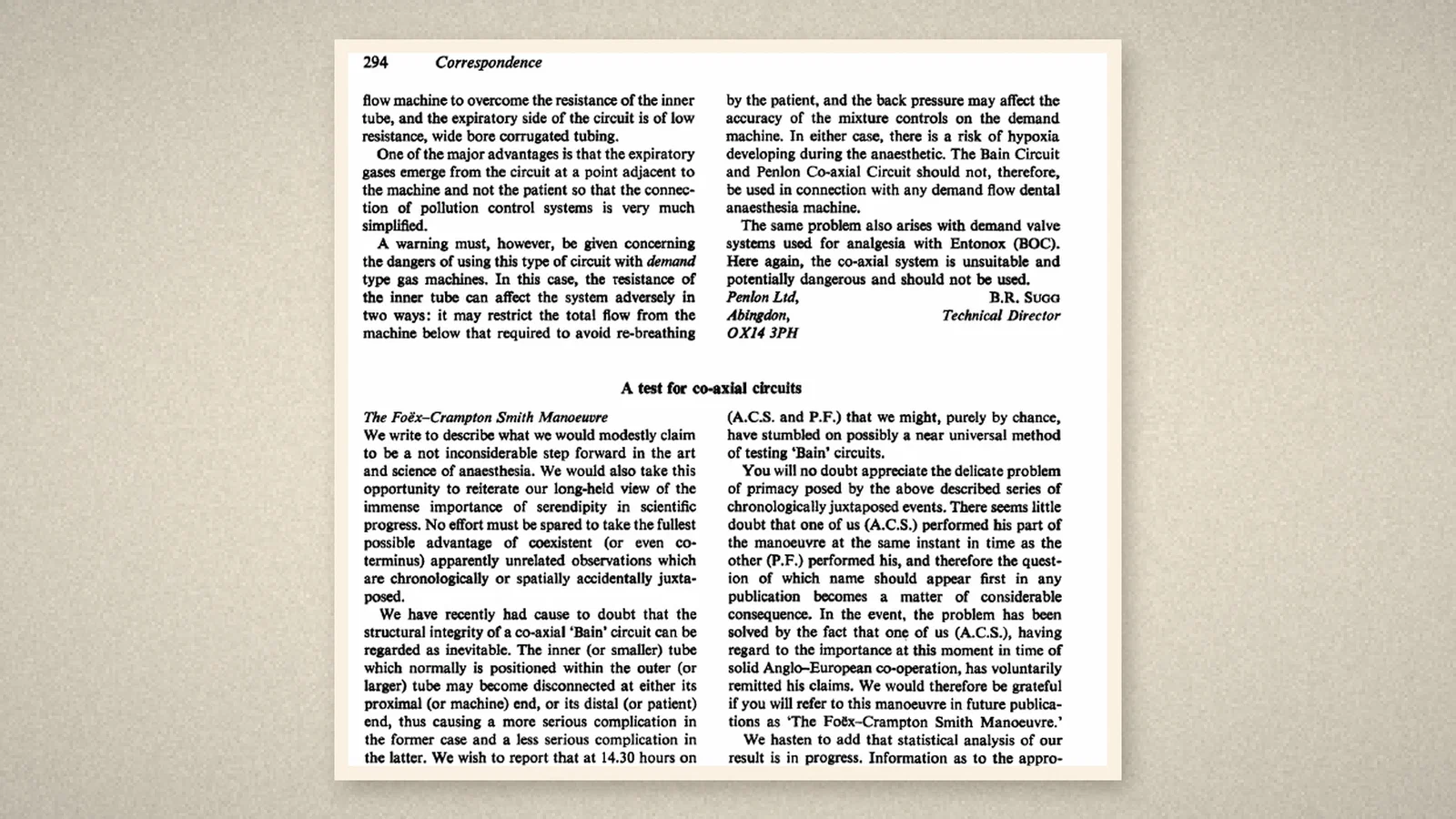
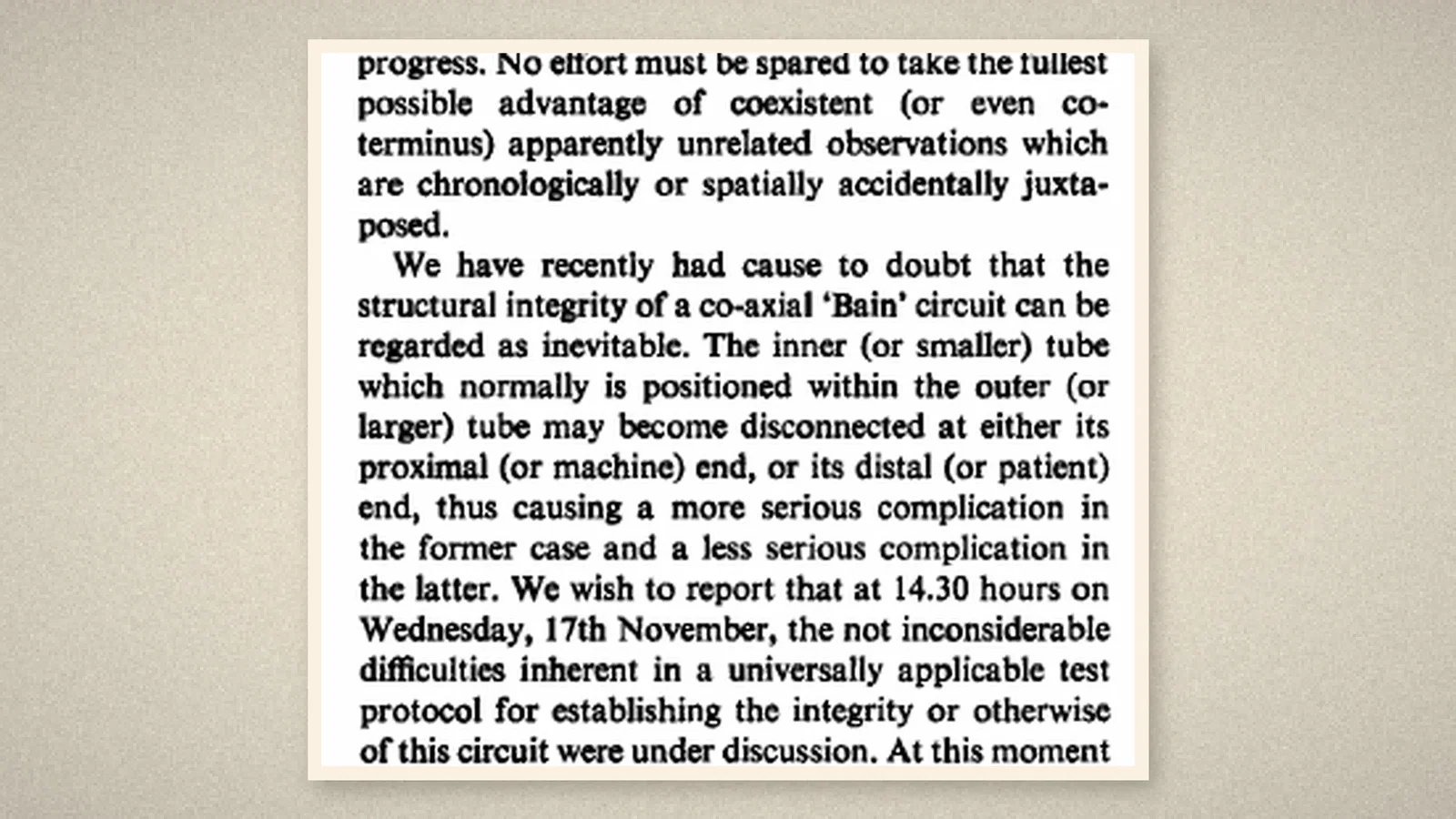
The letter states the problem at once. The authors had recently had cause to doubt that the structural integrity of a co-axial "Bain" circuit can be regarded as inevitable. The inner, smaller tube, which normally sits within the outer, larger one, may become disconnected at either its proximal, machine, end or its distal, patient, end, the former causing the more serious complication and the latter a less serious one. [1, p. 294]
Printed immediately above, on the same page, is a letter from a manufacturer's technical director about the other face of the same design. One of its major advantages, that letter says, is that the expired gases emerge from the circuit at a point adjacent to the machine and not the patient, so that pollution control is much simplified. It then gives a warning: such circuits should not be used with demand-flow dental anaesthesia machines, because the resistance of the inner tube may restrict the total flow from the machine below that required to avoid rebreathing, or the back pressure may affect the accuracy of the mixture controls on the demand machine, with a risk of hypoxia developing during the anaesthetic in either case. The same problem, it adds, arises with demand valve systems used for analgesia with Entonox. [1, p. 294]
The manoeuvre: a finger and a glance at the rotameters
The letter that follows is the one still quoted. It opens with a whole paragraph on the immense importance of serendipity in scientific progress, insisting that no effort be spared to take advantage of apparently unrelated observations that happen to be juxtaposed in time or space. [1, p. 294]
The occasion was a discussion of exactly this difficulty: how to devise a universally applicable test protocol for establishing whether such a circuit is intact. At that moment one of the authors, having nothing better to do, inserted an index finger into the distal, patient, end of the "Bain" circuit, so occluding the inner tube. The other, who was at that moment gazing vacantly in the general direction of the rotameters on the anaesthetic machine, noticed that as the movement began the rotameters descended slightly within their housings, and that as the finger was withdrawn they recovered their original position. [1, p. 294]
It occurred to both, they write, that purely by chance they might have stumbled on possibly a near universal method of testing "Bain" circuits. [1, p. 294]
The reasoning is easy to follow. Fresh gas can reach the patient only through the inner tube. If that tube is intact, occluding its far opening blocks the whole fresh-gas path, and the bobbins in the flowmeters on the machine fall in response. If the inner tube has come apart somewhere, the gas escapes into the outer tube instead, and occluding the far end changes nothing on the flowmeters. A dip, in other words, says the inner tube is both patent and whole.
A letter half in jest
The tone deserves reading. The authors solemnly consider the delicate problem of primacy: since both actions occurred at the same instant, which name should come first becomes a matter of considerable consequence, and the matter was settled when one of them, with regard to the importance of solid Anglo-European co-operation, voluntarily remitted all claims. They therefore ask that the manoeuvre be referred to in future publications as the Foex-Crampton Smith Manoeuvre. [1, p. 294]
They add, with a straight face, that statistical analysis of their result is in progress; information on the appropriate test to apply to a single observation is elusive, but if the literature proves unhelpful a test will be constructed, and they would be grateful for any advice readers can give. [1, p. 294]
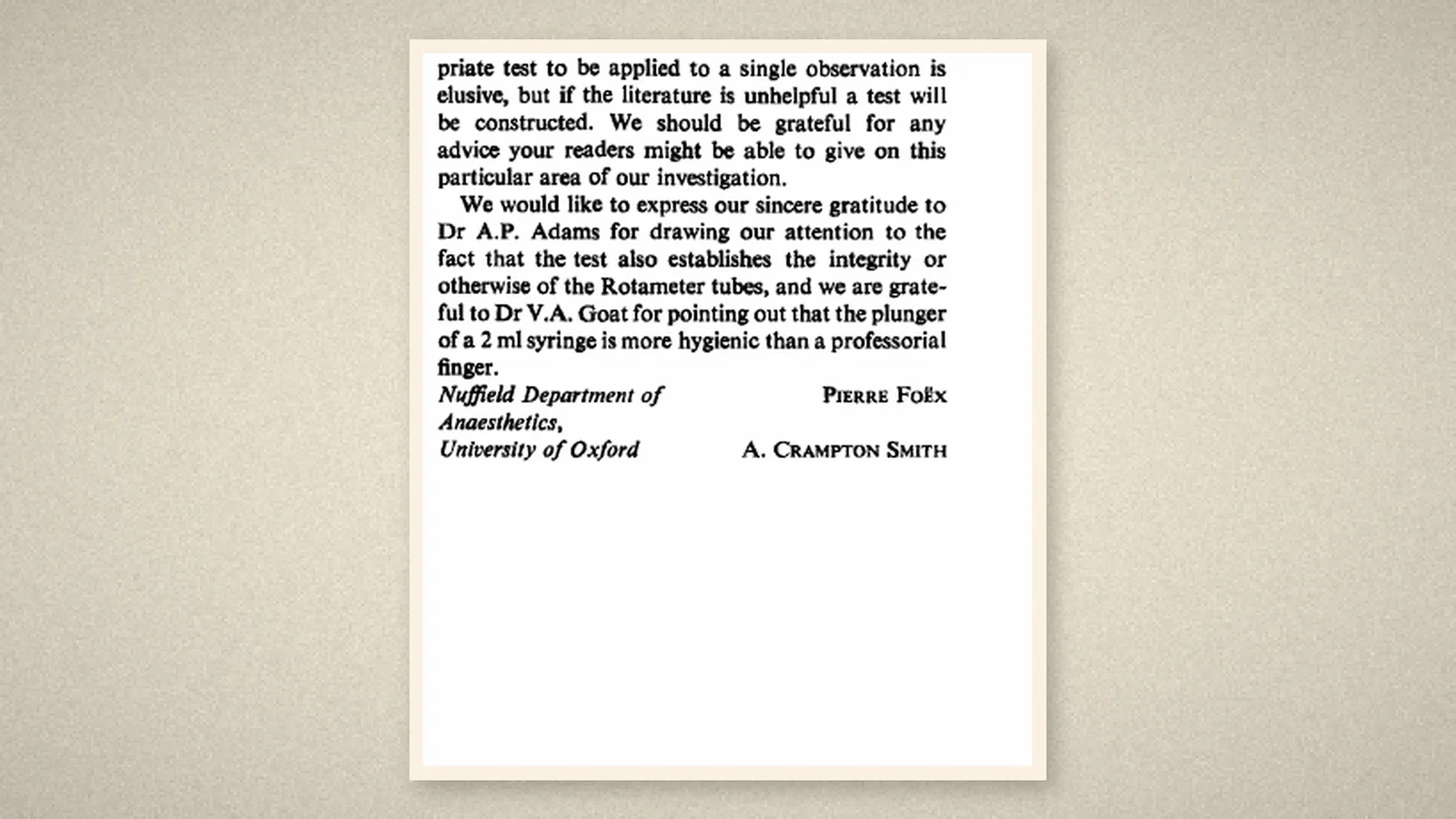
The acknowledgements are in the same spirit, and one of them is genuinely useful: thanks to one colleague for drawing attention to the fact that the test also establishes the integrity or otherwise of the rotameter tubes, and to another for pointing out that the plunger of a small syringe is more hygienic than a professorial finger. The letter is signed by Pierre Foex and A. Crampton Smith of the Nuffield Department of Anaesthetics, University of Oxford. [1, p. 294]
What the record shows
The two letters on this page make up the two faces of one piece of equipment: the convenience the co-axial design brings, and the fact that it hides a critical tube inside another. The check itself needs nothing but a finger, or a syringe plunger, and a glance at the flowmeters, which is exactly why it spread. It is also a reminder of how many practical clinical tricks began as something noticed in the middle of a conversation and were then published in a letter written half in jest.
Sources and reading limits
Read: the correspondence page of Anaesthesia, March 1977, vol. 32, no. 3, p. 294 (Wiley PDF, obtained through institutional access), in full, including the letter headed "A test for co-axial circuits", subheaded "The Foex-Crampton Smith Manoeuvre" and signed Pierre Foex and A. Crampton Smith, together with the manufacturer's letter above it on the same page; the page image was checked.
Bibliographic check: volume, issue, page and month were confirmed from the Crossref record for the article's DOI, which gives Anaesthesia vol. 32, no. 3, p. 294, March 1977, under the title "A test for co-axial circuits"; the printed page shows only the page number and the heading.
Naming note: some listings spell the name "Fox"; the printed heading and signature read Foex, and this article follows the printed form.
Not covered: Bain and Spoerel's original description of the circuit, any earlier test of the same kind, and later published assessments of this manoeuvre; none is cited in the letter. The letter dates the observation to 14.30 on Wednesday 17 November but gives no year, and none is inferred here.
Limits: the letter contains no data, and the authors themselves joke about the statistics of a single observation. The short explanation of why the manoeuvre works is drawn from the circuit structure and the observation as the letter describes them; the letter does not set that reasoning out step by step.
Three illustrations are taken from the 1977 page (the whole page, the paragraph describing the manoeuvre, and the acknowledgements with the signatures). One is a diagram drawn from the text, with no people drawn.
- A test for co-axial circuits. The Foex-Crampton Smith Manoeuvre [correspondence]. Anaesthesia. 1977;32(3):294. doi:10.1111/j.1365-2044.1977.tb11620.x
Continue exploring
Related reading connects shared questions and contexts; it does not by itself establish historical influence.
- 1975: Pethick Proposes an Oxygen-Flush Test for the Bain Circuit
- 1972: Bain and Spoerel Introduce a Single-Tube Coaxial Breathing System
- 1976: Lack Designs a Coaxial Mapleson A Circuit for Scavenging
Anesthesia Epochs · The Source Room · About & Editorial Method
Published November 5, 2026. Sources and reading limits are stated above. Illustrations are labelled as original source images or AI-made. Historical accounts are educational; they are not current treatment instructions.