From 254 pages in 1947 to 616 in 1959: J. Alfred Lee's Synopsis through six contemporary reviews.
Reading Library · Anesthesia Epochs · 中文版
Watch the education video (for clinicians)
1947: Lee's Synopsis of Anaesthesia — What 'Open Ether' Meant · Anesthesia Epochs Education Series
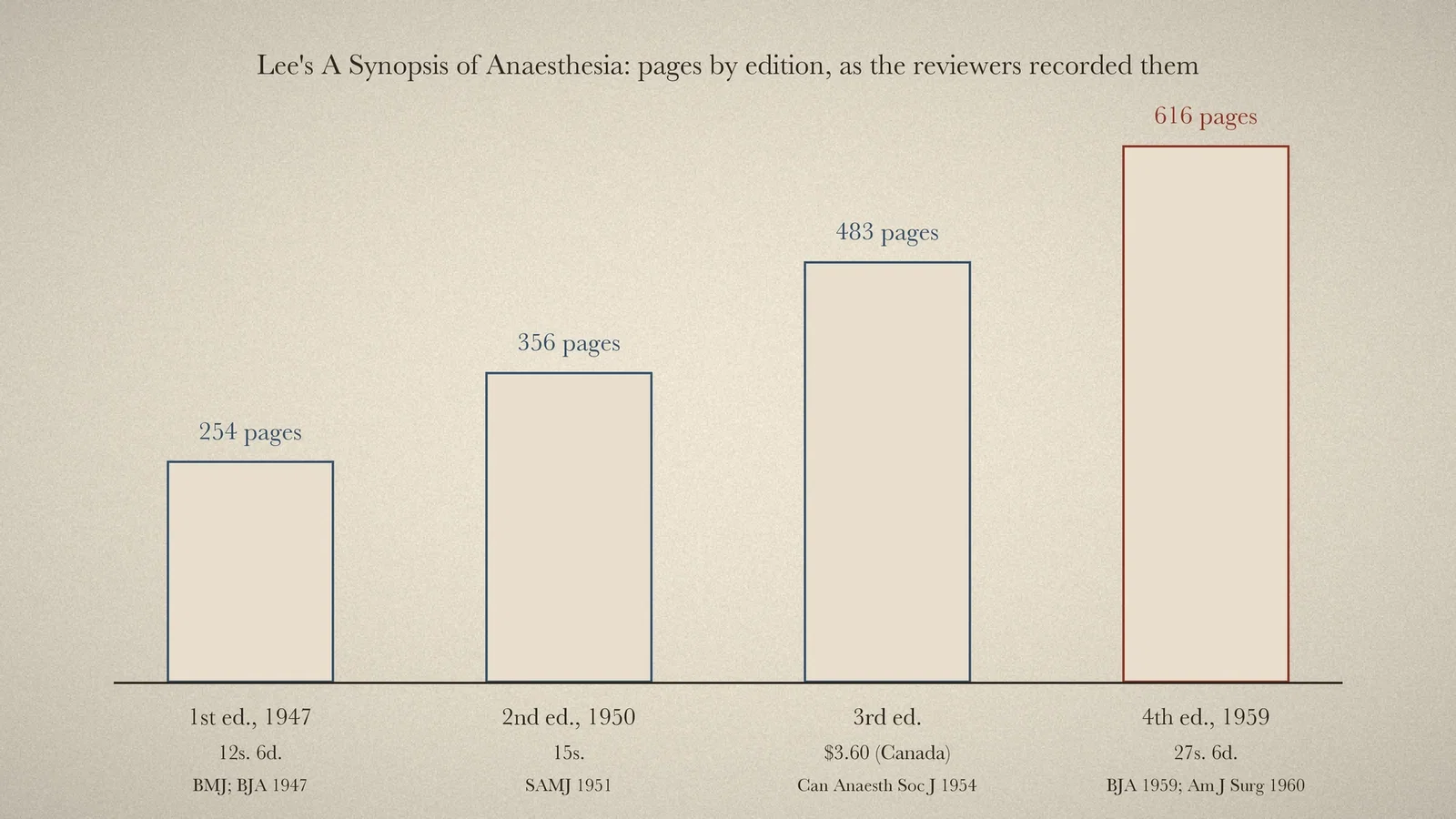
In 1947 John Wright and Sons of Bristol added a volume on anaesthesia to their series of medical "synopses": A Synopsis of Anaesthesia by J. Alfred Lee. No copy of the book itself could be obtained for this article. What can be read are six reviews published between 1947 and 1960, in Britain, South Africa, Canada and the United States, which together follow the book from its first edition to its fourth.
The first edition: a manual for revision
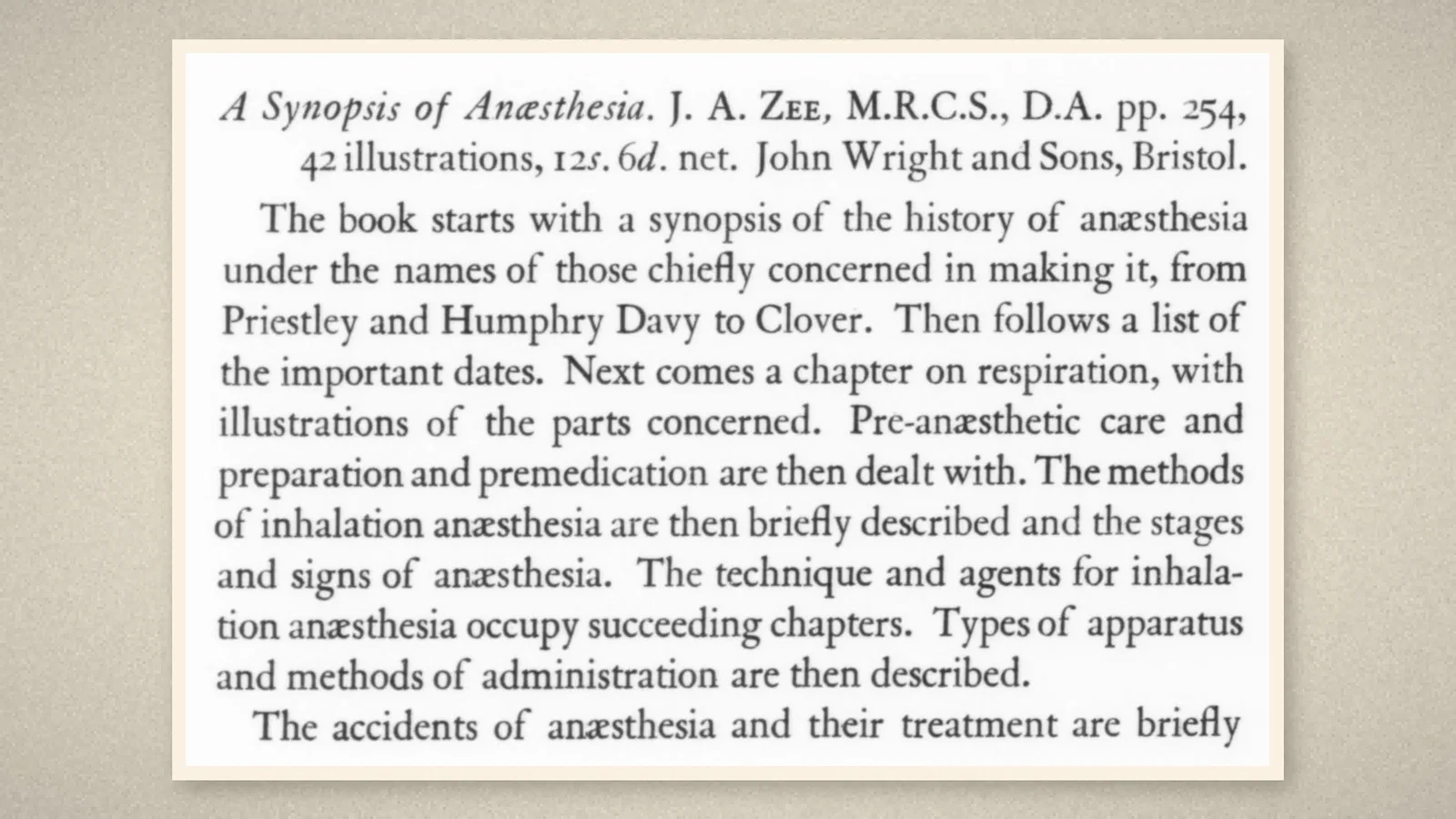
The British Journal of Anaesthesia noticed the book in July 1947, misprinting the author's name as "J. A. Zee": 254 pages, 42 illustrations, 12s. 6d., John Wright and Sons, Bristol. [2, p. 141] The reviewer walked through the contents. The book began with the history of anaesthesia under the names of those who made it, from Priestley and Humphry Davy to Clover, followed by a list of dates and a chapter on respiration; then pre-anaesthetic care and premedication, inhalation methods and the stages and signs of anaesthesia, agents and apparatus, accidents, gases, endotracheal, rectal and intravenous anaesthesia, analeptics and spinal analgesia, complications, and a final chapter on labour. The review ended: "We can cordially recommend the book as a sound and useful summary of anaesthetic practice." [2, p. 141–142]
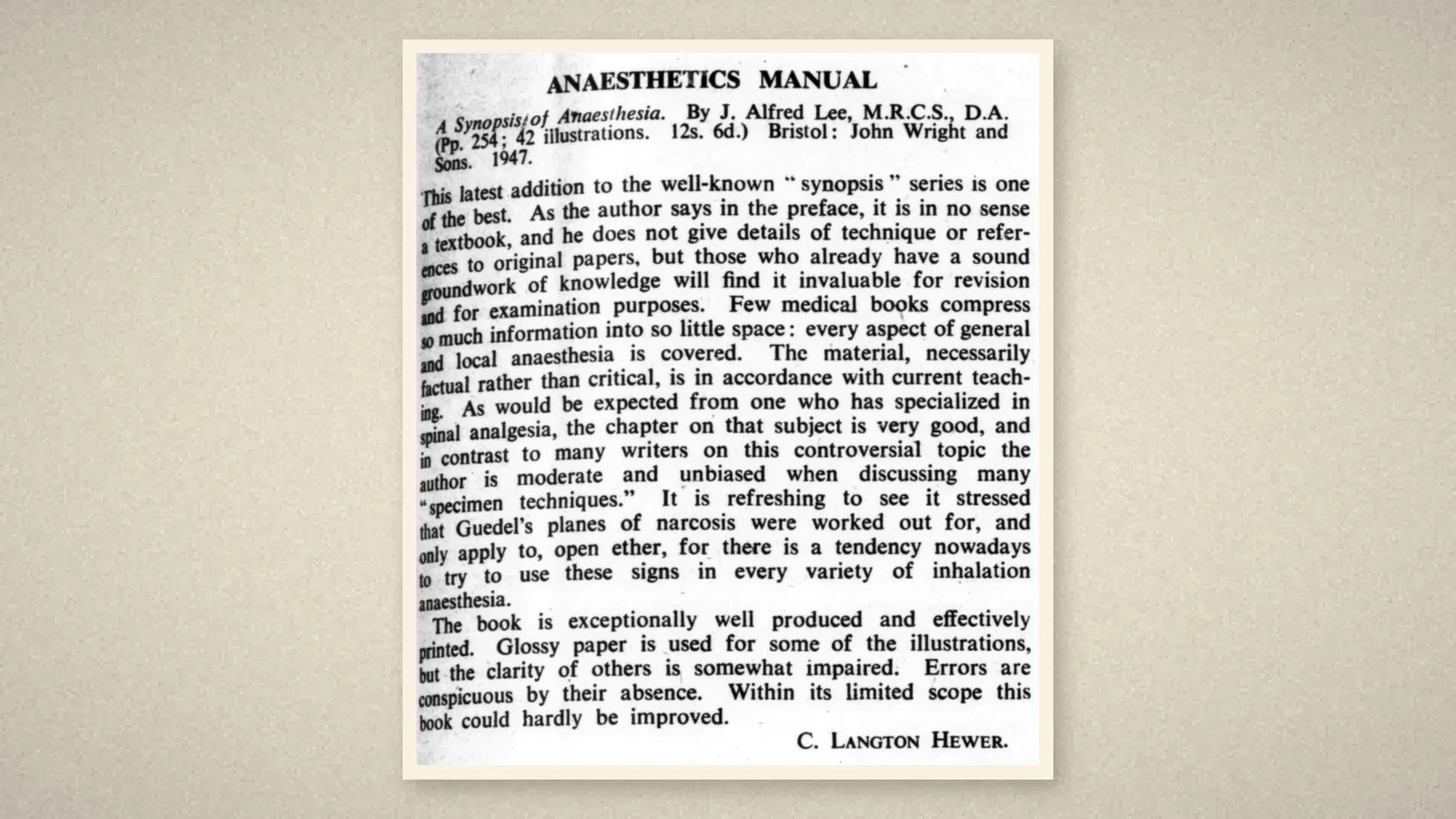
In the British Medical Journal of 6 September 1947, under the heading "Anaesthetics Manual", C. Langton Hewer was warmer. As the author said in the preface, the book was "in no sense a textbook": it gave no details of technique and no references to original papers, but those with a sound groundwork of knowledge would "find it invaluable for revision" and for examinations. Few medical books, Hewer wrote, compressed "so much information into so little space". [1, p. 373] The material was "necessarily factual rather than critical", the chapter on spinal analgesia, a subject in which the author had specialised, was very good, and it was refreshing to see it stressed that Guedel's planes of narcosis had been worked out for open ether only. Within its limited scope, Hewer concluded, the book "could hardly be improved". [1, p. 373]
Growing
The second edition is dated 1950. Reviewing it in March 1951, the South African Medical Journal listed 28 chapters, including the closed circuit and controlled respiration, muscle relaxants, refrigeration analgesia, explosion risks, anaesthetic records and an anaesthetic out-patient clinic; the book now had 356 pages and 66 figures and cost 15s. [3, p. 215] Since the first edition of 1947, the reviewer wrote, anaesthesia "has advanced and altered considerably", and some chapters had been rewritten entirely. The chapters on spinal and regional anaesthesia were singled out, and the book was said to meet the needs of both the undergraduate and the postgraduate student. [3, p. 215]
In October 1954 the Canadian Anaesthetists' Society Journal reviewed the third edition. It had two new chapters, on methods of reducing bleeding during operations and on the therapeutic applications of anaesthesia and analgesia, and although still called a synopsis it ran to 483 pages of small print, enough, the reviewer thought, to be called a textbook. It was a most useful book for students, a handy reference for practising anaesthetists, and cheap. [4, p. 127]
The fourth edition
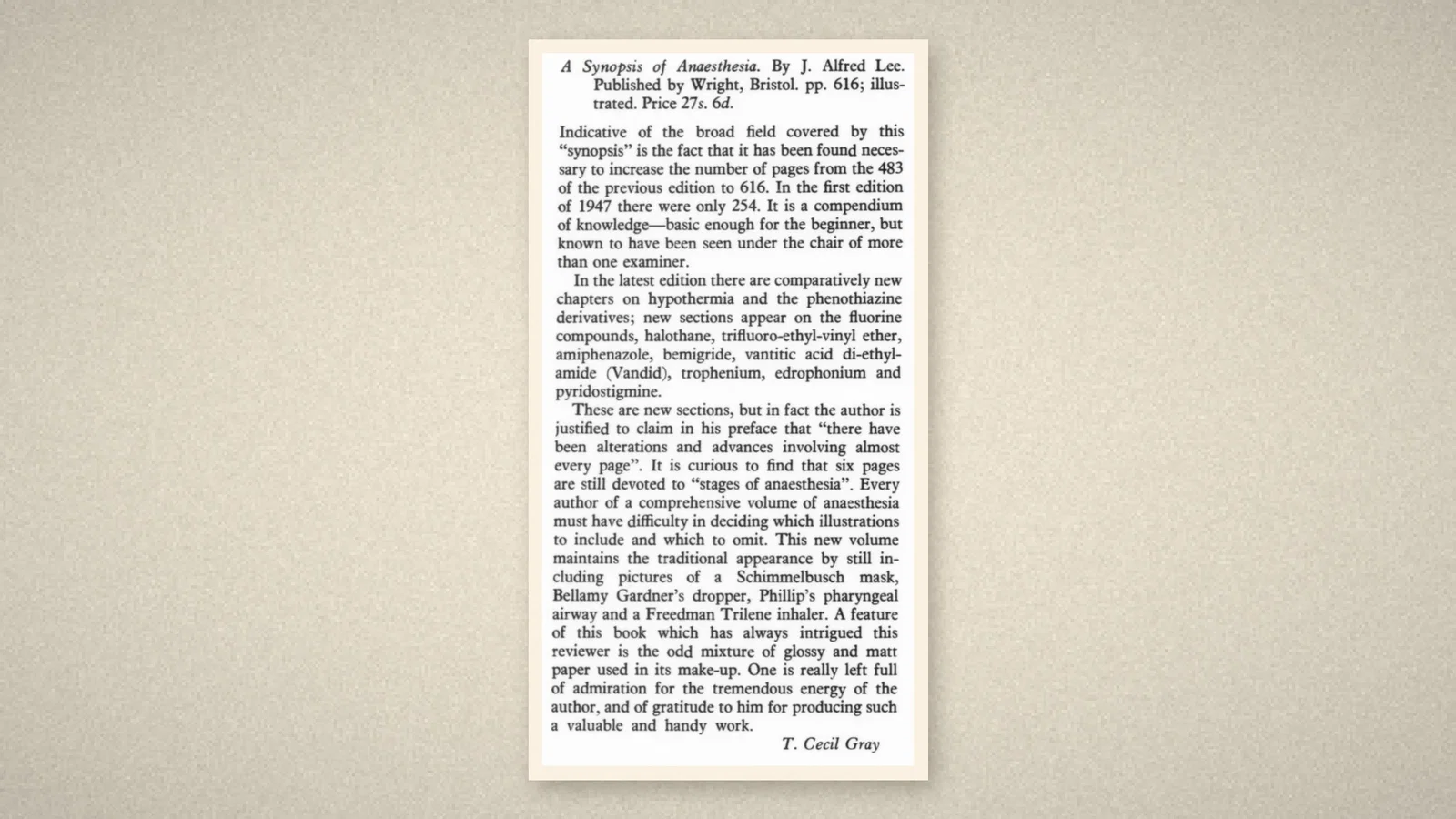
The fourth edition, of 1959, had 616 pages and cost 27s. 6d. Reviewing it in the British Journal of Anaesthesia that August, T. Cecil Gray set out the growth: from 254 pages in the first edition to 483 in the third and now 616. The book was "a compendium of knowledge—basic enough for the beginner, but known to have been seen under the chair of more than one examiner". [5, p. 374] New chapters covered hypothermia and the phenothiazine derivatives, with new sections on halothane and other recent drugs; yet six pages were still devoted to the stages of anaesthesia, and the book still pictured a Schimmelbusch mask. [5, p. 374]
In the American Journal of Surgery of July 1960, William Hamelberg reviewed the fourth edition as published by Williams and Wilkins in Baltimore ($6.50). Previous editions, he wrote, had "always been considered a necessary addition to the library of the anesthesiologist"; this one was up to date and could be recommended "not only to the practicing anesthesiologist but also to the surgical profession". [6, p. 152]
What the record shows
A book written for revision grew in twelve years from 254 to 616 pages. Its reviewers kept calling it a synopsis while noting that it had become a textbook; they recommended it for examinations, and one reported it under examiners' chairs. The reviews record which subjects were added as the specialty changed: relaxants and controlled respiration by 1950, hypothermia, phenothiazines and halothane by 1959.
Sources and reading limits
Read: the six reviews listed below.
Not covered: no edition of the book itself could be found free online, either on the Internet Archive or elsewhere, so its contents are described only through the reviewers, including the chapter list printed with the 1951 review. No review read gives the year of the third edition, and none is stated here. Lee's life and career are outside this article. The phrase "seen under the chair of more than one examiner" is the 1959 reviewer's and is reported as such.
One illustration is drawn from the reviews' figures; three are crops of review pages.
- Hewer CL. Anaesthetics manual [review of: Lee JA. A synopsis of anaesthesia]. Br Med J. 1947;2:373. Internet Archive
- [Review of: Lee JA. A synopsis of anaesthesia]. Br J Anaesth. 1947;20(4):141-2. Internet Archive
- [Review of: Lee JA. A synopsis of anaesthesia, 2nd ed.]. S Afr Med J. 1951;25:215. Internet Archive
- [Review of: Lee JA. Synopsis of anaesthesia, 3rd ed.]. Can Anaesth Soc J. 1954;1(2):127. Internet Archive
- Gray TC. [Review of: Lee JA. A synopsis of anaesthesia, 4th ed.]. Br J Anaesth. 1959;31(8):374. Internet Archive
- Hamelberg W. A synopsis of anaesthesia [review]. Am J Surg. 1960;100(1):152. doi:10.1016/0002-9610(60)90564-X
Continue exploring
Related reading connects shared questions and contexts; it does not by itself establish historical influence.
- 1946: The First Number of Anaesthesia
- 1947: Barbara Duncum's The Development of Inhalation Anaesthesia
- 1935: London Holds the Diploma in Anaesthetics Examination
Anesthesia Epochs · The Source Room · About & Editorial Method
Published November 2, 2026. Sources and reading limits are stated above. Illustrations are labelled as original source images or AI-made. Historical accounts are educational; they are not current treatment instructions.