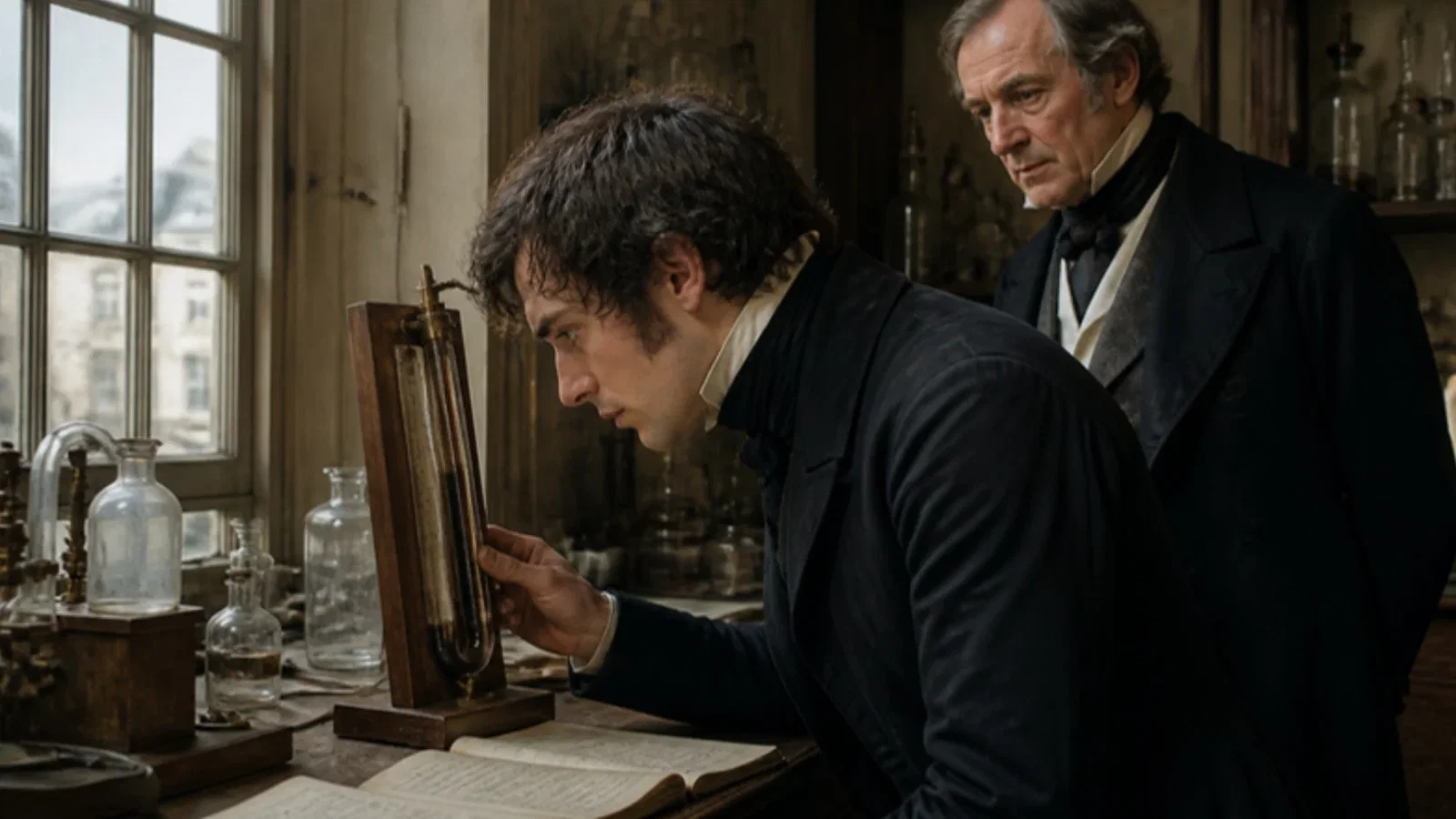
In a Paris thesis of 1828, Poiseuille replaced Hales's tall blood column with a mercury-filled bent tube joined to an artery, and watched it rise with each beat.
Reading Library · Anesthesia Epochs · 中文版
Watch the education video (for clinicians)
1828: Poiseuille's Mercury U-Tube — Measuring Arterial Pressure · Anesthesia Epochs Education Series
Blood pressure is still reported in millimetres of mercury, even where no mercury is used. The habit goes back to a young Paris physician, Jean-Léonard-Marie Poiseuille, who in 1828 replaced the tall columns of blood used by Stephen Hales with a short tube of mercury. This article reads the thesis in which Poiseuille described the instrument, defended at the Paris Faculty of Medicine on 8 August 1828. [1][2]
The thesis
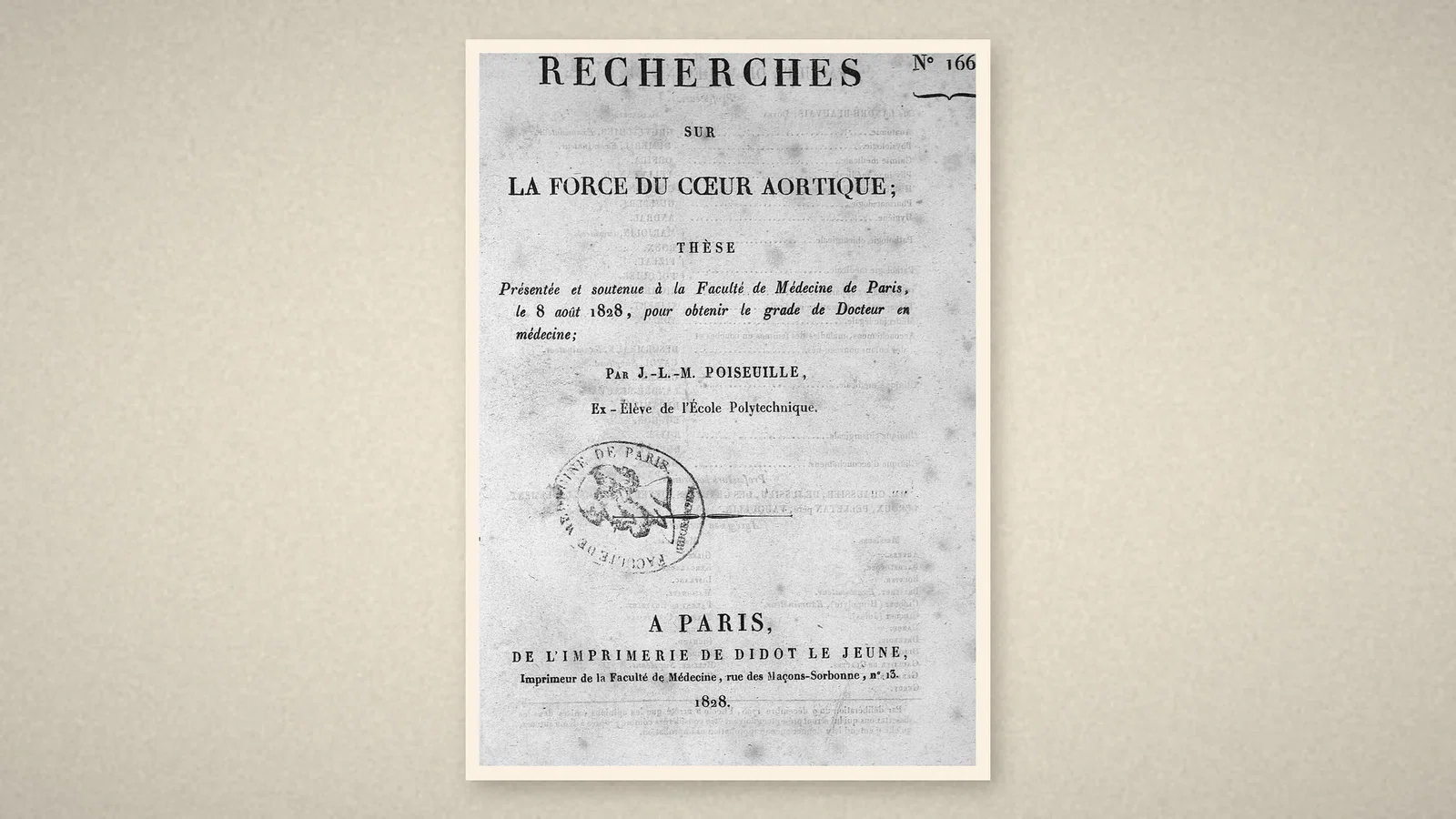
Recherches sur la force du cœur aortique ("Researches on the force of the aortic heart", meaning the left side of the heart) is thesis number 166 of the Paris faculty for 1828. The title page describes Poiseuille as a former student of the École Polytechnique. In the introduction, Poiseuille explains that the second part of the work seeks the force with which blood moves in the aorta or any other artery, "by a fairly large number of experiments made on the dog and the horse, with the help of an instrument that I devised for this purpose". [1]
Poiseuille is brief about the predecessors. Daniel Bernoulli, the thesis notes, had started from "the experiments of Hales, which, as we have recognized, are erroneous", and so is not discussed further. [1]
The tube
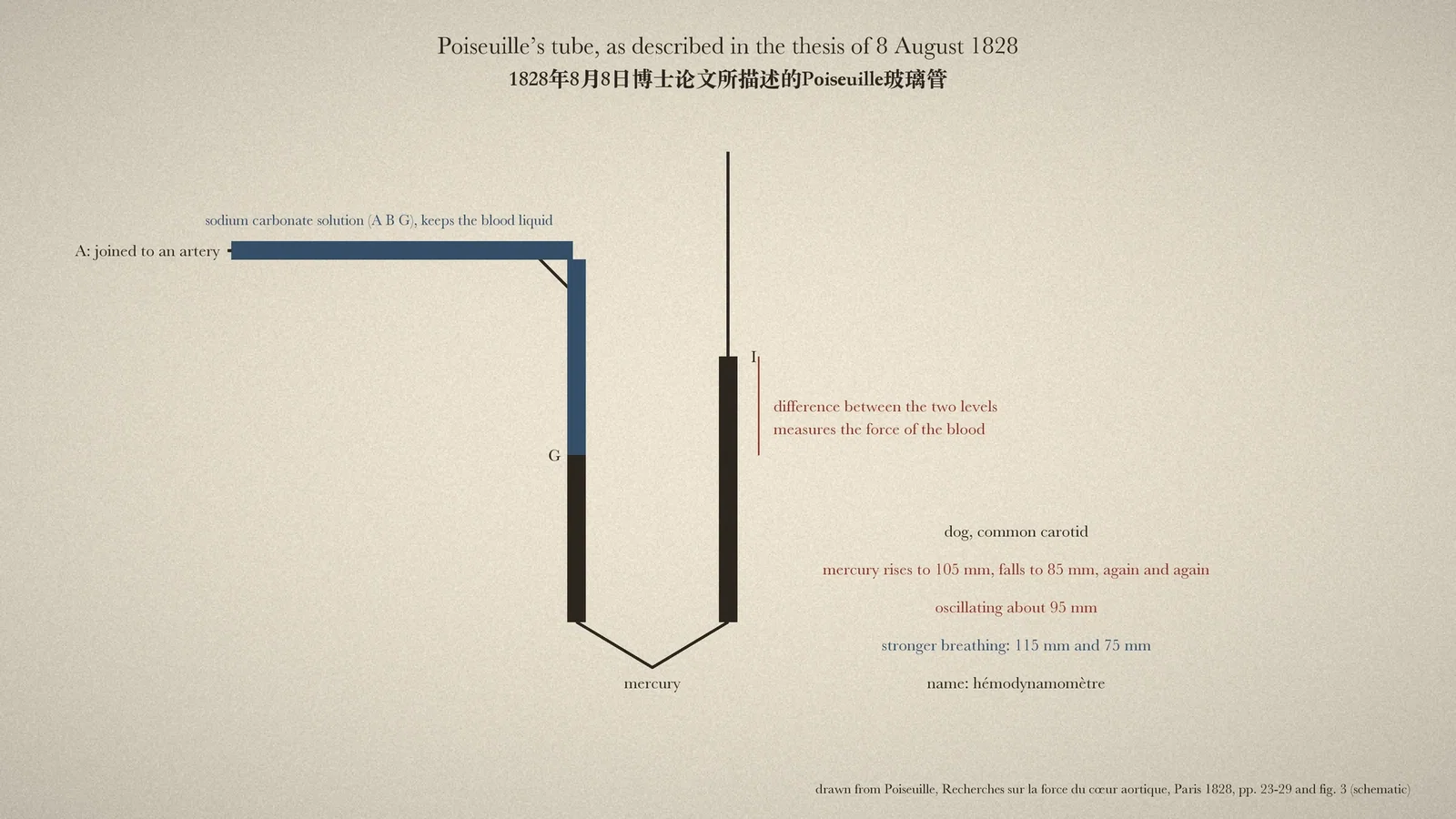
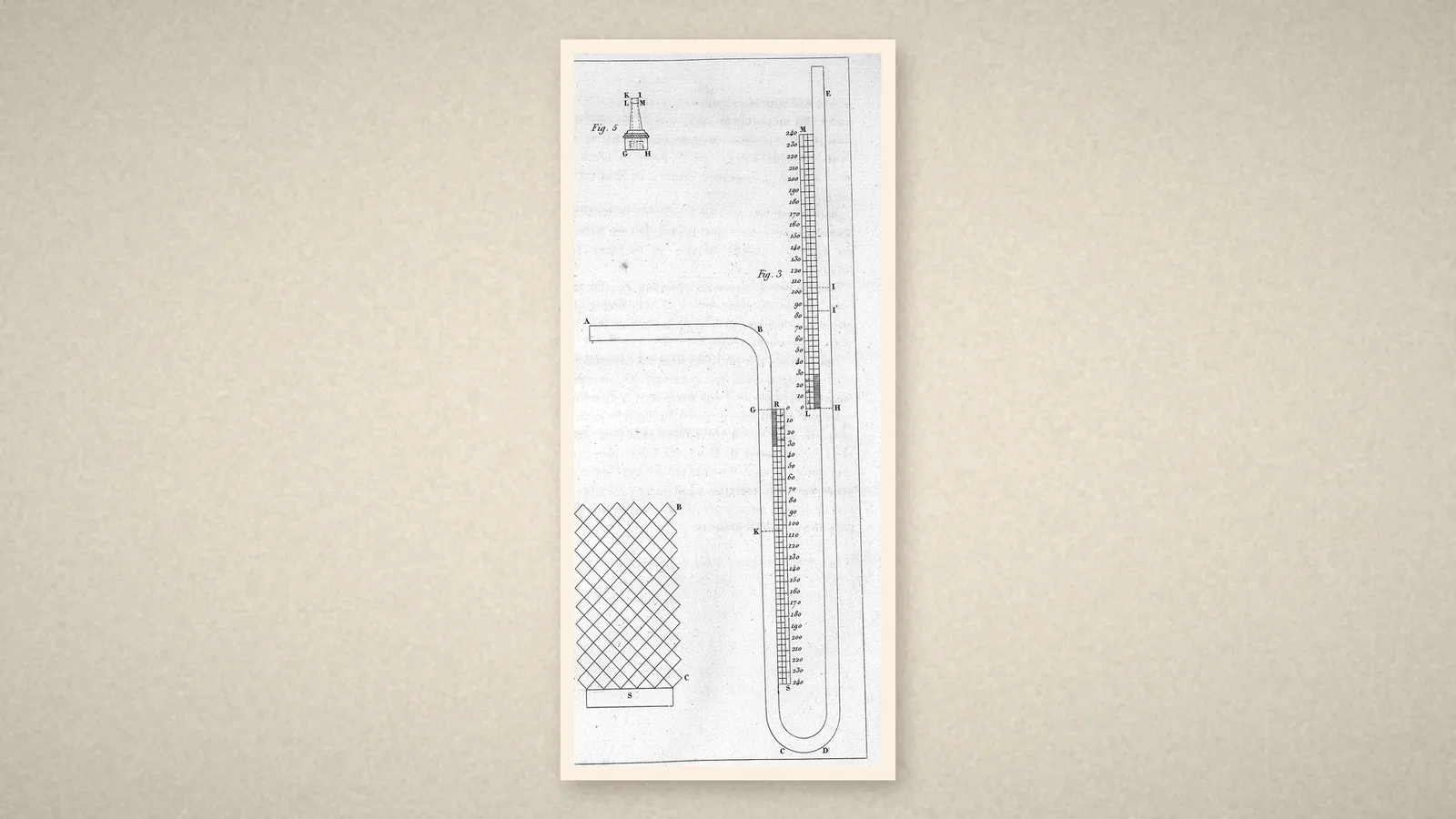
The description is plain. "Let there be a glass tube (fig. 3), having a horizontal arm A B, a descending vertical arm B C, and a third ascending arm D E", bent so as to form a quarter circle at B and a half circle at C D. Mercury is put in the lower part, so that with the tube upright the two mercury surfaces stand at the same level. If blood enters the arm A B G "through the orifice A, joined to an artery, it will press on the surface G of the mercury"; the mercury is pushed down on that side and rises on the other, and by the laws of hydrostatics the force with which the blood moves is measured by the difference between the two levels. [1]
One problem had to be solved first: blood clots. If it coagulated in the tube, no reading could be made. Poiseuille needed a liquid that would transmit the force of the blood to the mercury "while preventing its coagulation, or rather while keeping it liquid". Potash kept blood from clotting but turned it into a thick, sticky mass, and any of it entering the circulation might poison the animal. Water injected into the veins only delayed clotting by three minutes. "I then took subcarbonate of soda", Poiseuille wrote, and arterial blood mixed with it kept its scarlet colour and its fluidity. The arm A B G was filled with the soda solution before the tube was joined to the artery. [1]
The readings
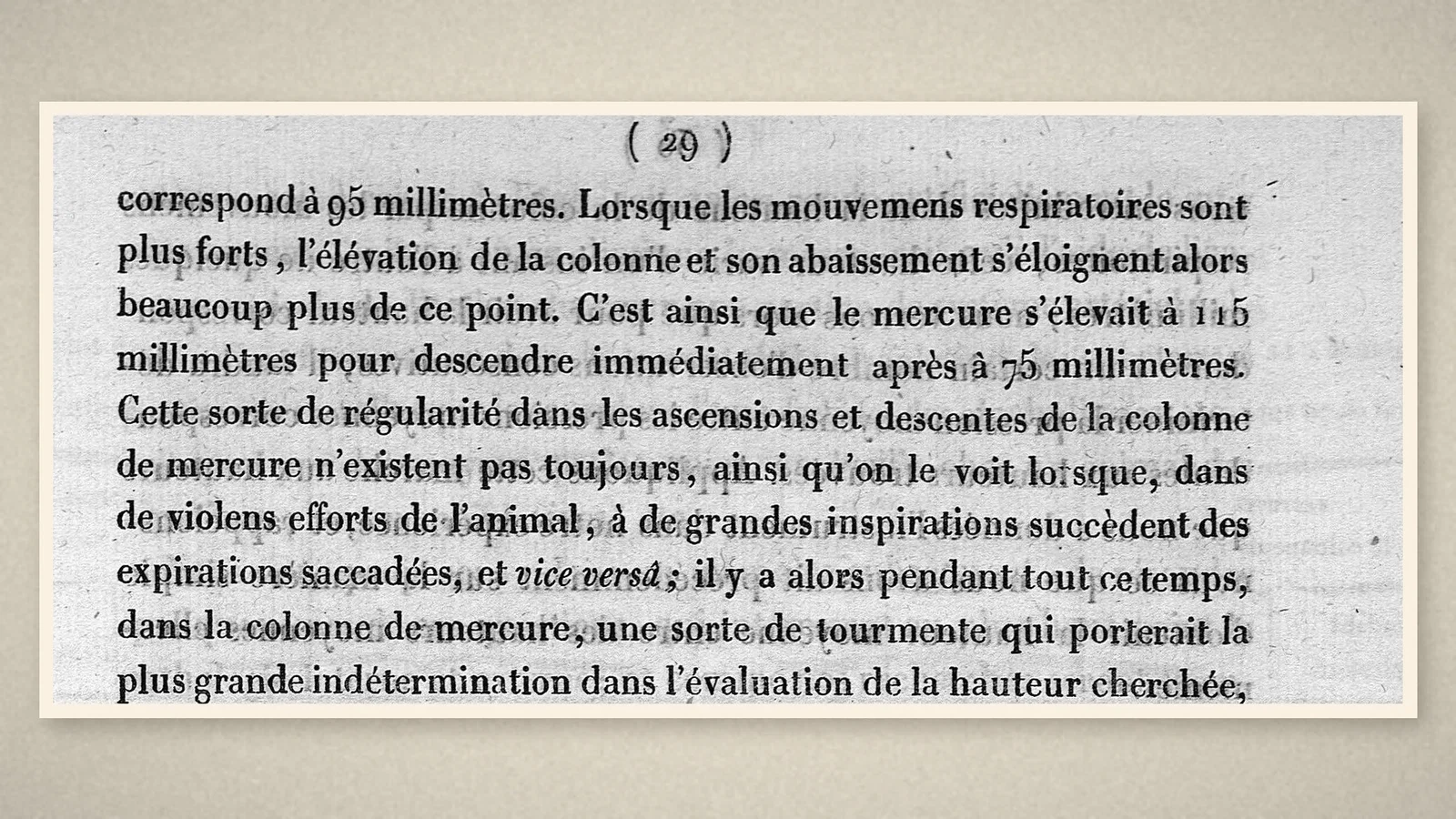
Applied to the common carotid artery of a dog, the instrument responded at once. In less than a second the mercury rose to 105 millimetres, fell to 85, rose again and fell again, in a regular series of oscillations about a point that "corresponds to 95 millimetres" when the animal breathed quietly. With stronger breathing the swings were wider: the mercury rose to 115 millimetres and fell immediately afterwards to 75. When the animal struggled, the column was so disturbed that the height could hardly be judged. Poiseuille proposed to call the instrument the hémodynamomètre. [1]
What the record shows
Poiseuille's tube made arterial pressure a short, readable number on a scale, in a unit that has outlasted the instrument. It also built in two problems that every invasive pressure line still has to manage: keeping blood from clotting in the connection, and remembering that the reading swings with each beat and with each breath.
Sources and reading limits
Read: Poiseuille's thesis Recherches sur la force du cœur aortique (Paris, 8 August 1828, no. 166) in full, with the title page, pp. 23-25 and 28-29 and the plate checked against the page images; the 2024 ASA timeline entry.
Not covered: Poiseuille's later memoirs on the instrument and the academic reports on them; later recording manometers; any human measurements. Poiseuille's judgement of Hales is reported as Poiseuille's. Translations from the French are this article's own. These were animal experiments, reported without endorsement.
Three illustrations are from the 1828 thesis (title page, plate and page 29); one is drawn from it.
- Poiseuille JLM. Recherches sur la force du cœur aortique [thèse no. 166]. Paris: Didot le jeune; 1828. Internet Archive
- Australian Society of Anaesthetists. Anaesthesia history timeline. 2024. ASA
Continue exploring
Related reading connects shared questions and contexts; it does not by itself establish historical influence.
- 1733: Hales Measures Arterial Pressure in a Living Mare
- 1856: Faivre Measures Human Arterial Pressure During Amputations
- 1881: von Basch Reads Blood Pressure When the Pulse Stops
- 1896: Riva-Rocci's Cuff Sphygmomanometer, Tested in a Munich Thesis
Anesthesia Epochs · The Source Room · About & Editorial Method
Published November 2, 2026. Sources and reading limits are stated above. Illustrations are labelled as original source images or AI-made. Historical accounts are educational; they are not current treatment instructions.